
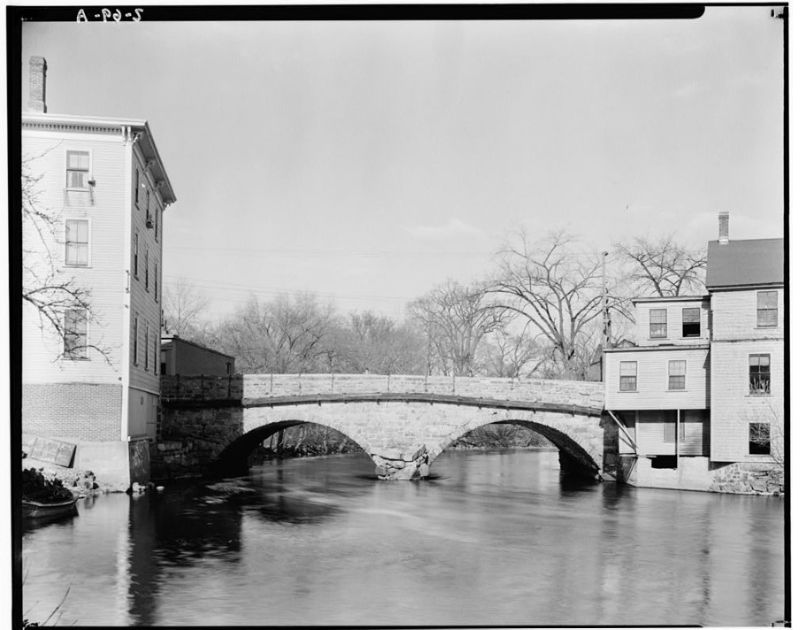
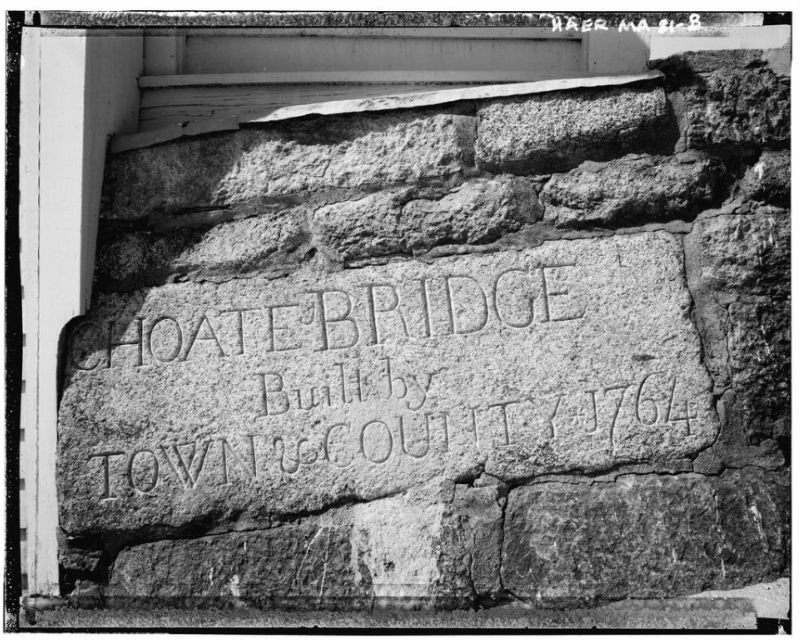
The Choate Bridge is a historic bridge in Ipswich, Massachusetts. Built in 1764, it is the oldest double-arch stone bridge in America.
Named after Colonel John Choate, who supervised its construction in the summer and fall of 1764, the Choate Bridge is located on South Main Street, where it spans the Ipswich River.
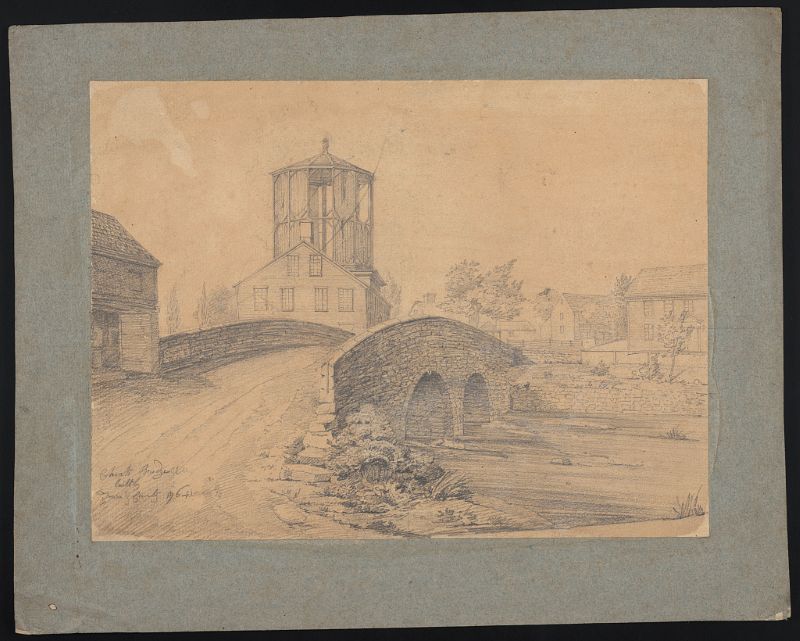
The bridge was built to replace the last of a series of wooden bridges that had spanned the Ipswich River since 1641. On March 6, 1764, a town meeting was held to look into upgrading the existing timber bridge in order to accommodate the increase in the volume of traffic.
The committee appointed to the project determined that the existing bridge was too narrow for the safe passing of horses, carts, and carriages. The committee secured a hearing before the Court General Session in March of 1764, during which it was determined that the bridge was to be rebuilt in stone.
The bridge was constructed of random-coursed granite ashlar blocks and features two elliptical arches and a battered stone parapet, or “guard wall.” The bridge originally measured 80 feet 6 inches long and 20 feet 6 inches wide.
According to a 1948 news report, when the bridge was first constructed, the local townspeople didn’t believe the arches of the bridge would hold up, and they even threatened Colonel Choate with violence if an accident happened with the bridge.
After the bridge was completed, people from the surrounding area flocked to it for opening day, during which Colonel Choate watched from a distance on his horse, ready to flee if the crowd turned on him.
However, when the bridge stood up to the foot traffic and even a horse and cart, the crowd reportedly cheered and celebrated (“World Famous Bridges,” 1948).
The Choate Bridge was reportedly the first arched stone bridge ever built in America, according to a 1869 news report in the Gloucester Telegraph.
The single-lane bridge was later widened to two lanes by an addition on the east side of the bridge in 1838.
The bridge has unfortunately been the scene of a few accidents and incidents over the years. On the night of March 21, 1903, a local man, 60-year-old L.E.B. Perkins, was attacked and beaten with a billiard cue on the bridge by three men in what appeared to be an attempted robbery. The three men were later arrested.
On September 19, 1918, two cars collided on the bridge, causing one of the cars to strike the bridge wall and break through it, after which it came to a stop with the front wheels suspended over the river.
Another car accident occurred on the bridge in June of 1929 when one car struck the side of another car when pulling out from the parking lot of the adjacent fruit store, but no damage was done to the bridge, and no one was injured.
In 1948, it was proposed to widen the bridge again with a stone-faced reinforced concrete extension, but the plan was never carried out.
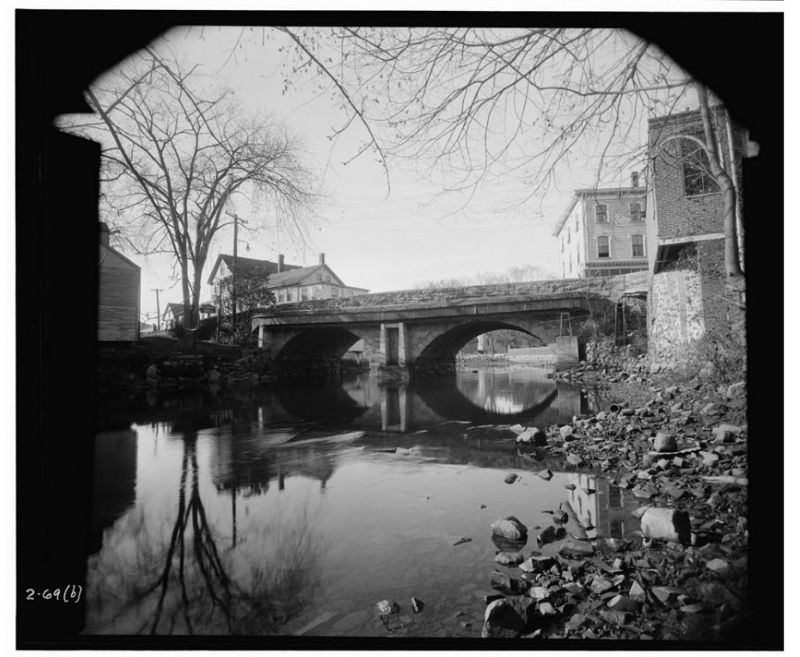
On August 21, 1972, the Choate Bridge was added to the National Register of Historic Places. In 1989, it was extensively renovated.
In May of 2006, devastating floods from record-breaking rainfall weakened the bridge and misaligned it, prompting officials to temporarily close it so it could be repaired and realigned.
Sources:
“Historic Bridge Detail: IPS.909 Choate Bridge.” MACRIS, mhc-macris.net/details?mhcid=IPS.909
“County Chat.” The Gloucester Telegraph, 2 Jun. 1869, p. 2.
“Choate Bridge.”Ipswich Chronicle, 25 Apr. 1891, p. 4.
“First Stone Arch Bridge.” The Philadelphia Record, 2. Jan. 1901, p. 9.
“Badly Beaten.” The Boston Globe, 22 Mar. 1903, p. 4.
“Ipswich Has First Stone Bridge Built in America.” The Boston Post, 26 Mar. 1905, p. 26.
“Ipswich, The Town of a Seventeenth-Century Flavor.” The Boston Herald, 10 Jul. 1910, p. 32.
“First Stone Arch Bridge.” The Cairo Bulletin, 31 Oct. 1913, p. 2.
“Auto Goes Through Wall and Hangs Over the Water.” The Boston Globe, 19 Sept. 1919, p. 1.
“Auto Accident on Choate Bridge.” The Ipswich Chronicle, 7 Jun. 1929, p. 5.
“First Stone Arch Bridge Derided.” The Boston Transcript, 13 Feb. 1935, p. 27.
“World Famous Bridges.”The Boston Post, 8 Aug. 1948, p. 30.
“Suggest Face Lifting Historic Choate Bridge.” Amesbury Daily News, 12 Sept. 1963, p. 3.
“Nobody Thought Choate Bridge Would Stand.” The Ipswich Chronicle, 24 Oct. 1963, p. 9.
Jefferson, Brandie. “Ipswich Still Struggling.” Telegram & Gazette, 18 Jun. 2006, telegram.com/story/news/local/north/2006/06/18/ipswich-still-struggling/53086151007/?gnt-cfr=1&gca-cat=p&gca-uir=true&gca-epti=z114424e008200v114424d–49–b–49–&gca-ft=172&gca-ds=sophi