
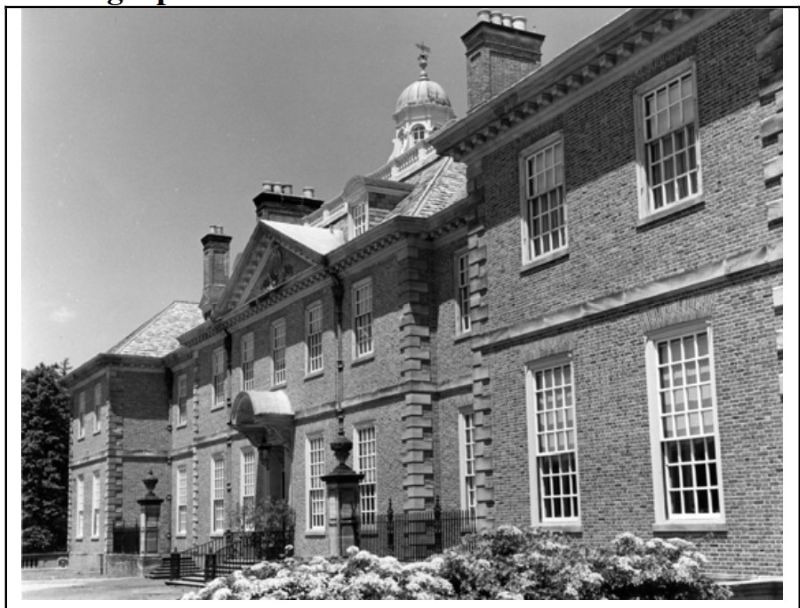
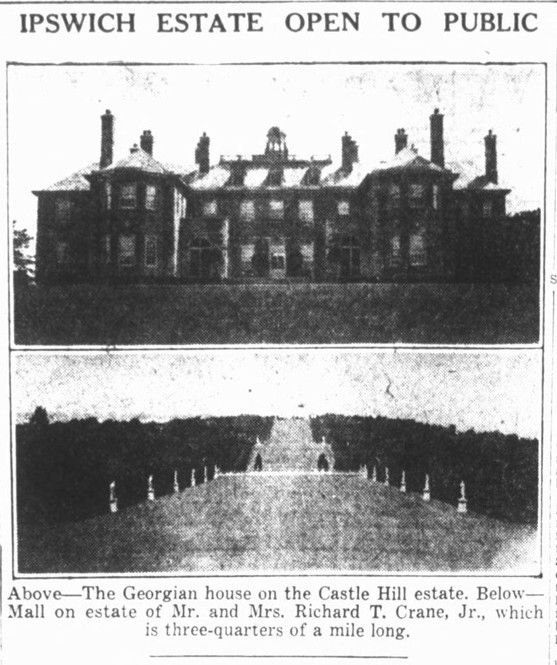
Castle Hill is a historic mansion on the Crane Estate on Argilla Road in Ipswich, Massachusetts. Built in 1928, the mansion is a fifty-nine-room Stuart-style house designed by architect David Adler of Chicago.
The mansion is two stories tall and is built out of small pink-red Holland bricks, with arched windows and a slate hip roof topped by a cupola and ten brick chimneys.
It was built for Richard Teller Crane, Jr., an early-20th century plumbing magnate, to serve as a summer home. The Cranes purchased the land, which was previously owned by John Burnham Brown, in 1910 and demolished the old farmhouse that existed on it.
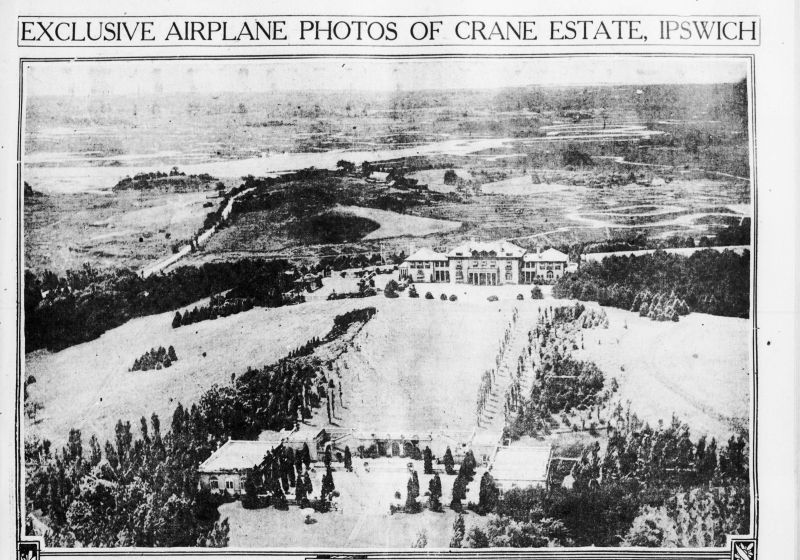
The estate is 165 acres in size and features landscape designs by the Olmsted Brothers, including a series of ornate terraced gardens and an expansive grass mall lined with evergreens. The property also originally had a deer farm and a large saltwater swimming pool.
The interior of the house is arranged around a large hall or gallery that runs the length of the central block. The gallery is 63 feet long with 16-foot ceilings and two fireplaces.
Leading off from the gallery to the southeast is the Queen Anne paneled drawing room. The library is in the northwest wing and features an ornate wooden mantel, paneling, and bookcases imported from Cassiobury Park in Hertfordshire, England. Opposite of the library is the guest bedroom suite.
The dining room is northwest of the gallery. Opposite the dining room at the front of the house is the grand stairway, which leads up to the central hall running the length of the main block on the second floor.
Two bedroom suites are located in the rear wings, which both consist of a large single room, a dressing room, a bath, and a sleeping porch.
Additional bedrooms with private baths are located along the central hallway in the central pavilion. The master bedrooms are located over the drawing room in the southeast end pavilion.
The bath fittings in the guest bathrooms are made of sterling silver, and the master baths have gold-plated fixtures.
The attic is framed in steel and roofed with lead, copper, and slate. The house is heated by steam heat fired from a large boiler in the sub-basement.
The mansion replaced an earlier mansion, an Italianate-style house called the Great House, that was built in 1912 but demolished in 1925 because the sandstone building materials couldn’t withstand the harsh New England winters and Mrs. Crane thought it was too drafty. The current mansion was built in its footprint.
On the night of December 15, 1928, an intruder broke into the deer farm located on the property and shot and killed eight deer. They then stole six of the dead deer and left two behind. The Cranes offered a $200 reward for information leading to the arrest of the intruder.
In 1931, a gruesome discovery was made on the beach at the Crane Estate when a group of school children found the left arm of a young girl washed up on the shore. Ipswich police searched the nearby waters but couldn’t find a body, and there were no reports of any missing children in the area.
Richard Crane died in 1931, and he left the estate to his wife, Mrs. Richard Crane. In 1937, town selectmen wrote to Edward VIII, Duke of Windsor, and suggested that he purchase the Crane Estate and settle there permanently after he had recently abdicated the British throne to marry the American divorcee Wallis Simpson.
Mrs. Richard Crane was apparently unaware of the offer to the duke and told the press that she had not put her estate up for sale and that she planned to spend the upcoming summer there. In an interview with the Boston Post, Mrs. Crane said that it was probably a publicity stunt drummed up by the selectmen:
“I hope that the selectmen do not take any action in the matter without consulting me. It looks like a bid for publicity on their part for the town and I am not looking for any publicity.” (Big Estate In Ipswich For Ex-King,” 1937)
The Duke did not ultimately purchase the Crane Estate and did not establish a permanent residence in the United States.
In 1949, Mrs. Richard Crane died and left the house and the 1,352 acres surrounding it to the Trustees of Reservations. In June of 1950, a total of 368 pieces of furnishings from the estate were sold at a public auction for $46,872.50. Some of the pieces included Chinese vases, pottery statuettes, glassware, and early American antique furniture.
According to a 1951 news report in the Ipswich Chronicle, the mansion was at risk of being torn down due to the cost of upkeep, which averaged hundreds of thousands of dollars a year, but the trustees decided instead to turn it into an art and cultural center to help pay for the costs.
The house and the 165 landscaped acres around it are now used as a function center, and the rest of the estate has been set aside as the Crane Memorial Reservation, which is open to the public.
On December 2, 1977, Castle Hill was added to the National Register of Historic Places. On August 6, 1998, it was designated a National Historical Landmark.
Numerous movies have been filmed at Castle Hill over the years, including Tears for Tomorrow in 1961, Flowers in the Attic in 1987, The Witches of Eastwick in 1987, The Next Karate Kid in 1994, Little Women in 2019, and others.
Sources:
“Historic Area Detail: IPS.AO Castle Hill.” MACRIS, mhc-macris.net/details?mhcid=IPS.AO
“Castle Hill, Ipswich, As the Airplane Camera Depicts Its Charm.” The Boston Transcript, 25 Jun. 1921, p. 46.
“Buy Tract at Ipswich.” The Boston American, 27 Sept. 1926, p. 7.
“Castle Hill, Ipswich, Again Open for Benefit of Cable Hospital.” The Boston Transcript, 7 Jul. 1928, p. 33.
“Break Into Pen, 8 Deer Killed.” The Boston Globe, 21 Dec. 1928, p. 29.
“$200 Reward.” The Ipswich Chronicle, 28 Dec. 1928, p. 1.
“Girls’ Arm is Found on Crane Estate Beach.” The Boston Advertiser, 14 Jun. 1931, p. 3.
“Crane Estate Pays Biggest Ipswich Tax This Year.” The Ipswich Chronicle, 25 Sept. 1936, p. 1.
“Big Estate In Ipswich For Ex-King.” The Boston Post, 22 May. 1937, p. 1
“Mansion is Willed to State.” The Boston Post, 6 Aug. 1949, p. 1.
“Crane Estate Worth Million.” The Boston Post, 9 Aug. 1949, p. 1.
Watts, Elizabeth. “Treasure of Crane Estate Under Hammer at Ipswich.” The Boston Globe, 30 Jun. 1950, p. 7.
“Crane Estate to be Converted Into Art Center.” The Boston Globe, 26 May. 1950, p. 12.
“Castle Hill Concerts Could Prove Great Boon to Town.” The Ipswich Chronicle, 12 Jul. 1951, p. 1.