
Worcester State Hospital was the first state hospital built in Massachusetts. Established in 1833, the hospital was originally known as the Worcester Lunatic Asylum.
Worcester State Hospital in the 19th Century:
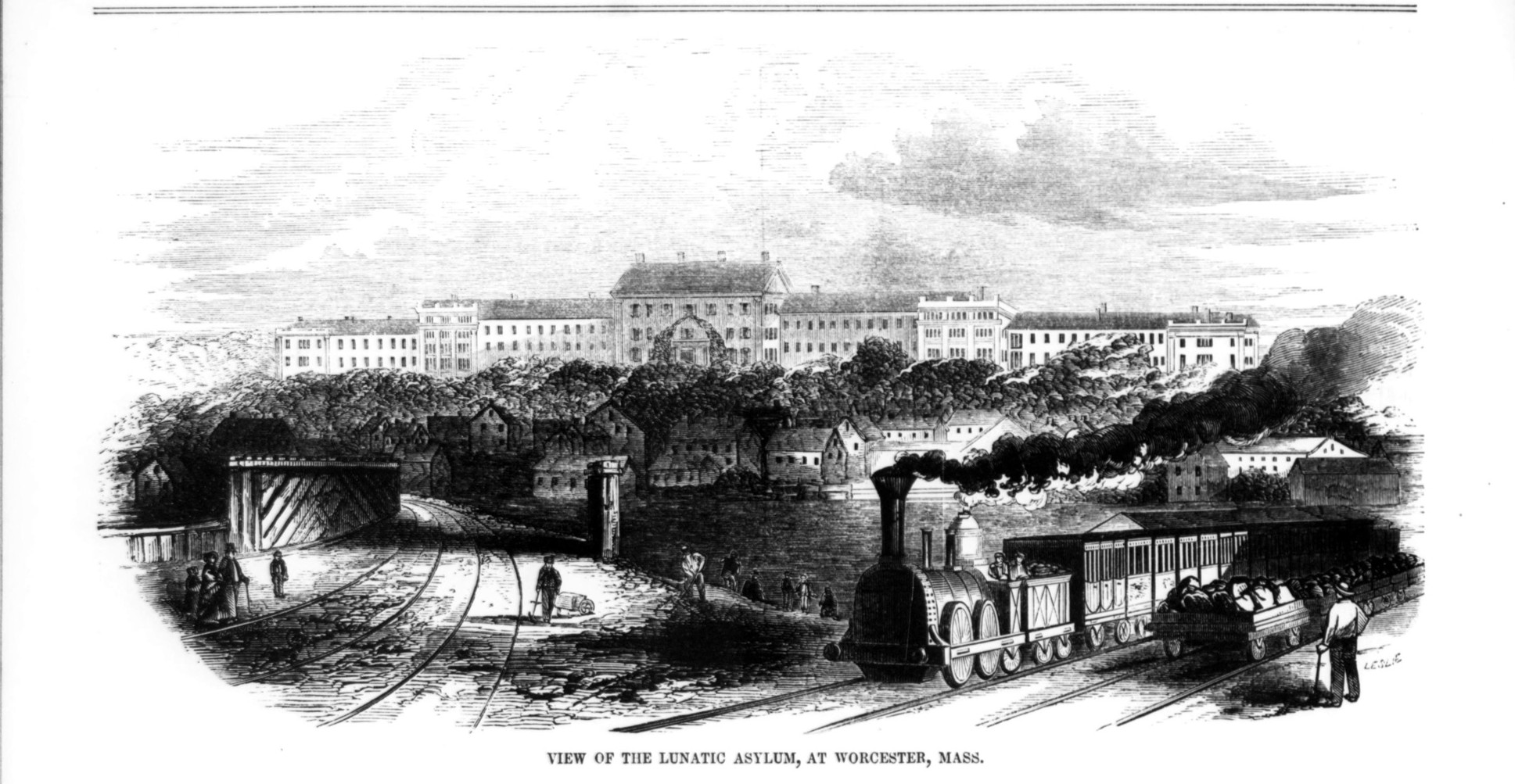
The original hospital was built in 1833 and consisted of a large, massive block of buildings on Summer Street in Worcester.
The hospital had five wings in the rear, two extending from each ell on either side of the main structure, and the remaining wing extending from the center of the building.
The southern half of the building was occupied by male patients and the northern half by female patients. The ward on the first floor had 16 rooms and also bath and dining rooms and a room for the attendant.
Another ward was located at the rear of the first ward and was used to house aged patients. It featured 10 rooms and a dormitory that could accommodate several patients.
Another wing extended from the rear portion of the building and featured a large hall and more rooms and a dormitory for patients having violent outbursts. Another ward, used to house the most violent patients, was located below that ward and was accessed by a set of stairs.
The building also had a middle wing in the upper story that housed the chronic yet nonviolent patients. Another ward located in the upper center and in the middle center housed the convalescent patients who had recovered and were about to be released.
Directly in the rear of the center of the main building was the chapel wing. The upper level of the wing was used as a chapel, and the lower level housed the laundry room, kitchen, and bakery (“Worcester Lunatic Asylum,” 1874).
A yard was located behind the building and had a set of swings as well as a pair of horses and carriage to provide carriage rides for the patients.
The asylum received its first patient on January 19, 1833. During the asylum’s first year, it had a total of 164 patients. The asylum’s first superintendent was Samuel B. Woodward.
In November of 1838, the hospital held a Thanksgiving feast for the patients, during which patients ate a Thanksgiving meal in the great hall and danced to music played by fellow patients.
According to a 1842 news report in the Mercantile Journal, the number of patients at the hospital that year was 399, of whom 195 were male and 204 were female. Around 82 had recovered, 26 were improved, and 12 had died (“Worcester Lunatic Asylum,” 1842).
In May of 1844, a man named Abner Rogers, who had been acquitted for the murder of the warden at the Massachusetts State Prison on the grounds of insanity and sentenced to the Worcester Lunatic Asylum, killed himself by jumping from a window at the asylum.
According to a 1850 news report in the Buffalo Daily Republic, the number of patients at the hospital that year was 420, and around 138 had been discharged as cured.
In 1852, it was reported in the Daily Telegraph that there were six female patients at the hospital who had gone insane because of the “departure of their husbands to California,” which seems to be a reference to the California Gold Rush.
In 1856, a patient named John Cate hanged himself with a handkerchief in his room at the asylum.
In 1864, the hospital released a report citing the main causes of insanity at the hospital. In many cases, the cause was unknown, but the main cause was intemperance, followed by a long list of other causes:
“In 6,603 cases the causes were unknown of about one third, or 2,076 cases. The largest number from any one cause was intemperance, which has had in this hospital 602 victims; 446 were insane from domestic troubles, 402 from masturbation, pecuniary trouble, 179; puerperal disease, 199; death of relatives, 97; paralysis, 81; old age, 46; fright, 44; use of tobacco and opium, 27; political excitement, 10; religious excitement, 332; spiritualism, 41; disappointed love, 159.” (“Causes of Insanity,” 1864)
In 1866, the superintendent of the asylum, Dr. Merrick Bemis, was suffering from depressive moods and decided to seek private treatment at the Pennsylvania Hospital for the Insane rather than at his own hospital.
In 1868, a patient named William Aiken died by suicide by throwing himself in front of a moving train while out on a walk with two hospital attendants and some other patients.
According to a 1871 news report in the Boston Post, around 384 patients had been admitted to the hospital that year, of whom 196 were male and 188 were female. The article stated that about 158 had recovered, 123 had improved, six had not improved, and 64 had died (“Worcester Lunatic Asylum,” 1871).
Like many state hospitals, the asylum quickly became overcrowded, so the trustees purchased a new property in 1871 in order to build a larger hospital. The new site was about 270 acres in size, cost $110,000, and was located approximately one mile away from the center of the city.
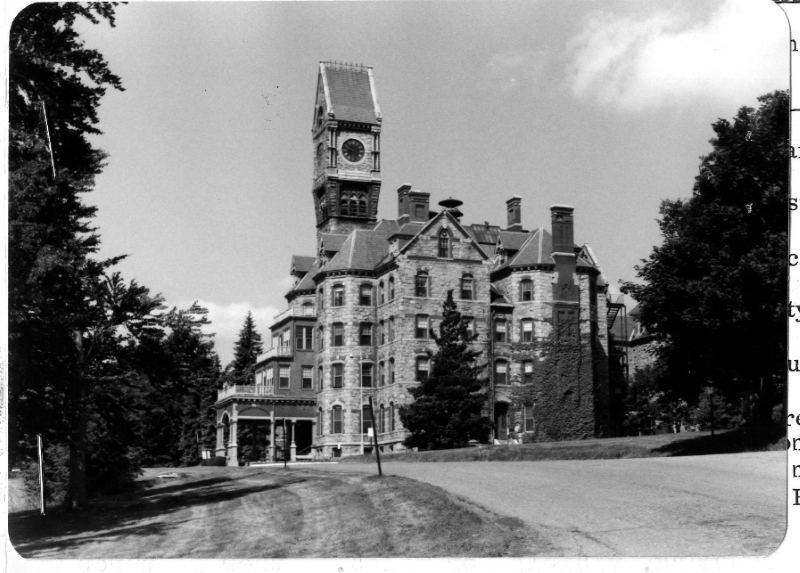
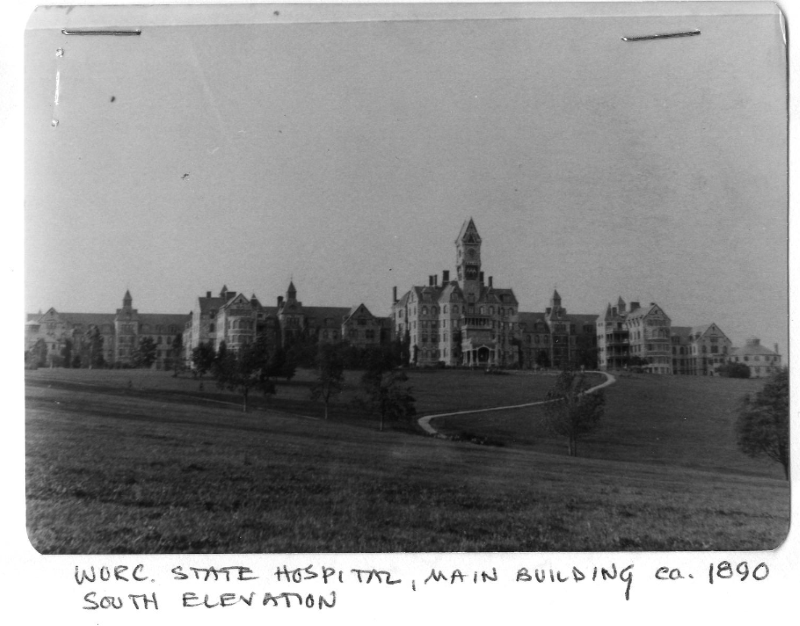
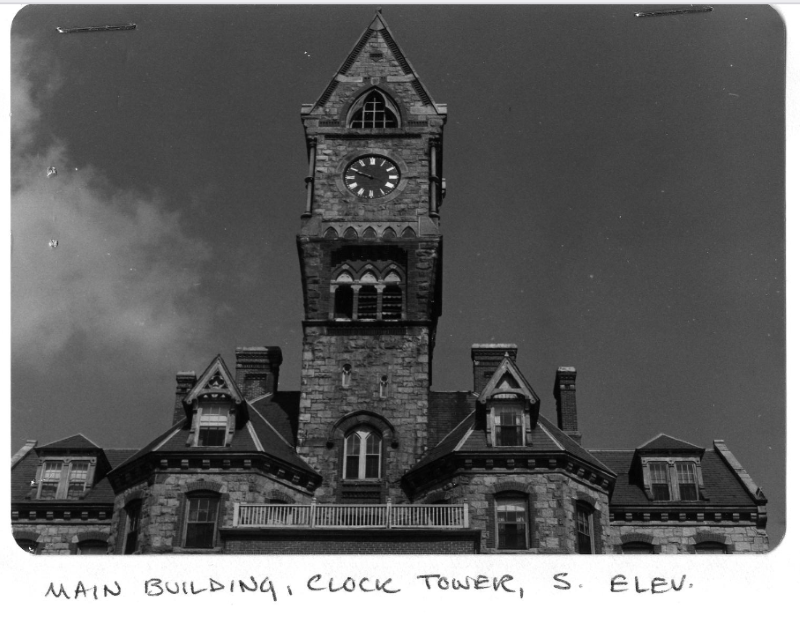
The new hospital, known as the Worcester Lunatic Hospital, was built between 1874 and 1877 and was based on the Kirkbride plan.
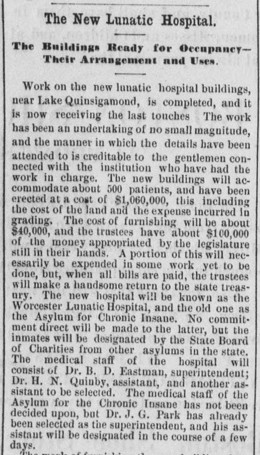
It was designed by architects Fuller, Dellano, and Frost and cost over $1,500,000 to build and was constructed out of gneiss rubble, red brick, and rock-faced granite.
The wings of the main building were 3 ½ stories high and receded in three stages. The wings had high hip roofs and ventilator turrets.
In addition to the main building, other buildings were also constructed on the property around the same time, such as the old laundry building, the old boiler room, and the stables.
According to a news report in the Boston Globe, the number of patients admitted to the hospital in 1877 was 354; about 72 patients had recovered and been discharged, 92 had improved, 74 had not improved, and 69 had died.
The Globe reported that the chief cause of insanity among the patients was intemperance and that most of the male patients were laborers, shoemakers, and farmers, and most of the female patients were housekeepers and domestics (“The Worcester Lunatic Asylum,” 1877).
In 1878, John D. Washburn, a trustee of the Worcester State Hospital, suffered from a nervous breakdown that was attributed to “the care and anxiety incidental to the erection of the new hospital for the insane.” His physician, fellow trustee Dr. Thomas Gage, prescribed a trip to Havana instead of a stay in the new hospital as treatment (Kearin 2022).
In 1880, a patient named Thomas Durger was killed by another patient, Warren Rice, who had been sent to the asylum for the murder of his father 15 years earlier.
In September of 1882, the hospital had a total of 533 patients, of whom 233 were male and 300 were female (“Worcester Lunatic Asylum,” 1882).
In January of 1890, a fire broke out in the north wing of the state hospital after an attendant carelessly dropped a “lighted paper.” The fire quickly spread to the roof and to the center of the building before it was extinguished. The building was flooded with water and sustained water damage as a result.
In 1896, a farmhouse was built on the property on Plantation Street. The building was a 2 ½-story brick building with an L-shaped floor plan. It had a slate hip roof with window dormers and cupolas.
It is likely that the farmhouse was built to house farm workers who were hired to take care of the farm on the property. Sometime between 1896 and 1911, a wing was built on the west side of the farmhouse.
In 1899, the asylum changed its name to the Worcester Insane Hospital.
Worcester State Hospital in the 20th Century:
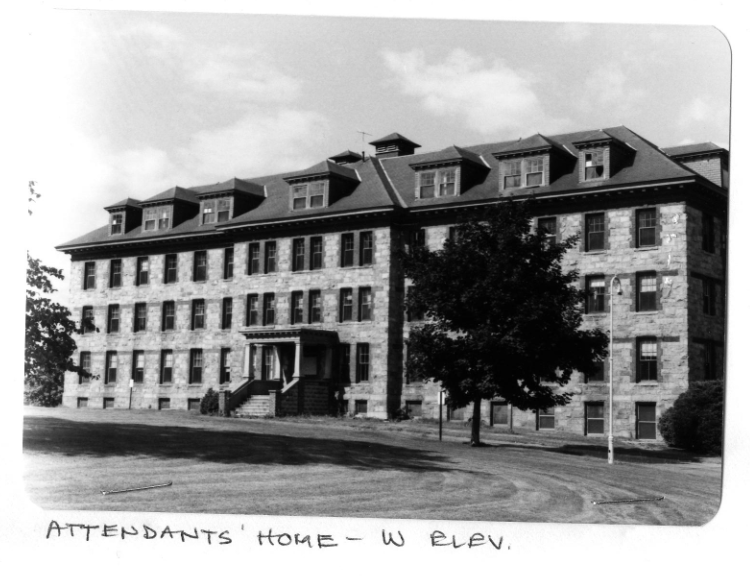
Sometime around 1900, the Nurse’s Home was constructed just southwest of the main hospital building. The building was 3 ½ stories high and was also made out of gneiss rubble and was trimmed with red brick. It had a slate hip roof and window dormers.
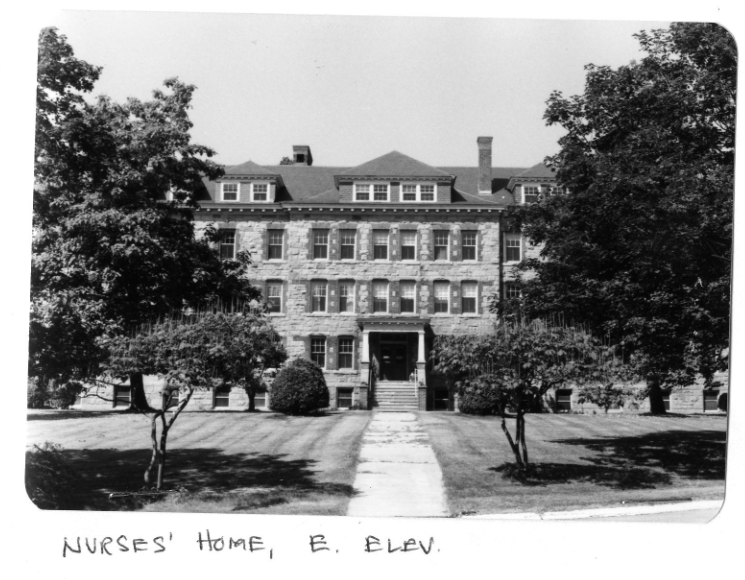
In 1906, the attendant’s home was constructed east of the main building and is identical to the nurse’s home, except for brick banding beneath its cornice, which is a detail not used in the nurse’s home.
In 1909, the hospital changed its name to the Worcester State Hospital.
In the 1920s, four houses were built for doctors and staff housing. All of the houses were two-story brick buildings with rectangular floor plans.
Between 1955 and 1958, the Bryant Building was constructed to expand the hospital. It is an eight-story, concrete and steel frame building with two four-story wings extending from its south wall.
In 1956, a three-story concrete-block service building was constructed, and in 1962, a new one-story concrete-block laundry building was built on the property.
In 1985, the main Kirkbride building was abandoned. The left wing of the building was destroyed, and the right wing was partially damaged during a fire in 1991.
In 2008, the Kirkbride building and the other remaining buildings on the property, except for the administrative building, the Hooper turret and the Hale building, were demolished.
In 2009, construction began on a new hospital on the site, Worcester Recovery Center & Hospital, which was completed in 2012.
The Bryant Building continued to operate as a state hospital until the new hospital opened in 2012 and the patients were transferred over.
The only original buildings that are still standing are the Bryant Building and Hale Building.
Sources:
Catalog Record: Annual Report of the Trustees of the Worcester State Hospital. HathiTrust, catalog.hathitrust.org/Record/000059102
“Historic Area Detail: WOR.AC Worcester Asylum – State Hospital.” MACRIS, mhc-macris.net/details?mhcid=WOR.AC
“Historic Building Detail: WOR.258 Worcester State Hospital – Main Hospital Building.” MACRIS, mhc-macris.net/details?mhcid=WOR.258
Kearin MB. Dirty Bread, Forced Feeding, and Tea Parties: The Uses and Abuses of Food in Nineteenth-Century Insane Asylums. J Med Humanit. 2022 Mar;43(1):95-116. doi: 10.1007/s10912-019-09603-8. PMID: 31907702; PMCID: PMC8901470.
“The Lunatic Asylum at Worcester, Mass.” The Geneva Gazette, 12 Feb. 1834.
“Worcester Lunatic Asylum.” Vermont Phoenix, 15 Sept. 1837, p. 4.
“Thanksgiving in the State Lunatic Hospital at Worcester.” The Boston Advocate, 6 Dec. 1838, p. 2.
“Thanksgiving in a Mad House.” Columbus Democrat, 12 Jan. 1839, p. 2.
“Death of Abner Rogers Jr.” The Boston Republican, 21 May. 1844, p. 3.
“Abner Rogers.” Gazette and Chronicle, 24 May. 1844, p. 2.
“State Lunatic Hospital.” Daily Republican, 24 Feb. 1845, p. 3.
“A Lunatic.” The Boston Traveler, 26 Aug. 1846, p. 2.
“The Average Number of Patients in the Worcester Lunatic Asylum.” Buffalo Daily Republic, 30 Jan. 1850.
“In the Lunatic Asylum at Worcester.” Daily Telegraph, 13 Mar. 1852, p. 3.
“Lunatic Asylum at Worcester.” Ballou’s Pictorial Drawing-Room Companion, 23 Oct. 1852.
“Worcester Insane Asylum.” New York Times, 25 Feb. 1853, p. 2.
“Suicide.” The Boston Traveler, 10 Jun. 1856, p. 2.
“Causes of Insanity.” The Pittsburgh Post, 16 Feb. 1864, p. 2.
“Dr. Bemis, Superintendent of the State Lunatic Asylum at Worcester.” Daily National Republican, 16 Jan. 1866, p. 2.
“Items.” Peterborough Telegraph, 25 Apr. 1868.
“Worcester Lunatic Asylum.” The Boston Post, 4 Jan. 1871, p. 4.
“Worcester Lunatic Asylum.” Worcester Daily Press, 6 Jun. 1874, p. 1.
“The New Lunatic Hospital.” Worcester Daily Spy, 6 Oct. 1877, p. 4.
“The Worcester Lunatic Asylum.” The Boston Globe, 22 Dec. 1877, p. 5.
“Asylum for the Chronic Insane.” The Boston Herald, 8 May. 1877, p. 2.
“Murder of a Lunatic in the Worcester Asylum.” The Springfield Daily Union, 27 Jan. 1880, p. 4.
“Worcester Lunatic Asylum.” The Boston Transcript, 3 Jan. 1882, p. 5.
“Fire in a Lunatic Asylum.” The Wilmington Messenger, 19 Jan. 1890, p. 1.
“The State’s Insane Asylums.” Evening Press, 8 Dec. 1890, p. 1.