
The Andrew-Safford House is a historic Federal-style house in Washington Square in Salem, Massachusetts.
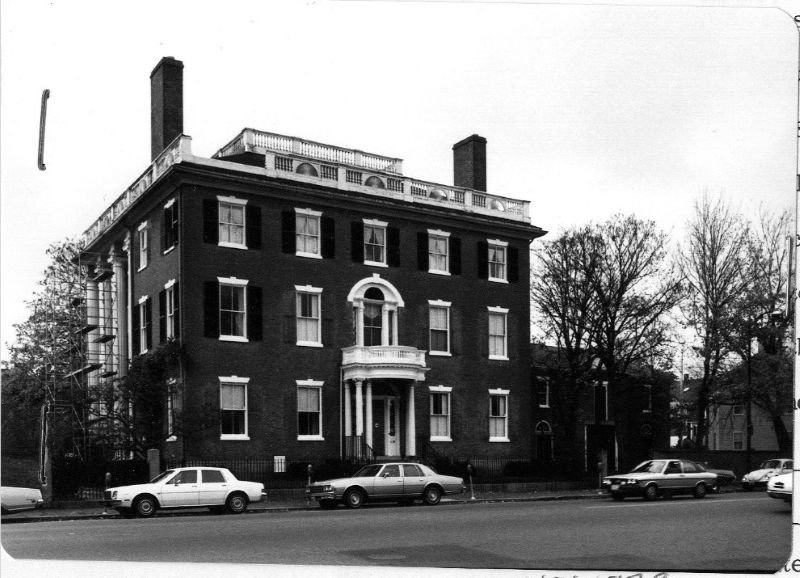
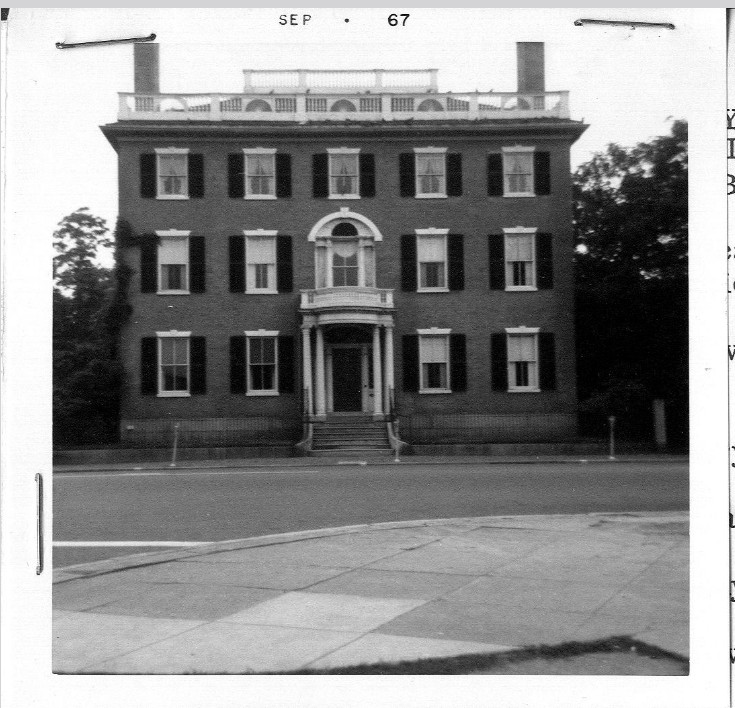
Built in 1818 for local fur merchant John Andrew, the house is a three-story brick house with a central front portico, four large Doric columns on the south side, and a hip roof. It is said to have been the most expensive private residence in New England at the time it was built.
The house also features a two-story, hip roof, brick chaise house that is connected to the main house by a two-story brick ell. The chaise house has a facade gable and a large central entrance.
The interior woodwork of the house was carved by Joseph True, a master carpenter who apprenticed with Samuel McIntire. True also carved the gilded wooden eagle on the Custom House in 1819.
The interior of the house is divided by a central hallway and has about four rooms per floor. A three-story staircase leads to every floor in the house, and the interior rooms also feature solid mahogany doors with mercury glass knobs.
The front door opens into a small vestibule, which then flows into the central hallway. The stairs move up the left side of the main hallway and curve to the right at the top.
The first floor features a double parlor. The front parlor is the most lavishly decorated, with a marble mantelpiece, a panel of imported wallpaper, carved door casings, and a plasterwork ceiling.
When John Andrew died in 1829, his wife, Catherine, inherited half of the house, and their son, John Forrester Andrew, inherited the other half. When Catherine died in 1845, her half of the house passed to her other son, Isaac Watson Andrew.
John Andrew died suddenly of a heart condition just two years later in 1847, and his half of the house was placed in a trust. Andrew’s wife and children were allowed to live in the house for as long as they liked.
In 1851, the trustees purchased the other half of the house from Isaac Andrew. In 1860, the house was sold to local merchant Edmund Smith for $12,000.
When Smith died in 1864, his wife, Harriet, sold the house to Frederic M. Creamer for $20,000. Creamer died shortly after, and his wife, Martha, sold the house to John Osborne Safford on June 24, 1871, for $8,806. The house remained in the Safford family for the next 76 years.
On August 15, 1947, the Essex Institute purchased the house for $14,216 to use as a residence for its executive director. In 1972, the third floor was used as storage for the institute’s costume collection.
In April of 1976, several rooms on the first floor, which were furnished with items from the museum’s collection, were opened to the public for the first time. The house is still owned by the Peabody Essex Museum but is not open to the public for tours.
Sources:
Ward, Gerald W. R. The Andrew-Safford House. Essex Institute, 1976.
“Historic Building Detail: SAL.2458 Andrew – Safford House.” MACRIS, mhc-macris.net/details?mhcid=SAL.2458