
Samuel McIntire was an American architect and craftsman from Salem, Massachusetts. He is most famous for his work in the Chestnut Street District of Salem.
McIntire was born on January 16, 1757, in Salem, Massachusetts, in a house on the corner of Mill and Norman Streets, to housewright Joseph McIntire and Sarah Ruck. He was baptized in the First Church in Salem.
McIntire came from a long line of woodcarvers and housewrights. The first McIntire arrived in the Massachusetts Bay Colony in 1666 and settled in Reading.
McIntire took up woodworking as a trade but also self-taught himself architecture by reading architecture books and studying the work of fellow architects in Salem.
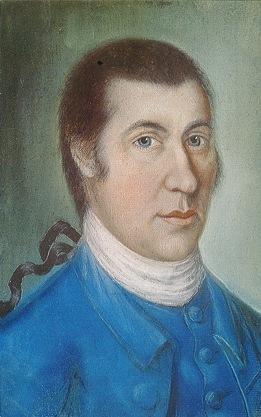
In October 1778, McIntire married Elizabeth Field. Their first child, Samuel Field McIntire, was baptized on August 29, 1779, but died in infancy. Their second child was also named Samuel Field McIntire and was baptized in November of 1780.
An article in the American Architect magazine says that McIntire’s father died in 1777 and his brother Joseph took over his father’s business. Yet another article, in the Danvers Herald, says that McIntire was 25 years old when his father died, which would have been 1782, and he himself took over his father’s business.
In 1786, McIntire bought a three-story house at 31 Summer Street and built himself a workshop at the rear of the house.
Some of the houses in Salem that McIntire designed include the Hawkes House, the Peirce-Nichols House, the Joshua Ward House, the Salem Courthouse (built in 1785 but later demolished in 1839), the Assembly Hall, the Peabody-Silsbee House, the Gardner White House, the Kimball House, the Gideon Tucker House, the Gardiner-Pingree House, Hamilton Hall, the South Church (destroyed by fire in 1903), and the Francis Boardman House.
McIntire also designed houses in nearby towns, such as the Derby Summer House in Danvers and the Jacob C. Rogers House on the Oak Hill Estate in Peabody.
In addition, McIntire also designed the Western gate on Salem Common during renovations to the common in 1805, which featured a carving of George Washington. The gate was later replaced by a cast iron fence in 1850, and the carving of George Washington was put on display in the Peabody Essex Museum.
On February 6, 1811, McIntire died at the age of 54, and his funeral was held at his house at 3p.m. the following Monday afternoon. McIntire was buried in the Old Burying Point Cemetery in Salem.
The inscription on his headstone reads:
“In Memory Of
Mr. Samuel McIntire
Who Died Feb. 6, 1811
AEt. 54He was distinguished for Genius in Architecture, Sculpture, and Musick: Modest and sweet Manners rendered him pleasing: Industry, and Integrity respectable: He professed the Religion of Jesus in his entrance on manly life; and proved its excellence by virtuous Principle and unblemished conduct.”
In 1916, local photographer Frank Cousins and Phil M. Riley published a book about McIntire titled The Woodcarver of Salem, Samuel McIntire, His Life and Work.
In 1930, after it was discovered that the Francis Boardman House on Washington Square was designed by McIntire, the Essex Institute conducted an expansive search to identify and authenticate as much of Samuel McIntire’s work in Salem as possible.
To do so, the institute asked owners of local houses and buildings constructed during McIntire’s time as an architect to search their papers and documents for any proof that McIntire may have designed their house.
In 1981, the Samuel McIntire Historic District was established in Salem, Massachusetts, in honor of McIntire.
Sources:
“Samuel McIntire Papers.” PEM, pem.quartexcollections.com/collections/samuel-mcintire-papers
“McIntire District.” Preserving Salem, preservingsalem.com/mcintire-district
“Portrait medallion in Salem, Massachusetts, 1805-11 in Painted Pine.” Historic New England, historicnewengland.org/explore/collections-access/gusn/359704
“Samuel McIntire.” Find a Grave, findagrave.com/memorial/8201/samuel-mcintire
“D.A.R. China Class Hears Talk on S. McIntire.” Danvers Herald, 20 Mar. 1941, p. 7.
“Search to Verify McIntire’s Work.” The Boston Globe, 25 Sept. 1930, p. 2.
“Salem Relives Days of Glory.” Evening Star, 8 Jun. 1930, p. 1-2.
“Samuel McIntire.” American Architect, 6 Apr. 1921, pp. 1-8.