
On October 27, 1903, 11 patients at the Tewksbury State Hospital were poisoned when they drank water that had been mixed with poison. One of the patients died the following day.
The hospital staff discovered the poisoning after the patients began showing symptoms of what they suspected was belladonna poisoning during breakfast hour the following day.
Aid was quickly administered, and most of the patients began to improve except for one patient, 76-year-old Walter Fitzgerald, who died that morning.
At first, Superintendent John Holyoke Nichols insisted that Fitzgerald had not been one of the victims who consumed the belladonna, but he later denied making that statement and said that Fitzgerald had indeed ingested the belladonna, but it had been removed from his system and that he actually died of myocarditis, not belladonna poisoning (“Probe State Hospital Death,” 1903).
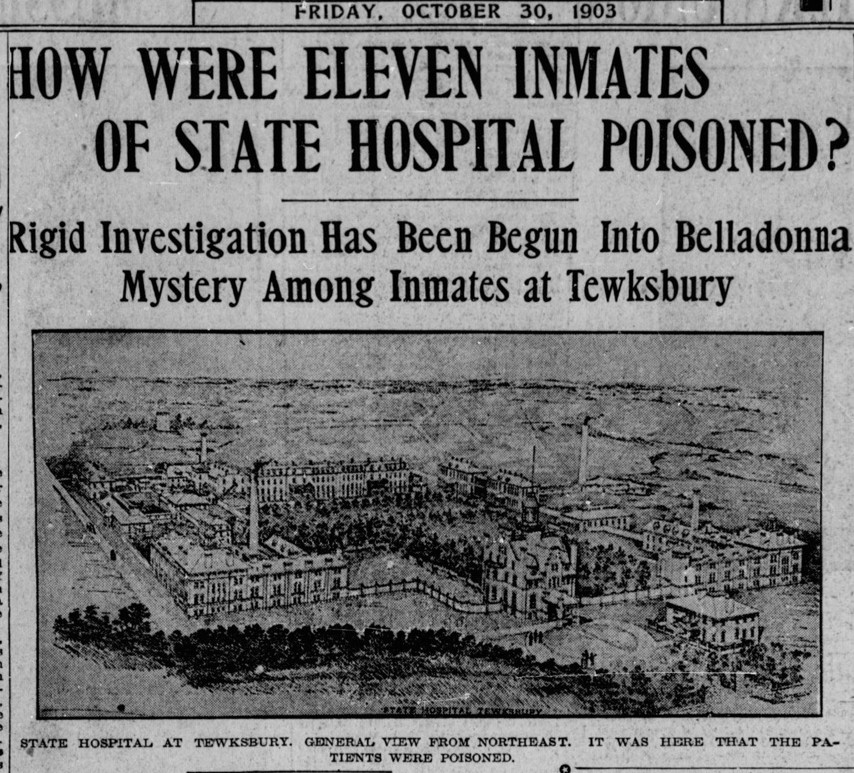
An investigation was launched, and it was determined that the poisoning was premeditated and that the belladonna had been brought in from outside the institution and mixed with water in a water pitcher.
The water in the pitcher was later tested, but no traces of belladonna could be detected. Officials explained that the water tested might not have been the actual water given to the patients.
Investigators theorize that someone could have put the poison in the pitcher when the night nurse left the ward for a moment and that the nurse inadvertently administered the poisoned water when pouring it for the patients while dispensing their medication later that evening.
It was later determined that it was actually atropine tablets that were put in the water, which is a tropane alkaloid that occurs naturally in plants from the deadly nightshade family, such as belladonna, which was probably procured within the institution (“Tewksbury Inmate Poisoned Pitcher,” 1903).
It was also discovered that an unknown man had tried to enter the North Ward, which is about 30 yards away from the male ward, on October 25, two days before the poisoning, but fled when he was detected. It was also found that a window may have been opened from the outside. It wasn’t clear, though, if the two events were related to the poisoning.
On December 1, 1903, the committee investigating the incident released their report, which stated that the employees of the institution were not to blame, and the committee believed the poisoning was carried out by a “degenerate or criminal, or mischievous person, presumably from the men’s dormitory,” according to a news report in the Boston Herald. The culprit was never discovered.
The poisoning wasn’t the only time that such an incident occurred at a state hospital in Massachusetts. In 1934, a similar incident took place at Danvers State Hospital when a large amount of insecticide was mixed into a sauce being prepared in the hospital’s kitchen. One patient died, and a dozen others became ill.
Sources:
“Probe State Hospital Death.” The Boston Evening News, 29 Oct. 1903, p. 1.
“Given Belladonna By Mistake.” The Evening Standard, 29 Oct. 1903, p. 9.
“Belladona Victim Dies in Tewksbury.” The Boston Evening News, 29 Oct. 1903, p. 5.
“Patients Poisoned.” Salem Gazette, 29 Oct. 1903, p. 1.
“Patients Were Poisoned.” The Boston Herald, 29 Oct. 1903, p. 7.
“Patients Doing Well.” Nashua Daily Telegraph, 29 Oct. 1903, p. 12.
“Old Men Poisoned.” The Boston Traveler, 29 Oct. 1903, p. 5.
“Hospital Poisoning Alarms Inmates’ Relatives.” The Boston Evening News, 30 Oct. 1903, p. 1.
“Patients Doing Well.” The Westerly Daily Sun, 30 Oct. 1903, p. 7.
“Eleven Were Poisoned.” The Buckingham Post, 30 Oct. 1903, p. 10.
“How Were the Eleven Inmates Poisoned.” The Boston Post, 30 Oct. 1903, p. 1.
“Did Not Take Poison.” The Boston Globe, 30 Oct. 1903, p. 3.
“Poisoning Mystery.” Nashua Daily Telegraph, 31 Oct. 1903, p. 2.
“Veil of Mystery is Thrown About It By Authorities.” The Boston Evening News, 31 Oct. 1903, p. 1.
“Investigating Tewksbury.” The Boston Herald, 2 Nov. 1903, p. 3.
“Poison Water at Tewksbury.” The Boston Post, 3 Nov. 1903, p. 10.
“No Clew to Poisoning.” The Boston Globe, 8 Nov. 1903, p. 8.
“Poisoned by Plotter.” The Boston Traveler, 10 Nov. 1903, p. 8.
“Crime Was Attempted.” The Boston Herald, 10 Nov. 1903, p. 1.
“Secret Meeting of Poison Committee.” The Boston Evening News, 24 Nov. 1903, p. 5.
“Poisoner is Known.” The Boston Post, 25 Nov. 1903, p. 1.
“Still Remains a Mystery.” The Boston Globe, 27 Nov. 1903, p. 8.
“Tewksbury Inmate Poisoned Pitcher.” The Boston Evening News, 27 Nov. 1903, p. 6.
“Degenerate or Criminal.” The Boston Herald, 2 Dec. 1903, p. 1.
“Tewksbury Poisoner in Men’s Dormitory.” The Boston Post, 2 Dec. 1903, p. 1.