
The James Blake House is a historic First Period house on Columbia Road in Boston, Massachusetts. Built in 1661, it is the oldest surviving house in Boston.
The house is a two-story, wood-frame, gable-roof house with a central brick chimney. Both the first and second floors consist of a single large room set to either side of the chimney and a small room in the southwest section of the house.
The house was built for Deacon James Blake, reportedly in preparation for his marriage to Elizabeth Clap, daughter of Deacon Edward Clap and niece of Roger Clap.
In 1700, the house passed to James and Elizabeth’s son, John Blake. John later bequeathed the house to his two sons John and Josiah in 1718.
Sometime prior to 1747, a one-story wing was added to the southeast section of the house, and a similar wing was added to the northeast section around 1772. The house also had two dormer windows on the northwest section that were removed sometime after 1750.
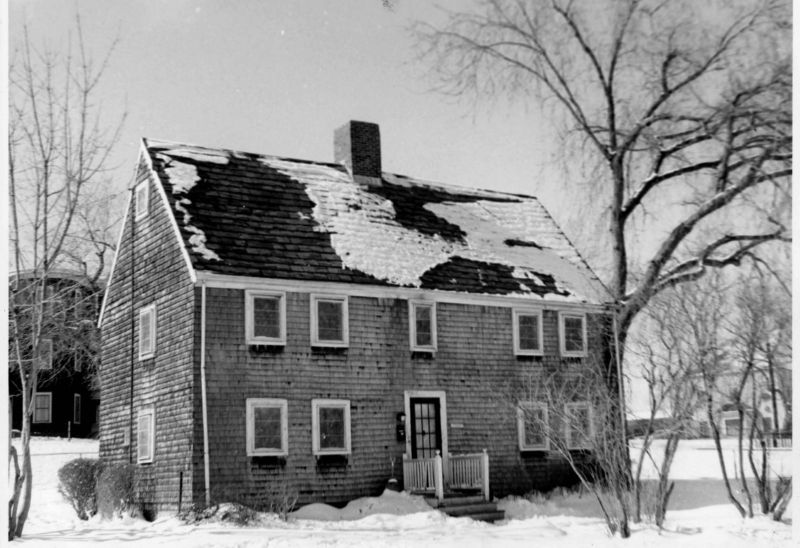
The property was settled by subdivision in 1748, after which the east and west halves of the house were occupied by separate families. In 1772, the east half of the house was sold out of the Blake family to a member of the Clap family.
The Blake family owned the west half of the house until 1825, when Caleb and Eunice (Clap) Williams purchased it from Rachel Blake, and, in 1829, they acquired the east half by inheritance.
The house remained in the Williams family until it was sold to George and Antonia Quinsler in 1892. In 1895, the Quinslers sold it to the City of Boston, which wanted the land so it could widen Massachusetts Avenue and build municipal greenhouses (Dorchester Historical Society, “The James Blake House”).
At first, the city planned to demolish the building, but it was later given to the Dorchester Historical Society after they offered to move and preserve the house. This was one of the earliest instances of a house being moved solely for the purpose of historic preservation.
Two descendants of Deacon James Blake, John H. Blake and Dr. Clarence J. Blake, donated $1,000 towards the expense of moving and restoring the house. Another $1,000 was raised by donations from members of the historical society and others.
Sometime between mid-December of 1895 and early January 1896, the house was moved about one-quarter mile east to its present location in Richardson Park.
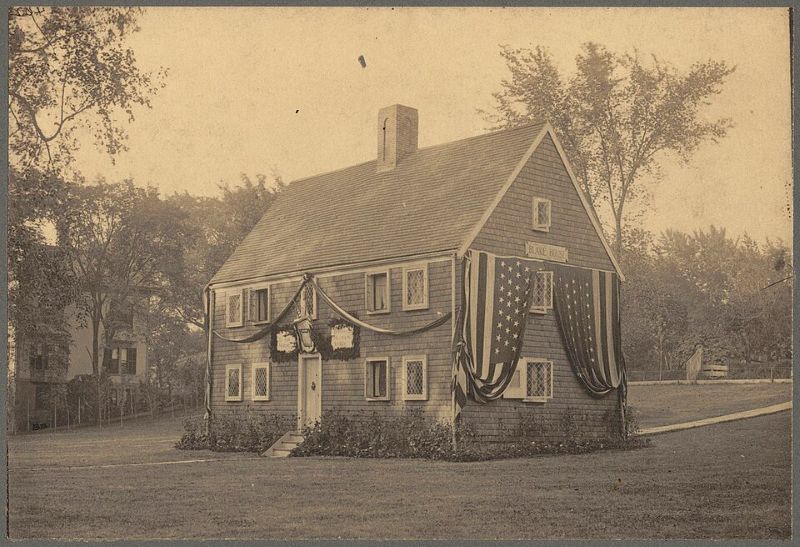
The house was also restored over the next few years, and the two wings were removed, and the clapboarding was replaced with handmade wood shingles (Commonwealth of Massachusetts, “NRHP nomination form for James Blake House”).
In addition, the small, leaded, diamond-paneled windows were replaced, the four antique fireplaces were restored, and the house was furnished with antique furniture from various Dorchester homes.
The house served as both headquarters for the historical society and as a historic house museum, named the Ye Old Blake House, displaying the society’s collection of Colonial and Civil War relics.
In the summer of 1910, the Dorchester Historical Society renovated the house and then opened the upper rooms to the public for the first time on October 5, 1910.
According to an article published in the Boston Herald in 1911, during the restoration of the house, the original window leads needed to be replaced because they were reportedly melted down during the Revolutionary War to make bullets.
The article also stated that the house had many antiques on display, such as a breastplate from the Tower of London dating to the Cromwell era, an ice creeper found in the ruins of the fortress of Louisburg in Cape Breton, and some remnants of the British frigate Charon, which was sunk in 1781 at Yorktown.
The house also had on display a letter from Theodore Roosevelt, explaining that, “For the sale in the old Blake house I send you the bullet with which I shot a rhinoceros in Africa,” as well as an autographed letter from President William Taft wishing the Dorchester Historical Society success with the Blake House museum.
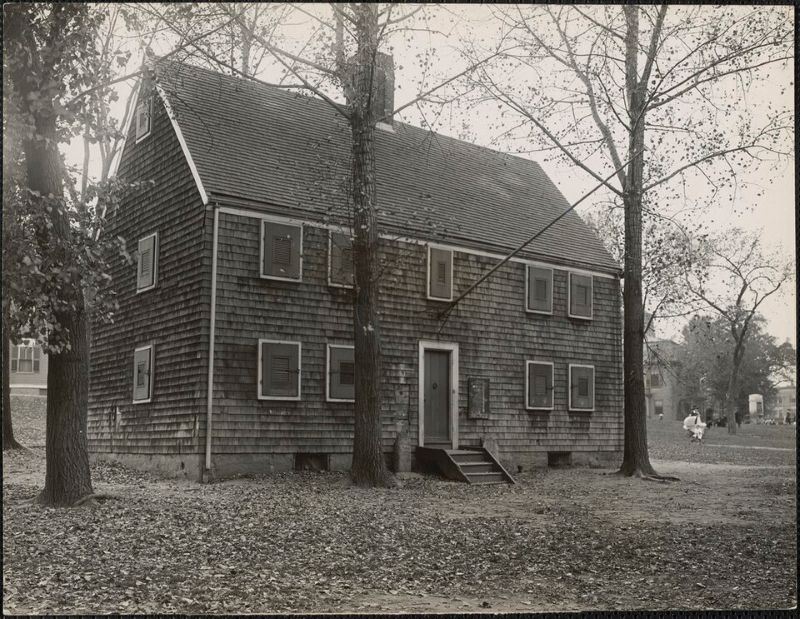
In 1919, the Blake house was damaged during acts of vandalism by local children who broke the windows, tore the shingles off the house, and used the house as a backstop (barrier to stop stray balls) during their baseball games (“Blake House Desecrated,” 1919).
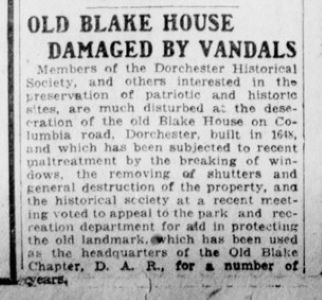
The historical society had to keep the shutters closed at all times to protect the windows and eventually appealed to the parks and recreation department for help.
On May 1, 1974, the James Blake House was added to the National Register of Historic Places. In 1978, the house was designated a Boston Landmark.
In 2007, a dendrochronology test of the beams in the house determined the timber was felled in the winter of 1660-1661, and therefore the house was most likely built in 1661.
The house is still open to the public as a historic house museum run by the Dorchester Historical Society.
Sources:
Stark, James Henry. History of the Old Blake House. Dochester Historical Society, 1907.
“Historic Area Detail: BOS.AFF Blake, James House.” MACRIS, mhc-macris.net/details?mhcid=BOS.AFF
“James Blake House.” Dorchester Historical Society, dorchesterhistoricalsociety.org/james-blake-house
“Our History.” Dorchester Historical Society, dorchesterhistoricalsociety.org/history
“Dorchester.” The Boston Traveler, 1 Jul. 1895, p. 2.
“To Save the Blake House.” The Boston Post, 2 Oct. 1895, p. 4.
“Public Hearing on the Subject Ordered by the Aldermen.” The Boston Traveler, 29 Oct. 1895, p. 3.
“Aldermen Meet.” The Boston Post, 29 Oct. 1895, p. 8.
“From the Mayor.” The Boston Daily Standard, 29 Oct. 1895, p. 3.
“Blake House.” The Dorchester Beacon, 7 Dec. 1895, p. 3.
“In Old Dorchester. History of the Blake Mansion Recently Sold to a Society.” The Boston Daily Standard, 14 Apr. 1896, p. 7.
“Historical Society.” The Dorchester Beacon, 2 May. 1896, p. 1.
“Dorchester Historical Society.” The Dorchester Beacon, 16 May. 1896, p. 1.
“Old Blake House.” The Dorchester Beacon, 23 Apr. 1898, p. 1.
“Old Blake House, Oldest Building in Dorchester.” The Boston Traveler, 10 Jun. 1905, p. 3.
“Blake House Inspected.” The Boston Herald, 6 Oct. 1910, p. 5.
“Open Upper Rooms of Old Blake House.” The Boston Record, 6 Oct. 1910, p. 5.
“Old Blake House Rooms Restored.” The Boston Transcript, 6 Oct. 1910, p. 12.
“Blake House is Restored.” The Boston Herald, 3 Jul 1911, p. 7.
“Blake House Desecrated.” The Boston Transcript, 20 Jun. 1919, p. 1.
“Old Blake House Damaged by Vandals.” The Boston Post, 21 Jun. 1919, p. 4.
“Tercentenary Pilgrimages – No. 21. The Blake House, Dorchester.” The Boston American, 2 Jul. 1930, p. 12.
“The Model House.” The Boston Record, 3 Sept. 1930, p. 16.
“Old Blake House.” The Boston Globe, 27 Nov. 1931, p. 16.