
The Peabody Essex Museum is an art museum in Salem, Massachusetts. It houses the nation’s largest collection of Asian art.
The museum began as the Essex India Marine Society in 1799, making the Peabody Essex Museum one of the oldest continuously operating museums in the United States.
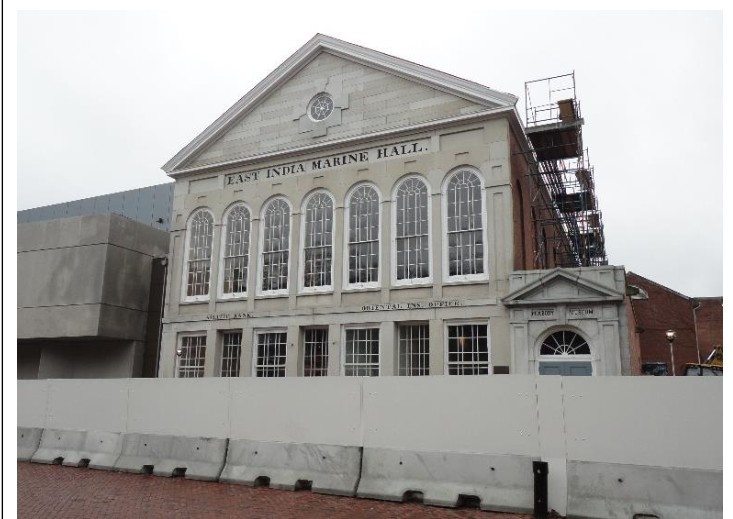
In 1825, the East India Marine Society built the East India Marine Hall on Essex Street to display its collection of 4,299 artifacts. The hall is a two-story, Greek Revival-style building with a pitched roof and a granite facade.
Then in 1848, the East India Marine Society merged with the Essex County Natural History Society to form the Essex Institute.
In 1867, George Peabody, a wealthy expat, established a trust fund of $140,000 to purchase the museum’s collection and changed the museum’s name to the Peabody Academy of Science.
In the late 1860s, the museum received the Essex Institute’s collection of natural history and ethnological artifacts and, in turn, transferred its historical collections to the Essex Institute.
At some point in the late 19th century or early 20th century, the museum built a series of wooden rowhouses on Orne Square to serve as housing for the museum staff. These rowhouses were later destroyed in the Great Salem Fire of 1914.
Fortunately, in 1915, Stephen W. Phillips, a donor and supporter of the museum, rebuilt the rowhouses located at 1-17 Orne Square, replacing them with eight concrete rowhouses. Each house is a two-story house with a rectangular plan.
Also in 1915, the Peabody Academy of Science changed its name to the Peabody Museum of Salem and continued to focus on collecting international art.
A news report in the Boston Globe in 1931 stated that the museum’s attendance was growing and it was receiving 50,000 visitors a year. Admission to the museum was free at the time.
In late December 1940, an earthquake shook the Eastern U.S., and some artifacts at the museum were damaged, such as a rare Japanese tile gargoyle that fell from a shelf through a glass showcase onto the floor, which shattered the bottom half of the gargoyle.
The museum expanded when a new wing was added, named the Francis B. Crowninshield Gallery, in 1953. The gallery is located on the upper floor of a two-story building erected over a basement section used for storage.
In the 1980s, the museum received what was rumored to be the skull of the pirate Blackbeard from the family of historian Edward Snow. It is not known for certain if the skull actually belonged to Blackbeard, and although it is still in the museum’s archives, it is not on display.
On May 14, 1988, the museum opened its newly built Asian Export Art Gallery wing. The new wing cost $8.1 million to construct and was designed by the Boston firm Kalimann, McKinnell & Wood, Architects Inc.
The museum looked into changing its name in 1989 when a trustee launched a public search for a new name for the museum after learning that the word “Peabody” translates phonetically in Chinese to “skin dry bottom.” Since the museum is known for its collection of Asian art, the trustee found the translation to be “not very graceful” and inappropriate for use among Chinese circles in America.
In 1992, the Peabody Museum of Salem merged with the Essex Institute to form the Peabody Essex Museum.
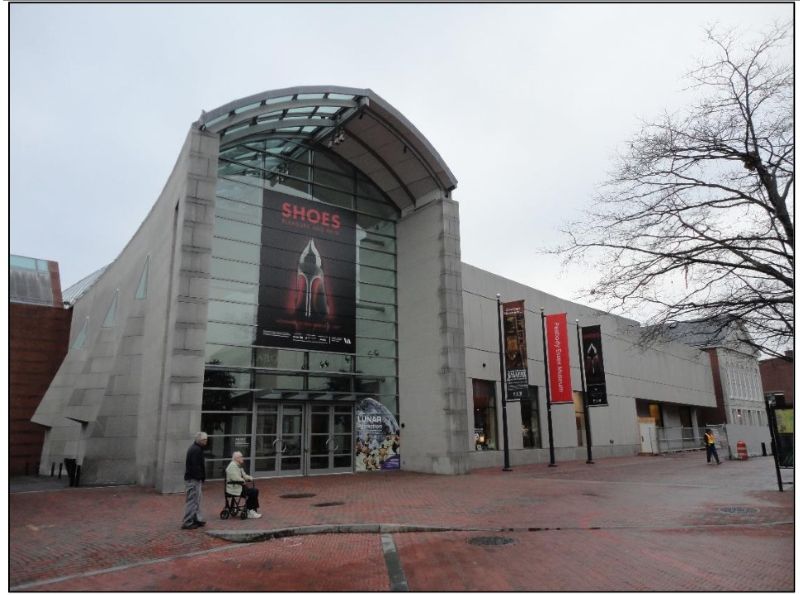
In 2003, the Peabody Essex Museum built another new wing, designed by architect Moshe Safdie, that now serves as the museum’s main entrance instead of the East India Marine Hall.
Sources:
“Museum History.” PEM, pem.org/about-pem/museum-history
‘Death of George Peabody.” The Union and Journal, 12 Nov. 1869, p. 1.
“Committees Occupy Day.” The Boston Herald, 13 Feb. 1915, p. 8.
“Peabody Museum May Be Enlarged.” The Boston Herald, 26 Jan. 1925, p. 8.
“Will Leaves $50,000 to Peabody Museum.” The Boston Globe, 26 Oct. 1927, p. 11.
“Peabody Leaves $280,000 to Charity.” The Boston Globe, 19 May. 1929, p. 19.
“Peabody Museum in Salem is Popular.” The Boston Globe, 11 Jun. 1931, p. 21.
“Quake Shakes Eastern US, Canada 20 Seconds.” Lewiston Evening Journal, 24 Dec. 1940, p. 1.
“Quake Damages Art Piece.” The Free Lance-Star, 26 Dec. 1940, p. 4.
Wayman, Dorothy G. “Quarrel With Agassiz Brings Morse New Job.” The Boston Globe, 20 Jan. 1951, p. 10.
“Francis B. Crowninshield Gallery Dedicated at Salem Museum.” The Boston Globe, 12 Sept. 1953, p. 2.
Guidry, Frederick. “New Wing of Peabody Museum Devoted to Asian Art.” The Telegraph, 3 Jul. 1988, p. 65.
“Museum’s Eminence Loses Something in the Translation.” The Deseret News, 6 May. 1989, p. 3.
“Historic Building Detail: SAL.2473 Peabody Museum of Salem – East India Marine Hall.” MACRIS, mhc-macris.net/details?mhcid=SAL.2473
“Historic Area Detail: SAL.FY Orne Square Area.” MACRIS, mhc-macris.net/details?mhcid=sal.fy
“Historic Building Detail: SAL.1060 Peabody Museum and Essex Institute Workers Housing.” MACRIS, mhc-macris.net/details?mhcid=SAL.1060
“Historic Building Detail: SAL.1061 Peabody Museum and Essex Institute Worker Housing.” MACRIS, mhc-macris.net/details?mhcid=SAL.1061
“Historic Building Detail: SAL.1062 Peabody Museum and Essex Institute Worker Housing.” MACRIS, mhc-macris.net/details?mhcid=SAL.1062
“Historic Building Detail: SAL.1063 Peabody Museum and Essex Institute Worker Housing” MACRIS, mhc-macris.net/details?mhcid=sal.1063
“Historic Building Detail: SAL.1065 Peabody Museum and Essex Institute Worker Housing.” MACRIS, mhc-macris.net/details?mhcid=SAL.1065
“Historic Building Detail: SAL.1066 Peabody Museum and Essex Institute Worker Housing.” MACRIS, mhc-macris.net/details?mhcid=sal.1066
“Historic Building Detail: SAL.1067 Peabody Museum and Essex Institute Worker Housing.” MACRIS, mhc-macris.net/details?mhcid=SAL.1067
“Historic Building Detail: SAL.1068 Peabody Museum and Essex Institute Worker Housing.” MACRIS, mhc-macris.net/details?mhcid=SAL.1068