
The Union Oyster House is the oldest restaurant in Boston, Massachusetts, and the oldest continuously operating restaurant in America.
Built on Union Street in 1716, the building is a three-story Georgian-style brick townhouse fashioned after the brick townhouses of London, England. It is considered a rare example of the early 18th-century London-style brick townhouses still standing in Boston.
The building was constructed by an unknown mason, possibly by Ebenezer Clough, as a shop and residence for John Savell. In 1726, Savell sold the building to Samuel Cunnable, who then sold it to James Pierpoint in 1737. Pierpoint sold it to Thomas Stoddard in 1742.
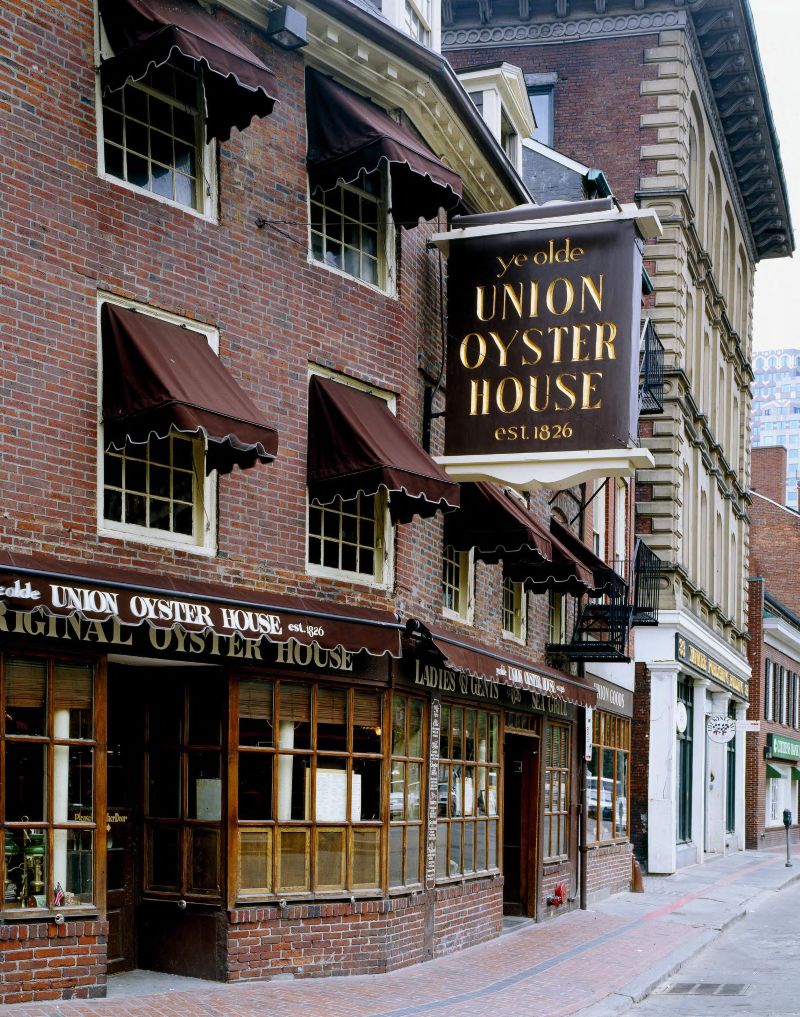
In 1760, the property passed to Hopestill Capen, who ran a silk shop called Capen’s Silks and Dry Goods Store in the building.
From 1771 to 1775, the second floor housed the print shop of Isaiah Thomas, who published the Massachusetts Spy.
In the fall of 1797, the exiled French King, Louis Philippe I, lived on the second floor above the shop and taught French to the young ladies of Boston’s high society. In 1798, the building passed to Thomas Capen. Capen later sold it to Hawes Atwood in 1826.
On October 7, 1826, Hawes Atwood opened Atwood’s Oyster House in the building. The Atwoods installed the U-shaped semicircular oak oyster bar near the entrance and replaced the original windows with large bay windows.
Oysters were a 19th-century fast food sold by street vendors and later by restaurants, bars, and saloons. The Atwood family had been selling oysters in Boston since at least 1818.
From 1842 to 1860, the restaurant was known as Atwood & Hawe’s Oyster House. Sometime in the 1880s or 1890s, the restaurant was renamed Atwood & Bacon’s Oyster House. In 1895, the dormer windows were removed from the building and replaced with skylights.
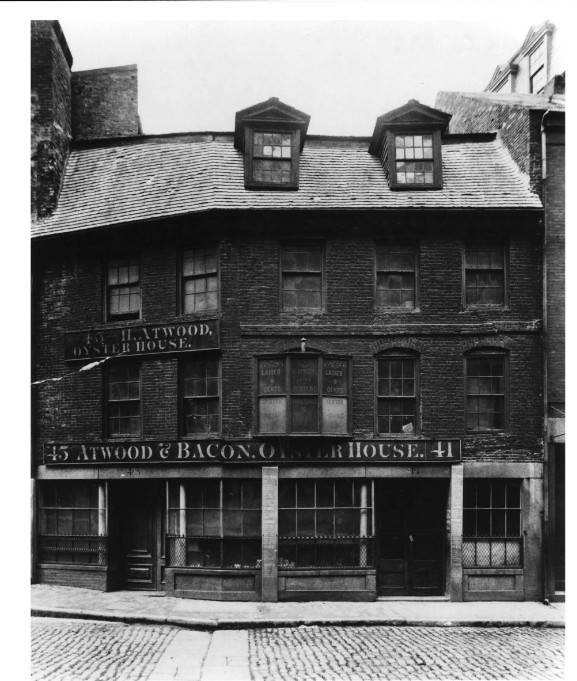
In 1913, the Atwood family sold the building to the Fitzgerald family, who renamed it the Union Oyster House, after the street it is located on.
The Fitzgerald family later sold the building to two brothers from Nova Scotia, Frederick and Chester Greaves, in 1927.
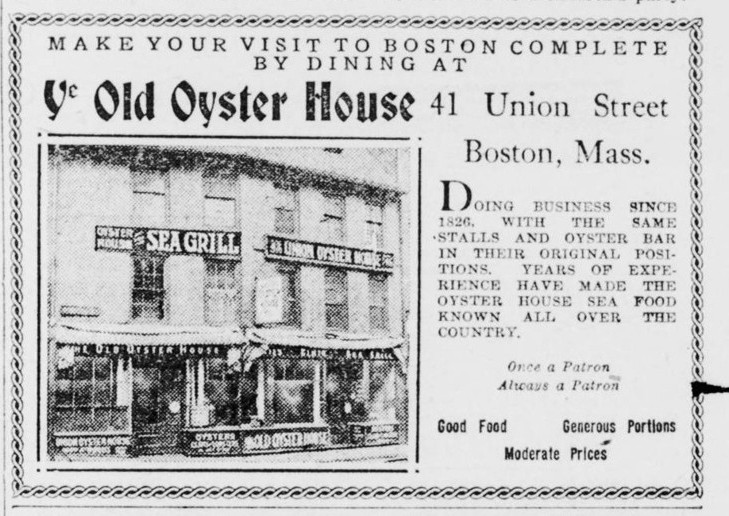
In 1932, the restaurant opened a satellite location at Stuart Street and another satellite location on Canal Street in January of 1940.
On April 16, 1933, thieves broke into the Union Street location and stole a 300-pound safe, which contained $1,000 in cash, silverware, and a loaded revolver (“300-Pound Safe with $1,000 Stolen,” 1933).
One of the thieves, Charles F. Hughes, was later caught and sentenced to four years in state prison in June of 1933.
In 1933-34, a vertical neon sign was hung on the front of the Union Street building, and in 1938, the building’s original dormer windows were rebuilt.
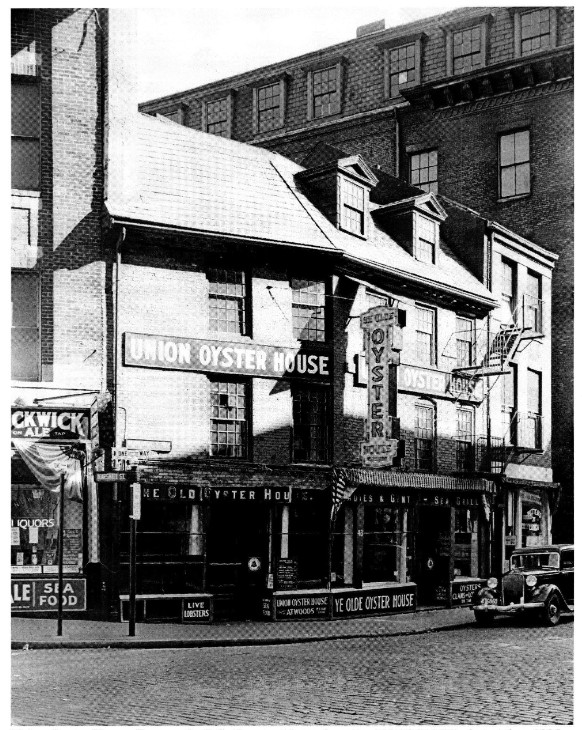
In 1941, the second floor of the building was renovated, and the walls of an existing office were torn down to create more dining room space.
On February 7, 1949, the Stuart Street location was robbed by three armed men who broke in through a fire door in the early morning and held the employees at gunpoint while they broke open the safe and stole $300.
On June 11, 1951, the Union Street location was damaged in a three-alarm fire that started in the second-floor kitchen and spread rapidly due to heavy winds, causing $25,000 in damage.
The fire was so intense it burst the windowpanes and damaged both the second and third floors of the building. The exact causes of the fire were unknown but a suspect was later detained and questioned about the fire. The restaurant was forced to temporarily close for a week for repairs, but it officially reopened for business on June 19.
On October 15, 1951, the Canal Street location restaurant was also robbed by three masked men just before it opened for the day. One man waited in the car while the other two entered the restaurant, one armed with a long-barreled revolver, and took a tray of $200 worth of rolled coins from one employee yet failed to ask for the money in the strong box.
In 1956, the neon sign on the Union Street building was replaced with a box sign. An additional large roof sign was added in 1957.
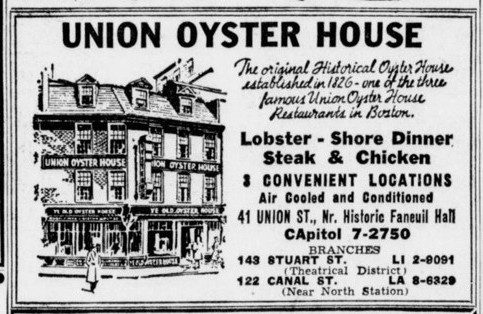
In 1961, the Stuart Street location was damaged in a fire and closed temporarily for renovations. Sometime around 1962, the satellite locations on Canal Street and Stuart Street closed.
In 1970, the Greaves brothers sold the restaurant to Joseph Milano. The Milano family owned the restaurant for 56 years.
On May 27, 2003, the Union Oyster House was listed on the National Register of Historic Places and declared a National Historic Landmark as the oldest continuously operating restaurant in the United States.
In August of 2026, the Milano family sold the restaurant to the Fertitta family of Texas.
Sources:
O’Connell, James C. Dining Out in Boston: A Culinary History. University Press of New England, 2016.
Olia, Maria. Discovering Vintage Boston: A Guide to the City’s Timeless Shops, Bars, Restaurants & More. Globe Pequot, 2015.
“NPS Form 10-900 Union Oyster House.” National Historic Landmark Nomination, 2001.
“Old Oyster House: One of the Oldest Restaurants in the Country.” American Battlefield Trust, battlefields.org/learn/articles/old-oyster-house
“Historic Building Detail: BOS.2101 Union Oyster House.” MACRIS, mhc-macris.net/details?mhcid=BOS.2101
“Union Oyster House.” Union Oyster House, unionoysterhouse.com/pages/history.html
“Union Oyster House.” NPS.gov, nps.gov/nr/travel/maritime/oys.htm
“Union Oyster House is Century Old This Month.” The Boston Herald, 21 Feb. 1926, p.72.
“Historic Shrines of Massachusetts. No. 92.” The Boston Record, 12 Aug. 1930, p. 18.
“Lug 300-Pound Safe and $1,000.” The Boston Post, 17 Apr. 1933, p. 13.
“300-Pound Safe with $1,000 Stolen.” The Boston Globe, 17 Apr. 1933, p. 8.
“Four Years for Safe Stealer.” The Boston Post, 16 Jun. 1933, p. 5.
“Old Union Oyster House Has New Dining Rooms.” The Boston Post, 2 Mar. 1941, p. 70.
“2 Officers Given Vacation for Nabbing Alleged Burglar.” The Boston Globe, 5 Mar. 1948, p. 9.
“Yeggs Crack Oyster House Safe for $300.” The Boston American, 7 Feb. 1949, p. 18.
“Blaze Sweeps Hub Landmark.” The Boston Post, 11 Jun. 1951, p. 1.
“Hub Oyster House Blaze Injures Four.” The Pawtucket Times, 11 Jun. 1951, p. 14.
“Blaze at Union Oyster House Fells 10 Firemen.” Hudson Daily Sun, 11 Jun. 1951, p. 1.
“4 Firemen Hurt in $25,000 Blaze at Oyster House.” The Boston Globe, 11 Jun. 1951, p. 1.
“Union Oyster House is Badly Damaged in Windswept Fire.” The Boston Globe, 11 Jun. 1951, p. 1.
“Suspect Quizzed on Two Fires.” The Boston American, 18 Jun. 1951, p. 5.
“Famed Union Oyster House Now Open.” The Boston Post, 19 Jun. 1951, p. 11.
“3 Bandits Rob Union Oyster House.” Gloucester Daily Times, 15 Oct. 1951, p. 7.
“3 Bandits Rob Union Oyster House, Boston, of $200.” Clinton Daily Item, 15 Oct. 1951, p. 1.
Khait, Natalie. “Boston’s Historic Union Oyster House Being Sold.” Boston 25 News, 26 Aug. 2026, boston25news.com/news/local/bostons-historic-union-oyster-house-being-sold/GY2IY5PDAFGYTCSCUGIKX33L2M/