
Pi Alley (sometimes misspelled Pie Alley) is a historic alley in Boston, Massachusetts.
Located off of Washington Street, the origin of the name is unknown, and it also went by other names such as Williams Court, Savage’s Court, Peck’s Arch, and Webster’s Arch. Pedestrians frequently used the alley as a shortcut between Newspaper Row and City Hall.
Since Pi Alley is located near Newspaper Row, the name may have originated from the fact that the local newspapers used to dump pied type (jumbled type) out the window into the alley. It could also be named after the local restaurants that sold coffee and pie for a nickel.
In 1732, the street was known as Savage’s Court. It was home to a number of bakeries at the time. In 1788, the alley was renamed Williams Court.
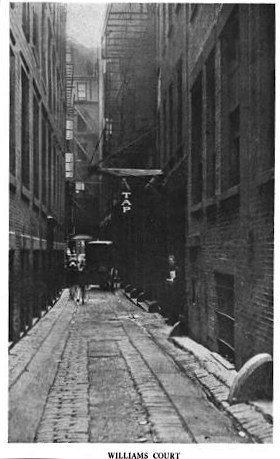
In 1853, the historic Bell In Hand tavern relocated to Pi Alley.
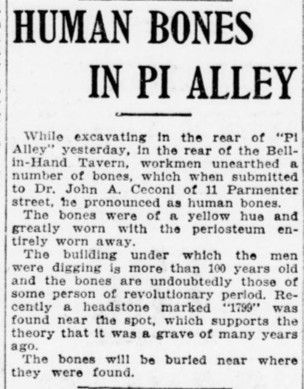
In December 1905, workers excavating behind the Bell In Hand tavern found human bones and a gravestone dating to 1799. It was theorized that the area was once a graveyard or a family tomb at some point. The bones were planned to be reburied near where they were found, according to news reports at the time (“Human Bones in Pi Alley,” 1905).
In March of 1909, two men, John Brown, of Northwood, N.H., and William Kelly, of Philadelphia, were wounded and arrested after they got into a knife fight in Pi Alley.
Then in April of 1914, a Lynn man, Charles Toomey, died after he got into a fight with three men while loitering in Pi Alley.
On January 9, 1915, the Bell In Hand tavern officially closed due to plans to turn the site, known as the Niles Block, into an office building. The plan to demolish the building didn’t happen, though, for reasons unknown.
In August of 1918, a sailor from the USS Bell, Lewis Holt, shot himself in the hand after firing a revolver several times in Pi Alley. It is not known why he was shooting the gun or how he shot his own hand, but one eyewitness saw him firing the gun at a wall in the alley. Holt’s only explanation for his behavior was, “I have troubles of my own.”
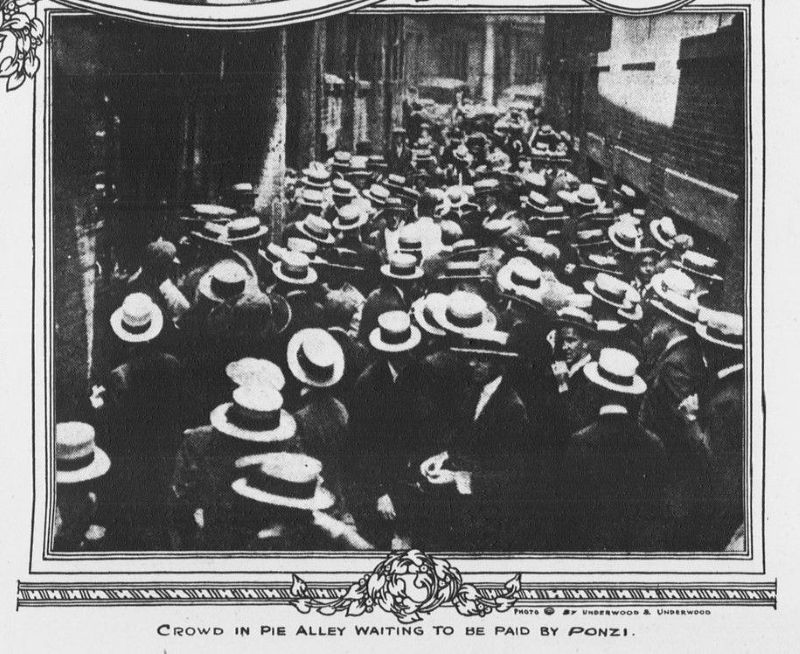
In 1920, Charles Ponzi began using the former Bell In Hand tavern building as a payout office for his securities exchange company. When news broke of his investment scheme, a hoard of nearly 1,000 investors crowded into Pi Alley, lining up outside the tavern to collect their payments (“Pi Alley Run Again in Full Swing,” 1920). Police later closed the office down.
In 1922, a sign was posted temporarily, for 48 hours, in Pi Alley stating that it was private property. The corporation that posted the notice, the Sumner Company, explained, though, that the sign is posted temporarily every 20 years to retain its property rights.
In December 1929, a man named Matthew Haggerty was beaten and robbed by four young men as he was walking through Pi Alley one morning. The men threw him to the ground and kicked him until he lost consciousness and then robbed him of about $50.
In 1950, a gas leak in Pi Alley killed one restaurant worker and sickened six others when a gas pipe broke and leaked gas into the nearby Purcell’s Restaurant near City Hall. The restaurant and other buildings in the immediate area were evacuated (“1 Dead, 6 Felled By Pi Alley Gas,” 1950).
In 1952, the Boston Public Works Department installed a sign in the alley that read “Pie Alley,” which caused a backlash from those who believe the lane is actually spelled Pi Alley instead (“Newspapermen Blast ‘Pie Alley’ Sign in Hub,” 1952).
The Public Improvement Commission officially named the street Pi Alley in 1955.
Sources:
“Human Bones in Pi Alley.” The Boston Post, 1 Dec. 1905, p. 11.
“Find More Human Bones in Famous “Pi Alley.” The Boston Post, 2 Dec. 1905, p. 5.
“Legal Battle O’er Pi Alley.” The Boston Post, 6 May. 1905, p. 13.
“Men in Knife Duel in Old Pi Alley.” The Boston American, 12 Mar. 1909, p. 7.
“Lynn Man Dies After Scuffle in Pi Alley.” The Boston Herald, 20 Apr. 1914, p. 16.
“Pie Alley Cafe Closes Doors.” The Boston Globe, 10 Jan. 1915, p. 14.
“’Pi Alley’ Shot Up, Perpetrator Hurt.” The Boston Globe, 8 Aug. 1919, p. 9.
“Hub’s New ‘Financial Lane’ Mecca For All.” The Boston Traveler, 29 Jul. 1920, p. 7.
“Ponzi Bothered None at All By Accounting.” The Boston Traveler, 29 Jul. 1920, p. 6.
“Pi Alley Jammed With Excited Mob.” The Boston Traveler, 2 Aug. 1920, p. 1.
“Ponzi’s Office Besieged.” The Boston News Bureau, 3 Aug. 1920, p. 4.
“Pi Alley Run Again in Full Swing.” The Boston Traveler, 3 Aug. 1920, p. 1.
“Ponzi Pays, Smiling, As Pi Alley Rages and Mob Beats Door.” The Boston Herald, 3 Aug. 1920, p. 1.
“Pi Alley.” The Sun and the New York Herald, 18 Aug. 1920, p. 8.
“PI or Pie?” The Sun and the New York Herald, 24 Aug. 1920, p. 6.
“20 Years Up, Boston’s Pi Alley Again Closes.” The New York Herald, 11 Jan. 1922, p. 14.
“Pi Alley Posted as Private Way.” Lewiston Evening Journal, 10 Jan. 1922, p. 1.
“Famous Pi Alley Private Property.” The Boston Globe, 10 Jan. 1922, p. 9.
“Pi Alley to Still Continue Doing Business Despite Warning Signs.” Biddeford Daily Journal, 10 Jan. 1922, p. 1.
“Historic Sites for Thompson’s Spa.” The Boston Post, 7 May. 1922, p. 38.
“Man Robbed in Pi Alley.” The Boston Post, 9 Dec. 1929, p. 7.
“When Grandma Was a Girl.” The Boston Post, 10 Feb. 1950, p. 24.
“1 Dead, 6 Felled By Pi Alley Gas.” The Boston Record, 24 Oct. 1950, p. 3.
“One Dead, Six Felled By Gas.” The Boston Post, 24 Oct. 1950, p. 1.
“Cave-In Blamed for Fatal Gas Leak in Pi Alley.” The Boston Globe, 24 Oct. 1950, p .31.
“Gas Kills Cook.” Fall River Herald News, 24 Oct. 1950, p. 14.
“Heart Trouble Contributed to Pi Alley Death.” The Boston Globe, 25 Oct. 1950, p. 7.
“Newspapermen Blast ‘Pie Alley’ Sign in Hub.” The Boston Post, 9 Jun. 1952, p. 3.
“Pi Alley Unpied Officially After All These Years.” The Boston Globe, 17 Feb. 1955, p. 1.
“Newspaper Rows Historic Lane All Pied Up Again.” The Boston Globe, 18 Feb. 1955, p. 17.
“Pi Alley.” The Boston Post, 20 Feb. 1955, p. 82.
“Post Buildings to be Razed for Parking Lot After Jan 1.” The Boston Globe, 22 Nov. 1957, p. 3.