
The Bell in Hand is a historic tavern on Union Street in Boston, Massachusetts. Established in 1795, by town crier Jimmy Wilson, it is one of the oldest taverns in Boston.
Wilson started the tavern when he retired as the town crier and named the establishment after his old job. It was originally located in the basement of the Exchange Coffee House on Congress Street.
Patrons who reportedly drank at the tavern include Daniel Webster and Paul Revere. Wilson refused to sell hard liquor, so the tavern only served Smith’s Philadelphia Cream Ale until 1919.
In 1853, the tavern relocated to Williams Court/Pi Alley, where it became a popular hangout for bankers, Harvard professors, news journalists, and writers from the nearby Newspaper Row and financial district.
In 1905, an excavation was conducted in the rear of the Bell In Hand tavern in Pi Alley that uncovered several human bones and a gravestone dated 1799. It is believed that the alley was once the site of a family tomb or graveyard (“Find More Human Bones in Famous ‘Pi Alley,’” 1905).
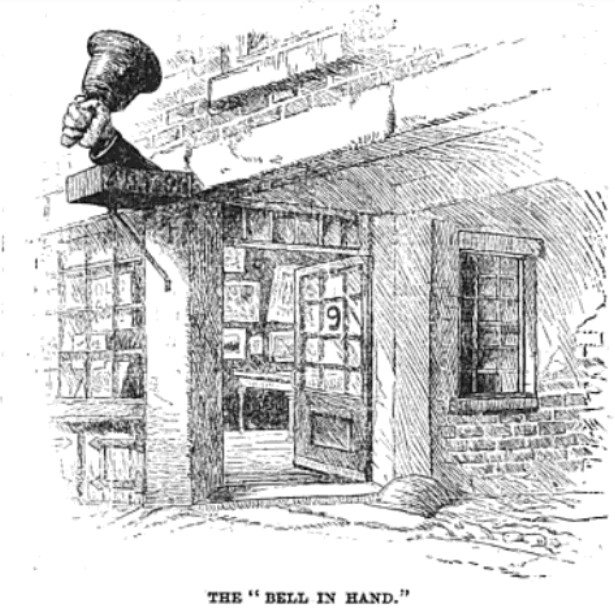
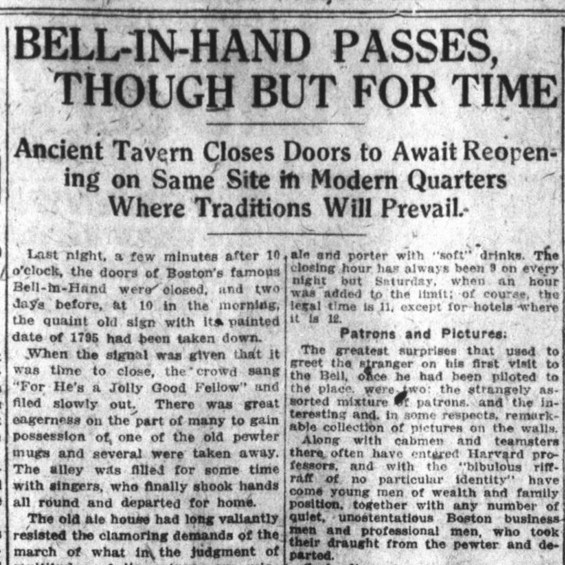
On January 9, 1915, the Bell In Hand tavern officially closed due to plans to turn the site, known as the Niles Block, into an office building.
On the tavern’s last day in operation, patrons made their way from all over to visit it one last time. At last call, they reportedly began singing “For He’s a Jolly Good Fellow” and slowly filed out (“Bell-In-Hand Passes,” 1915).
The old wooden sign of an upraised hand holding a bell that hung above the tavern was removed two days prior to the tavern’s closure and was loaned to Bostonian Society who put it on display at the Old State House. The sign is about two and a half feet tall and is painted with a light flesh tone for the hand and a copper color for the bell.
According to various news reports in the Boston Post, the Herald, and the Globe, the owner at the time of its closure, Daniel J. O’Connell, planned to move the tavern back into the new building after it was constructed. For reasons unknown, the building was not torn down as planned, and the tavern never reopened.
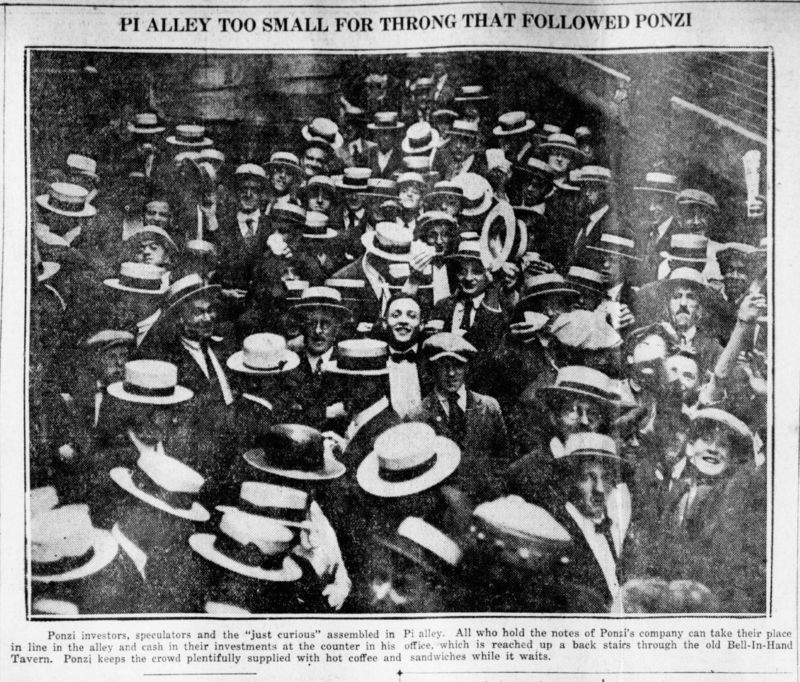
In 1920, Charles Ponzi began using the old Bell In Hand tavern building as a temporary cashier’s office for his Securities Exchange Company (“Ponzi Makes Big Profits By ‘Run,’” 1920).
When news broke of Ponzi’s investment scheme in July, his clients crowded into Pi Alley, lining up outside the tavern to collect their payments, and the police soon closed down the office while they conducted their investigation.
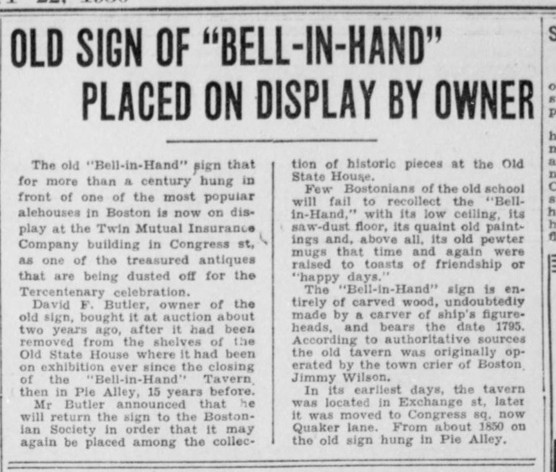
In 1928, items from the Bell In Hand tavern were sold at auction, including a collection of old pewter mugs, portraits of historical figures, and the tavern’s old sign, which was sold to a man named D.F. Butler for $255, who indicated he would loan it back to the Bostonian Society. All of the items sold brought about $1000.
In 1930, Butler put the sign on display at the Twin Mutual Insurance Company building on Congress Street in Boston for the city’s Tercentenary celebration. Butler said he would return the old sign to the Bostonian Society after the celebration.
In 1934, the tavern reopened on Devonshire Street, where it hung a copy of the tavern’s original sign above the new location. The building was owned by Harvard College, who leased it to Bell In Hand, Inc. (“Bell-In-Hand Reopens,” 1920).
After the tavern reopened, a local liquor business in Cambridge, also operating under the name Bell In Hand, sued the tavern, stating that it had a legal right to the name because it had been abandoned for over 18 years when the tavern went out of business. It’s not clear what the outcome of the lawsuit was.
The Bell In Hand tavern later moved to its current location on Union Street sometime in the 1950s, according to an article in Boston Magazine.
In December 1961, a thief stole $800 from the tavern’s cash registers in a planned robbery. An employee tipped off the police that a robbery was going to occur that night, prompting the police to ask the employee, Vincent Ciolla, to go along with the plan to smuggle the robber into the tavern’s cellar that afternoon. Police then set a trap for the robber, Bernard Zinna, but he escaped. Zinna was later arrested at his home (“Police Trap Fails,” 1961).
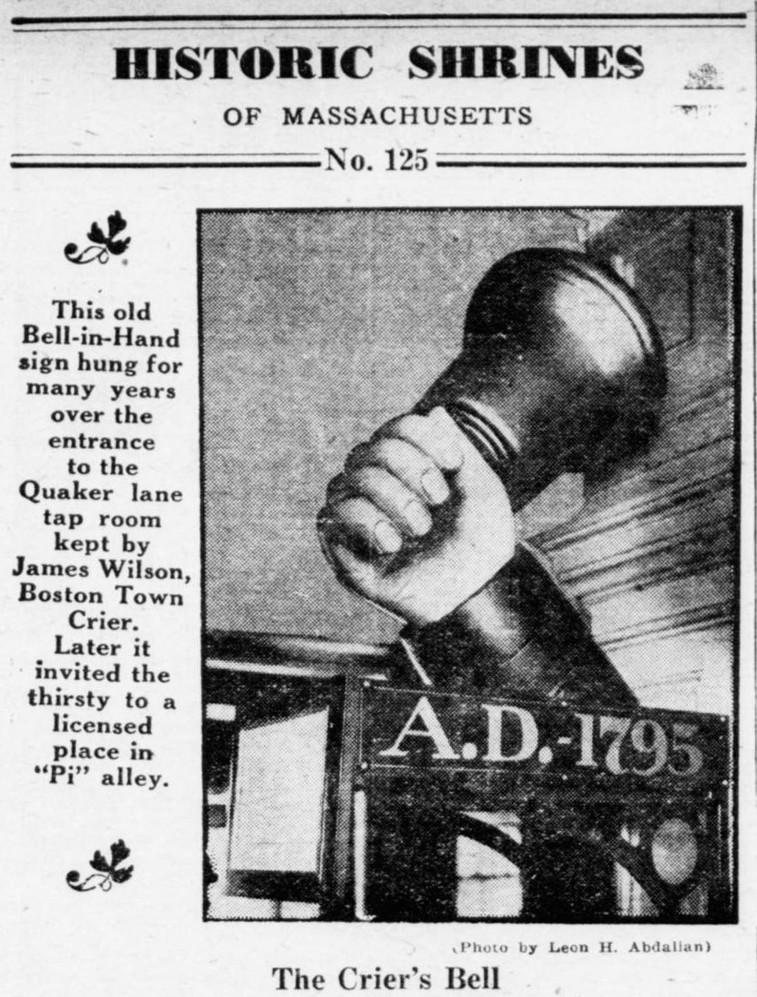
The original Bell In Hand sign is still archived at the Old State House Museum (formerly the Bostonian Society).
Today, the Bell In Hand tavern is managed by Eddie and Bryna Kaplan.
Sources:
“Our Story.” Bell In Hand, thebellinhand.com/about
“Proclamation of the ‘Bells’ Journey: Oldest Tavern in the United States.” Historical Marker Database, hmdb.org/m.asp?m=115270
“The Bell-in-Hand.” Historical Marker Database, hmdb.org/m.asp?m=176012
“Taverns in Boston.” The Boston Times, 24 Jul. 1881, p. 2.
“Find More Human Bones in Famous “Pi Alley.” The Boston Post, 2 Dec. 1905, p. 5.
“The Old Bell-In-Hand Takes a Vacation.” The Boston Post, 10 Jan. 1915, p. 27.
“Bell-In-Hand Passes, Through But For Time.” The Boston Herald, 10 Jan. 1915, p. 4.
“Pie Alley Cafe Closes Doors.” The Boston Globe, 10 Jan. 1915, p. 14.
“Famous Boston Inn Closed.” The Vincennes Commercial, 4 Apr. 1915, p. 6.
“Famous Boston Inn Closed.” Ottawa Free Trader, 31 Mar. 1915, p. 4.
“Ponzi Makes Big Profits By ‘Run.’” The Boston Globe, 29 Jul. 1920, p. 1.
“Run On Ponzi Office At Boston Continues.” Santa Anna Daily Register, 3 Aug. 1920, p. 2.
“Big Run on Ponzi Office Has Subsided.” The Steubenville Gazette, 5 Aug. 1920, p. 1.
“Ponzi, Money Wizard, Proves Man of One Idea Wins.” The Sun and the New York Herald, 8 Aug. 1920, p. 41.
“Meet Bell-In-Hand.” The Boston Transcript, 14 Aug. 1920, p. 15.
“Boston Hits Baltimore’s I.O.O.F. Claim.” The Boston Advertiser, 3 Oct. 1920, p. 16.
“Relics of Bell-In-Hand Tavern are Dispersed in Brisk Auction.” The Boston Herald, 9 Jun. 1928, p. 5.
“Liquid Brotherhood Lacking, Bidding Low.” The Boston Globe, 9 Jun. 1928, p. 3.
“Historic Shrines of Massachusetts. No. 125. The Crier’s Bell.” The Boston Record, 19 Sept. 1930, p. 25.
“Old Sign of ‘Bell-In-Hand’ Placed on Display by Owner.” The Boston Globe, 22 May. 1930, p. 11.
‘Several Business Leases Negotiated.” The Boston Post, 3 Jun. 1934, p. 23.
“Bell-In-Hand.” The Boston Post, 10 Jun. 1934, p. 67.
“Bell-In-Hand Reopens Not Far From Old Site.” The Boston Globe, 9 Jun. 1934, p. 3.
“Legal Contest Over Name Bell-In-Hand.” The Boston Globe, 21 Jun. 1934, p. 19.
“Name ‘Bell-In-Hand’ Is Subject Of Suit.” The Boston Herald, 21 Jun. 1934, p. 3.
“’Bell-In-Hand’ in Litigation.” The Boston Post, 21 Jun. 1934, p. 19.
“Police Trap Fails But Revere Man Nabbed in Theft.” The Boston Globe, 15 Dec. 1961, p. 21.
Buell, Spencer. “Can Any of Boston’s ‘Oldest Continuously Operating’ Landmarks Keep the Title?” Boston Magazine, 1 Mar. 2021, bostonmagazine.com/news/2021/03/01/continuously-operating-record/