
Haywardville was a mill village located in Stoneham, Massachusetts, in the 19th century.
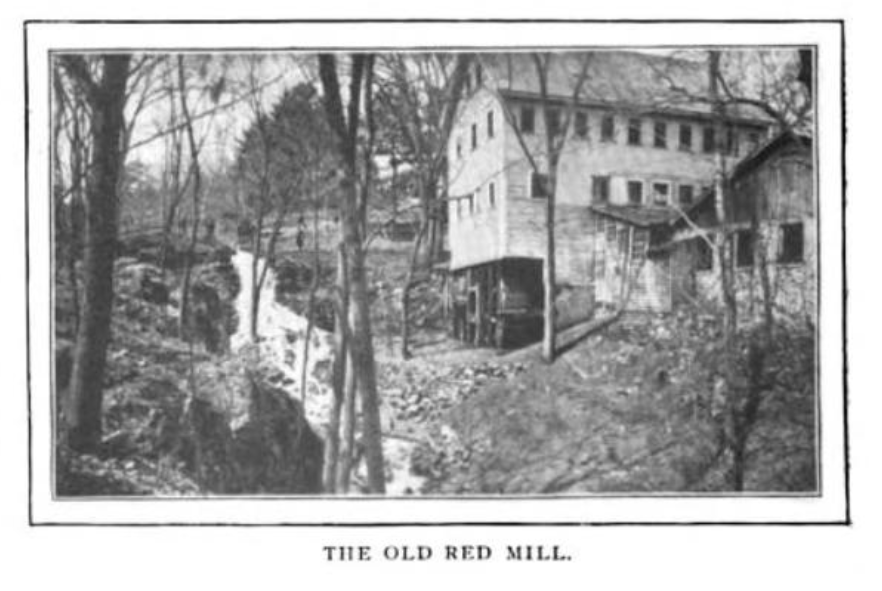
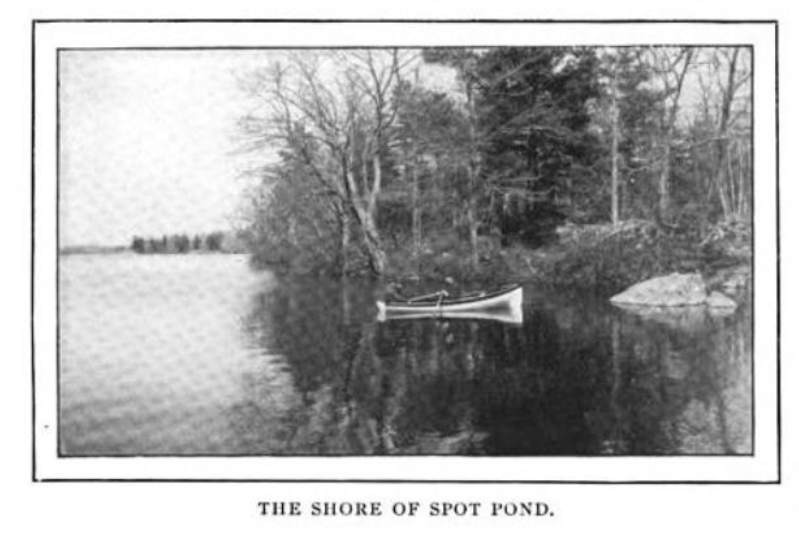
The first known settler of the area was James Barrett, who built a sawmill in 1706 along a brook that flowed into Spot Pond. After the timber supply was exhausted, the sawmill was converted into a grist mill.
In 1792, William Nicklefield erected a snuff mill along the brook about half a mile east of the original grist mill, and Thomas Rand built a chocolate mill along the brook in 1798.
In 1811, the Hurd family built a spice mill there as well. A few years later, in 1813, Stephen Buckman sold a parcel of land at the corner of Pond Street and Wyoming Ave to a man named Barrett, who built a mill there shortly after.
In 1830, Ebeneezer Bucknam built a road connecting Pond Street to the center of this industrial area. Bucknam’s house and barn stood at the end of this road next to Pond Street.
Sometime around 1840, Barrett died, and his son later sold his property to Elisha Converse in 1848. Converse started a rubber company in the existing building on the property and also built two or three small buildings on the lot.
Sometime between 1845 and 1848, the William Bailey Lang house, an Italianate-style stone house, was built on the eastern shore of Spot Pond.
In 1849, the John Botume house, an Italianate-style stone house, was built by William Foster, Jr. along the eastern shore of Spot Pond.
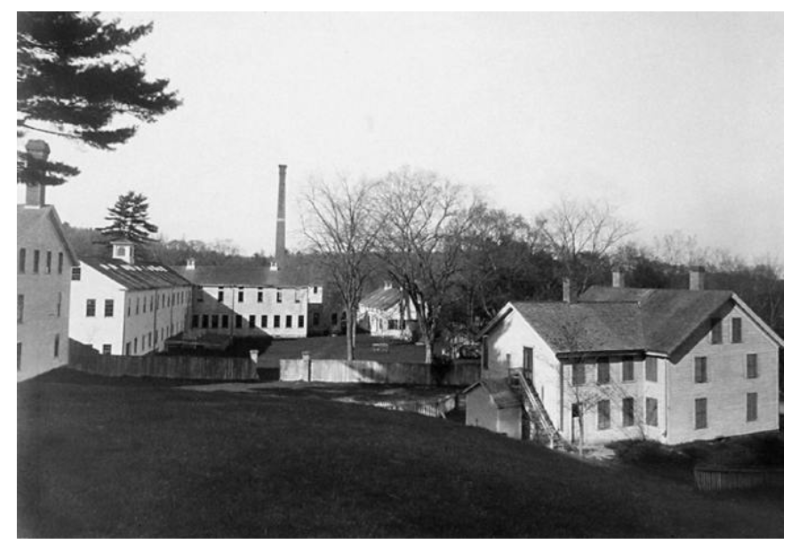
In 1858, Nathaniel Hayward bought the Converse Mill property. He constructed many new buildings on it and improved the property extensively.
By 1860, Hayward had 17 acres of land he called Haywardville, upon which he had two houses on Pond Street, a rubber factory, a gasworks, an office building, barn, ice house, and the Smith Shop.
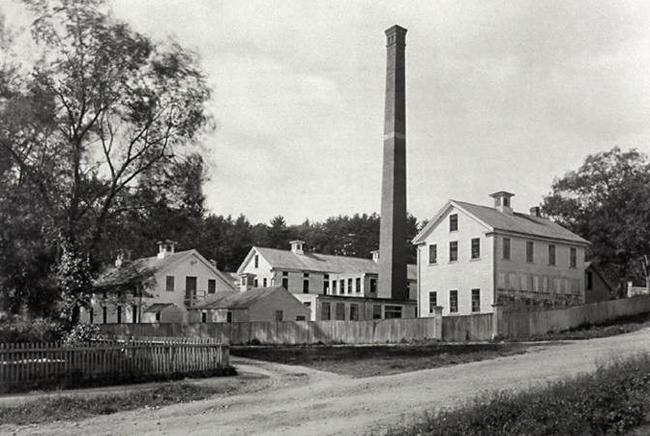
A six-tenement house was also constructed on Pond Street to provide housing for workers, and a general store was established on the opposite corner of the tenement house so workers could purchase supplies.
In October of 1864, a worker at Hayward’s rubber factory suffered a fatal accident when his right arm and left shoulder were crushed and lacerated by the cylinders while rolling rubber (“Fatal Accident in Stoneham,” 1864).
On April 2, 1870, the towns of Medford, Malden, and Melrose took away Haywardville’s water rights when they voted to convert Spot Pond into a reservoir, which essentially put the mills in Haywardville out of business.
The mill owners sued and won a small settlement from the three towns after a 10-year-long court battle. The Hurd & Grundy mills won $1,000, the Haywardville Rubber Company won $14,679, and William Barrett and Philander Ames also both won settlements (“Land Around Spot Pond,” 1891).
Some of the mill buildings were relocated to Ravine Terrace, Wyoming Ave, Fells Court, and Brook Street in Stoneham.
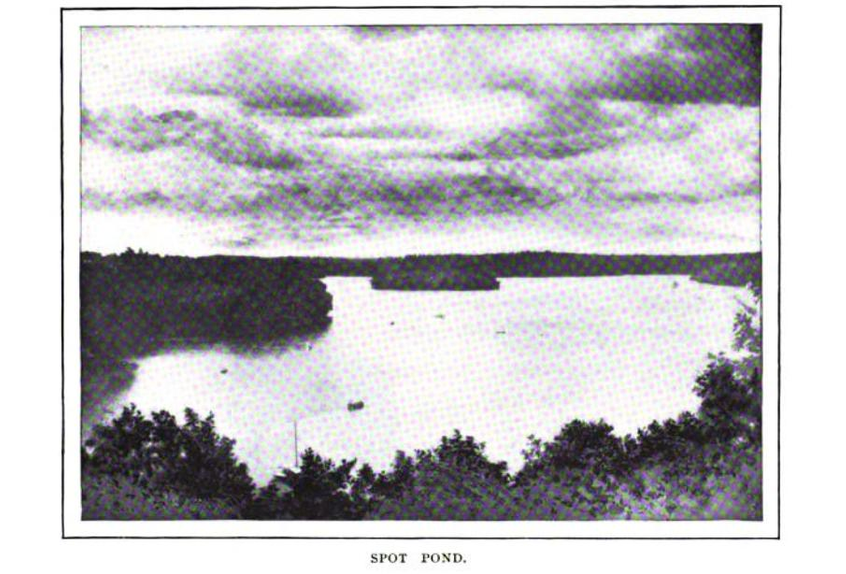
Spot Pond was, unfortunately, the scene of a few accidents over the years. On June 10, 1877, a 22-year-old man from Melrose, John Colligan, drowned in Spot Pond after his boat capsized while he was sailing with friends.
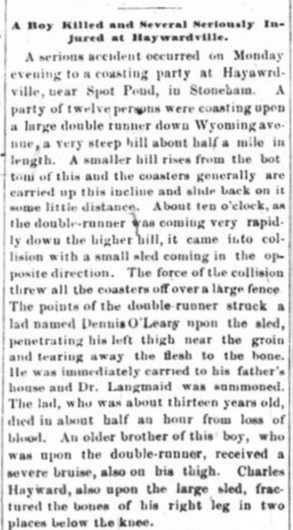
In January of 1884, Haywardville made national news when one person was killed and several others were seriously injured in a fatal sledding accident at Spot Pond when two sleds collided with each other (“Fatal Coasting Accident,” 1884).
In July of 1888, a 10-year-old boy, Charlie Berg, drowned in Spot Pond. The boy was an employee of W.H. Mace, the boathouse keeper at Spot Pond, and was rowing from the boathouse to the icehouse when he lost his balance and fell overboard. A rescue party searched the pond and found Berg under the water a half hour later and tried unsuccessfully to resuscitate him.
In 1894, Haywardville was purchased by the Commonwealth of Massachusetts for use as Middlesex Fells Reservation, and all of the old buildings and foundations were torn down, the cellar holes were leveled off, and the mill dams were rebuilt in 1896.
On April 13, 1984, the John Botume house was added to the National Register of Historic Places and now serves as the visitor center of the Middlesex Fells Reservation.
In 1986, the William Bailey Lang House was slated for historic preservation, but a developer secretly demolished the historic house in the middle of the night. It was one of the last existing houses of Haywardville.
On July 24, 1992, the Spot Pond Archeological District was added to the National Register of Historic Places.
All that remains of Haywardville now is the old foundation to the rubber factory, some stone walls, and the John Botume house. The site of the village is accessible by trail, and trail maps are available at the visitor center in the John Botume House.
Sources:
“Historic Area Detail: STN.A Spot Pond – Haywardville.” MACRIS, mhc-macris.net/details?mhcid=STN.A
“Historic Building Detail: STN.1 Lang, William Bailey House.” MACRIS, mhc-macris.net/details?mhcid=stn.1
Rathsmill, Victoria. “Middlesex Fells: Haywardvill Returns from the Past.” Wicked Local Malden, 23 April 2014, malden.wickedlocal.com/article/20140423/News/140429134
“Fatal Accident in Stoneham.” Charlestown Advertiser, 8 Oct. 1864, p. 3.
“Drowning Accident in Stoneham.” The Boston Herald, 11 Jun. 1877, p. 4.
“Fatal Coasting Accident.” New York Times, 16 Jan. 1884, p. 5.
“A Boy Killed and Several Seriously Injured at Haywardville.” Melrose Journal, 19 Jan. 1884, p. 3.
“Drowned in Spot Pond.” The Melrose Reporter, 21 Jul. 1888, p. 3.
“Land Around Spot Pond.” Stoneham Independent, 5 Dec. 1891, p. 4.
“The Old Red Mills.” Stoneham Independent, 21 Apr. 1933, p. 7.
“Stoneham’s Lost Village Was Alive with Industry.” Stoneham Press, 15 Nov. 1946, p. 61.
MacAllister, Joe. “Stoneham Was the Birthplace of Many Modern Manufacturing Ideas.” Stoneham Press, 20 Jan. 1955, p. 5.
“Stoneham had the First Factories in the Haywardville Section.” Stoneham Press, 3 Feb. 1955, p. 4.
“Spot Pond Brook Gave Life to Early Village of Haywardville.” Stoneham Press, 24 Mar. 1955, p. 4.
“Thriving Community Once Existed in Middlesex Woods.” The Melrose Free Press, 4 Oct. 1962, p. 17.
MacAllister, Joseph. “Stoneham Historical Society Made Tour of Haywardville.” Stoneham Independent, 6 Jun. 1963, p. 3.