
According to legend, Tuggy Noyse was a woman from Byfield, Massachusetts, in the late 18th century who was suspected of being a witch.
A story about Tuggy was published in various newspapers, although it seems to have originated in the Boston Bee newspaper, in the mid 19th century by a person named Syphax.
It’s not known who Syphax is, but the person claimed to have read an entry in a journal from 1789, which was then in the possession of the Digby family, describing Tuggy and her alleged witchy activities.
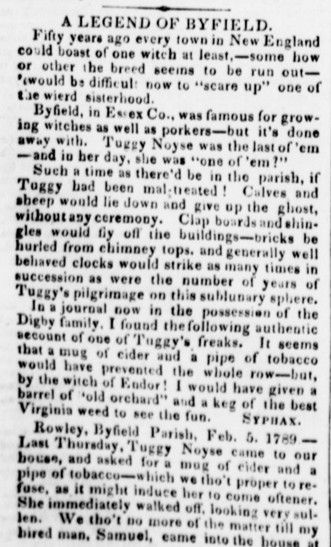
It’s not known whose journal it is, although it most likely belonged to an ancestor of the Digby family, but the entry is dated February 5, 1789, and it explains that Tuggy came to their house the previous week and begged for a mug of cider and a pipe of tobacco.
When the writer of the journal refused, fearing that it might encourage Tuggy to come back begging again, Tuggy immediately walked off looking sullen.
That night, their farm hand, Samuel, came to the house and said he couldn’t get the oxen to walk past Tuggy’s house to return to the barn.
The writer said he immediately went to assist in the matter and found his oxen in the middle of the road still attached to the sled they were pulling. Unable to get them to move, the writer said he went back to his barn to get another pair of oxen but found that they refused to move as well.
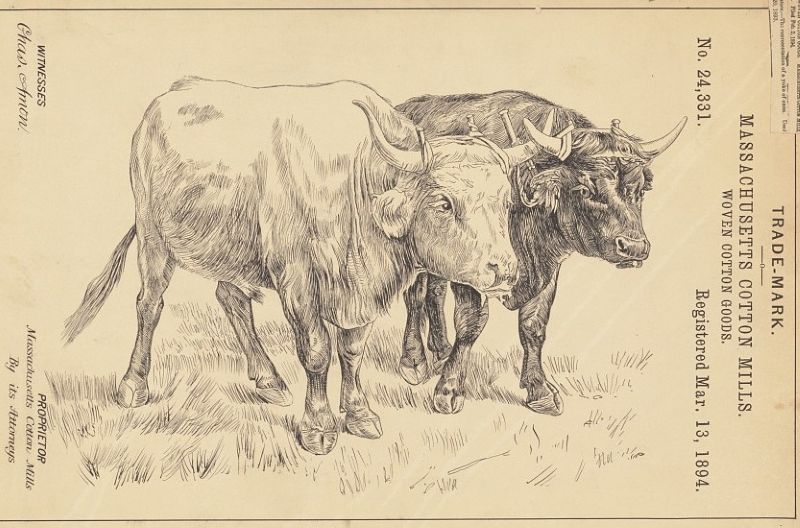
While whipping and goading the oxen to get them to move, Tuggy reportedly appeared at the door of the barn. She lifted her finger in the air and the oxen suddenly stood straight up on their hind legs.
When Tuggy then inverted her finger, the oxen suddenly stood on their horns, with their hooves and tails in the air. Then, Tuggy waived her finger in the air in a circle, and the oxen spun in the air, while balancing on one horn, and whirled around at such a speed that it caused the other cattle in the barn to scatter in fear.
The article states that Tuggy was notorious for this type of behavior and that anytime someone mistreated her she would wreak havoc on them, such as by killing their livestock, making shingles and clapboards fly off houses, causing brick chimneys to collapse, and making clocks to strike and chime the number of years Tuggy had been alive.
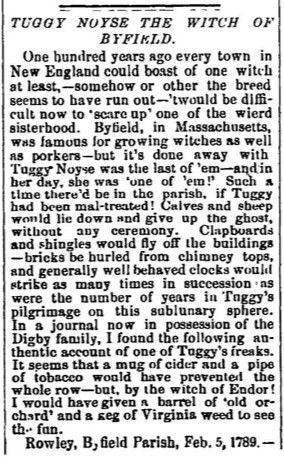
The strange story was published in the various newspapers in 1847 and was then republished yet again in a Rhode Island newspaper in 1882. Then, in the 1960s, the story also appeared in some journals and books about folklore and legends.
There doesn’t seem to be any historical record for anyone named Tuggy Noyse, though, in Byfield or Newbury, yet there was a Noyes family living in Byfield at the time. It’s possible the last name was just misspelled or that it was a variation of the name. It seems that Tuggy Noyse and her witchy behavior remains a mystery to this day.
Sources:
Carey, George Gibson. Folklore in the Writings of John Greenleaf Whittier. Indiana University, 1965.
Morris, Alton Chester. Southern Folklore Quarterly. University of Florida, 1968.
“The Legend of Byfield.” Republican Herald, 26 Jun. 1847, p. 4.
“A Legend of Byfield.” Pontiac Jacksonian, 21 Jul. 1847, p. 2.
“Tuggy Noyse The Witch of Byfield.” The Spirit of Democracy, 4 Sept. 1847, p. 4.
“A Legend of Byfield.” The Southern Whig, 29 Jul. 1847, p. 1.
“A Legend of Byfield.” Windham County Telegraph, 11 Apr. 1850, p. 1.
“Tuggy Noyse The Witch of Byfield.” Pawtucket Valley Gleaner, 4 Nov. 1882, p. 1.