
Byfield, Massachusetts, is a village within the town of Newbury. It is notable for being the home of Governor William Dummer, who lived on a farm there in the 18th century. It was also once home to several mills and factories in the 19th and early 20th centuries.
18th Century Byfield:
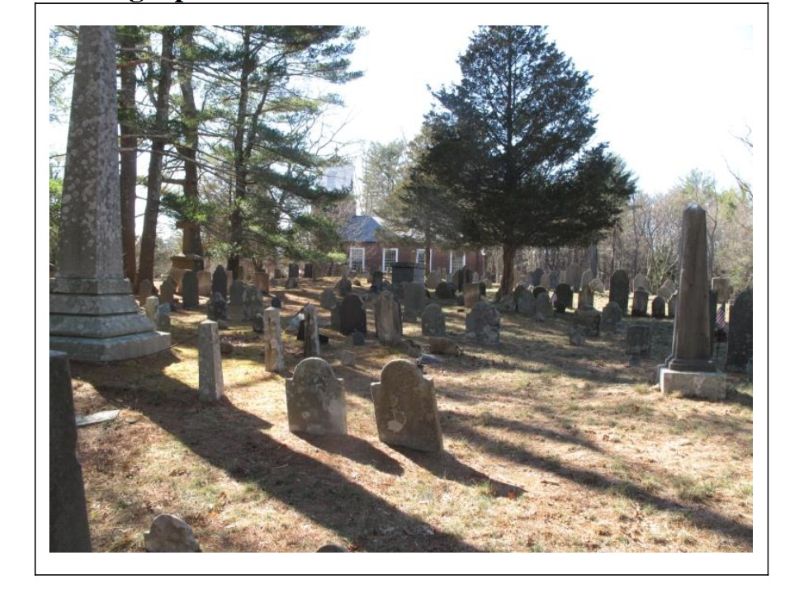
Sometime around 1702, the Old Byfield Parish Cemetery was established on Warren Street. The cemetery stands in both Georgetown and Newbury and contains 420 graves and two tombs. A meetinghouse was also constructed in the village in 1702.
In 1704, the Abraham Adams House, a First Period timber-frame house, was built for a local sea captain and shipbuilder named Captain Adams on Pearson Drive in Byfield.
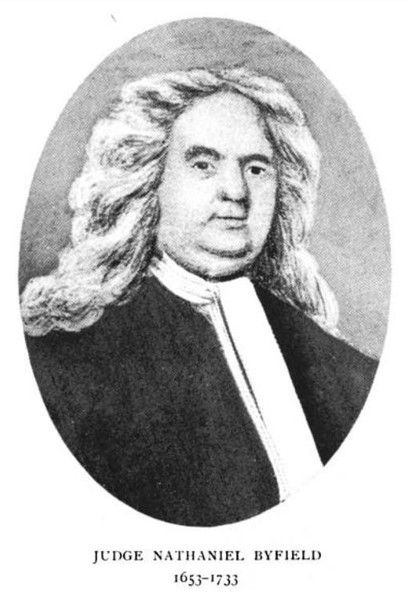
On October 28, 1710, the village of Byfield was incorporated by the General Court and was named after Judge Nathaniel Byfield.
In 1715, the William Dummer Mansion House was constructed on Elm Street in South Byfield. Local legend says that when the mansion was completed, Dummer charged on horseback up the broad staircase to the second floor (“Glories of Colonial Period,” 1914).
In 1761, William Dummer died a childless widower. In his will, he bequeathed his mansion and 300-acre farm for the establishment of a prep school.
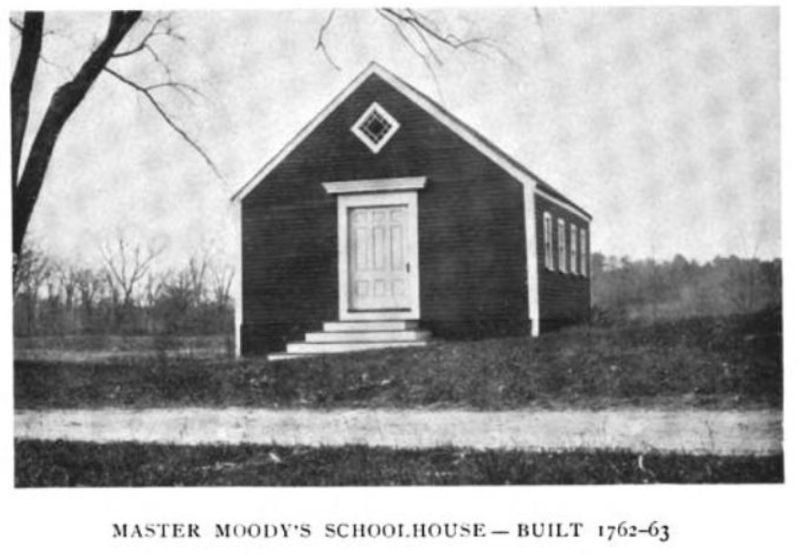
A few years later, on March 1, 1763, the Governor Dummer Charity School was officially established when the schoolhouse on the Dummer farm, which was run by Sam Moody, opened to the public. The Dummer Mansion was used as a residence for the headmaster.
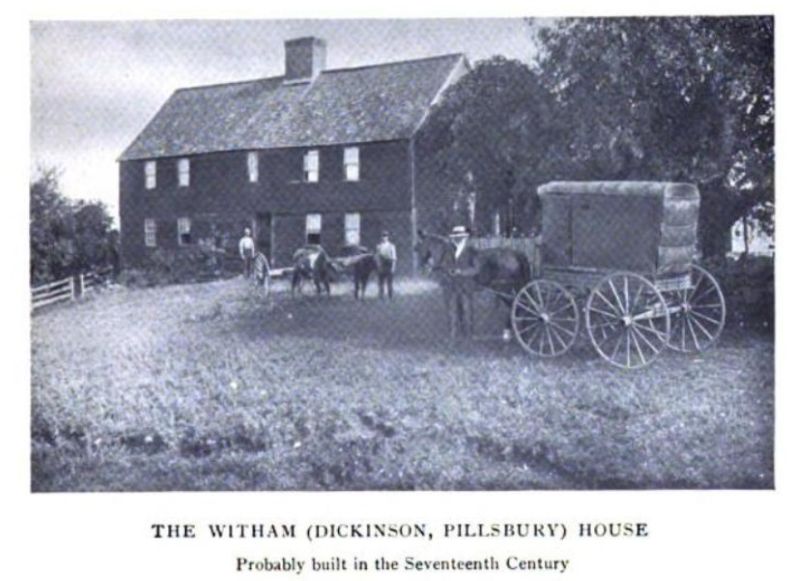
In 1780, one of the first shoe factories in Byfield was established after Paul Pillsbury invented the first wooden pegs used in shoemaking. He used the pegs to manufacture shoes at the Pillsbury Homestead in Byfield.
In 1782, the Governor Dummer Charity School was incorporated as Governor Dummer Academy.
In February of 1789, a local woman named Tuggy Noyse reportedly bewitched a local family’s oxen and made them levitate after she begged the family for some cider and tobacco and they refused.
The manufacturing industry in Byfield continued to grow when the first carding machine in the United States was put into operation there in 1793, and the first woolen mill to be operated successfully by power was built there in 1794.
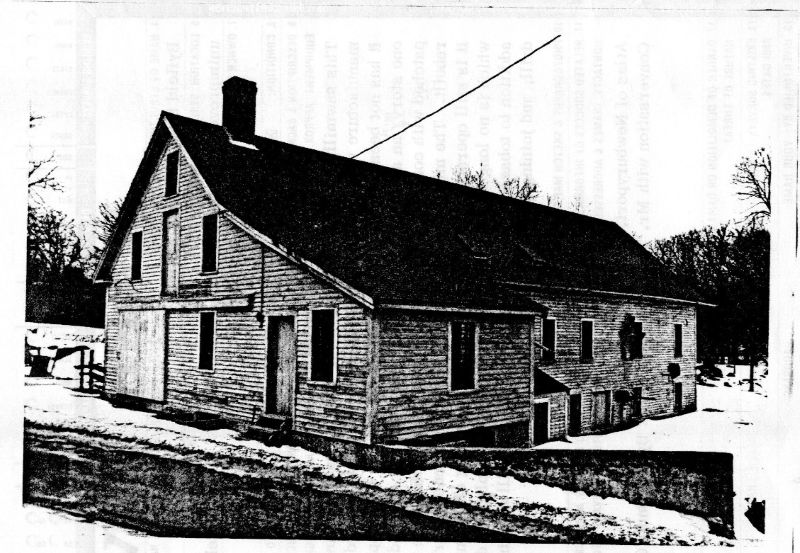
Sometime in the 18th century, a sawmill was established on Larkin Road, which was later converted into the Byfield Snuff Company Mill No. 1 in 1804. The mill was about 45 feet by 20 feet in size with two stories and an attic.
19th Century Byfield:
In 1806, yet another school was established in Byfield when Reverend Joseph Emerson opened a girls’ school called the Byfield Female Seminary. Reverend Emerson served as the principal of the school until 1821, when he moved the school to Saugus.
In 1830, the Pearson family purchased the Byfield Snuff Company Mill No. 1. That same year, a sawmill was built on Lower Main Street which was later purchased by the Pearson family and converted into the Byfield Snuff Company Mill No. 2 in 1860.
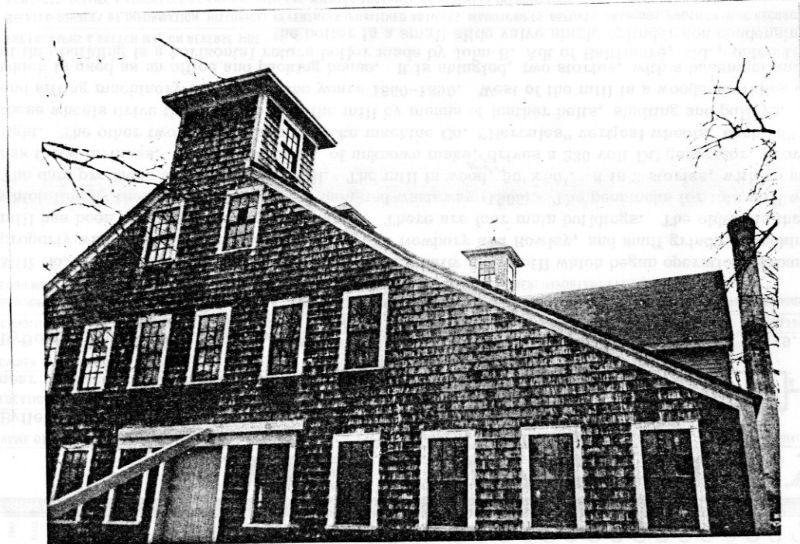
In the winter of 1832, the old meetinghouse burned down and had to be rebuilt, this time with a square tower instead of a steeple.
In 1840, the Friendly Market, a Greek Revival-style building that served as a grocery store, was constructed on Main Street in Byfield.
Another sawmill was constructed on River Street in 1860. It was later purchased by the Byfield Snuff Company in 1870. It was used to manufacture veneer until the 1930s, after which it was converted into a tobacco grinding facility. The mill is a one-story, wood-frame building with an attached wheelhouse.
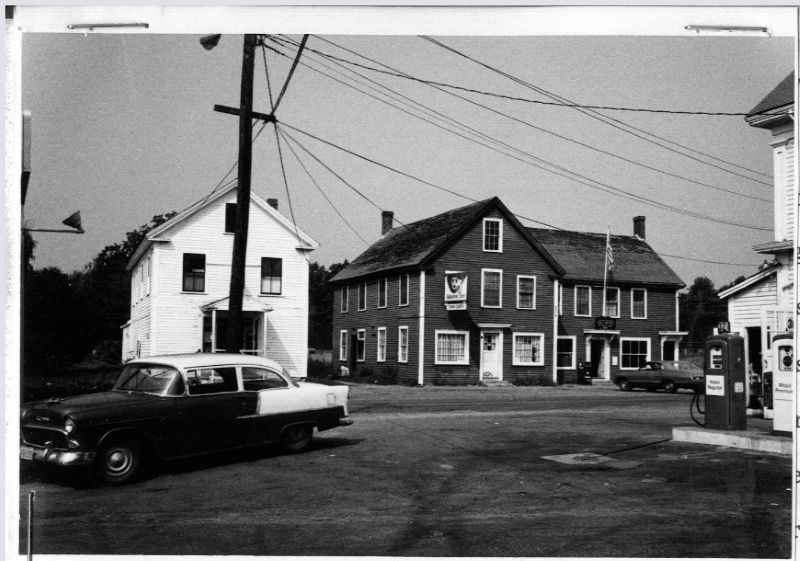
In 1870, the Byfield Center Branch of the U.S. Post Office was built on Main Street. It was a wood-frame, clapboarded Victorian Eclectic-style building.
In May of 1875, a local man named William Russell was arrested for killing his mother and wounding his father and two brothers with a knife. Russell, a widower with two children who had been living at home with his parents, had allegedly come home intoxicated at 2 a.m. and violently attacked the family.
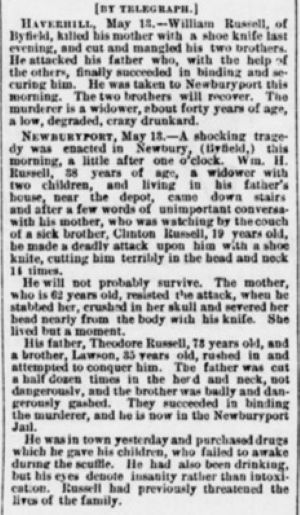
Russell was put on trial in November and pronounced insane. Some news reports state he was sent to the Taunton Insane Asylum while others say he was sent to the Worcester Insane Asylum (“The Byfield Murderer,” 1875).
In May of 1882, one of many accidents occurred at the Byfield Woolen Mills when a 30-year-old employee named Charles Longfellow lost his hand and suffered a broken arm in an accident at the mills.
In November of 1893, the Byfield Woolen Mills was sold to Jacob F. Brown at auction after the business, which was owned by the Ewing Bros, failed that summer. The property featured 13 tenement houses, three acres of land, and the mill building, and was valued at about $40,000.
In 1895, the new owners of the Byfield Woolen Mills enlarged and improved the plant, installing a new engine and switching from steam power to water power.
20th Century Byfield:
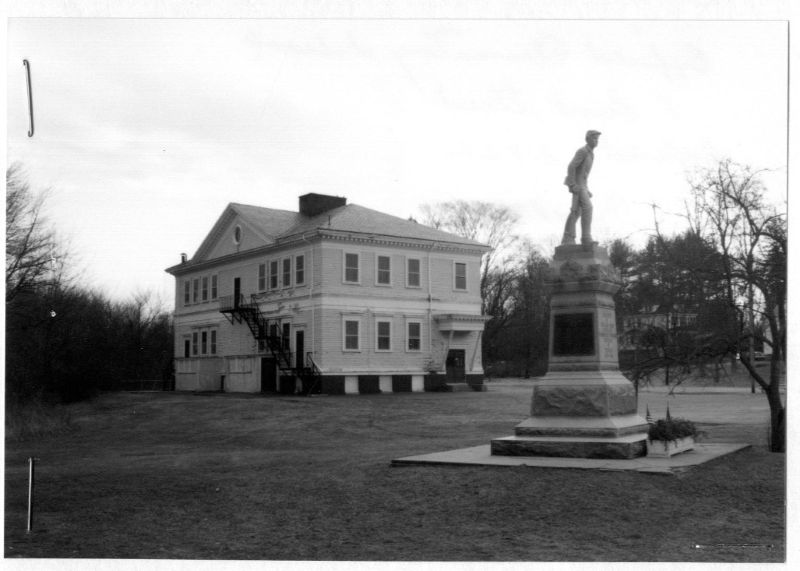
In 1901, the Byfield Elementary School, a two-story Colonial Revival-style building, was built on Lunt Street. It was designed by noted architects Cooper and Bailey and is a timber frame clapboard building that still stands today.
On December 19, 1911, a worker at the Byfield Woolen Mills, 35-year-old Antonio Belfatto [Bellofatta], was killed instantly when his head was crushed after a rope lifting a piece of machinery broke and it fell on him. His widow, Nicoletta, later sued the mill over his untimely death.
In October of 1913, another employee at the Byfield Woolen Mills, Robert Churchill, lost his hand when it was torn from his arm while removing wool that had become jammed in a machine.
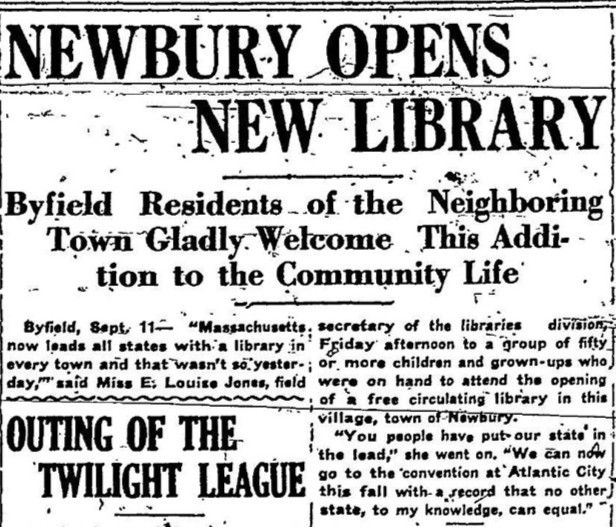
In September of 1926, the new town library opened in Byfield, which officially made Massachusetts the only state with a library in every town.
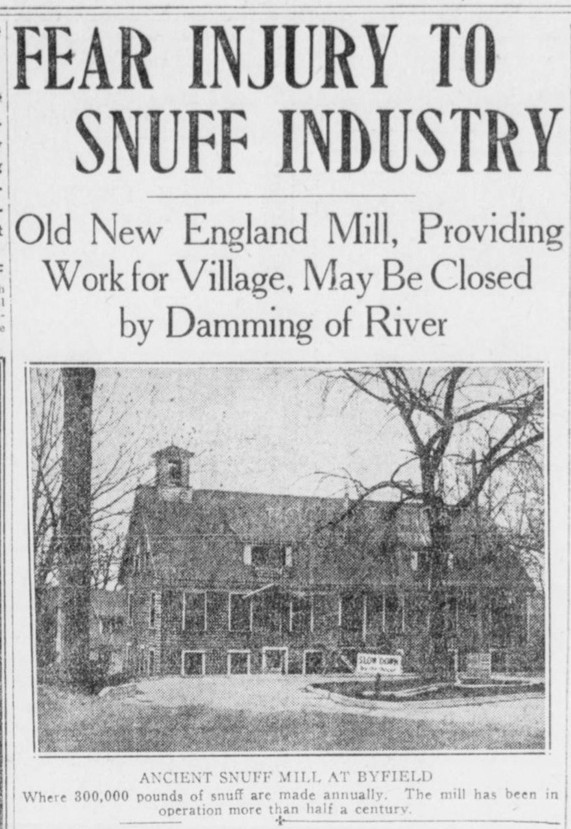
Operations of the Byfield Snuff Company mill were put into jeopardy in 1929 by plans to dam the Parker River so the upper part of the river could be used for fish propagation.
The mill relied on water power from the Parker River for the grinding and pulverizing of tobacco, and the company argued that losing access to that water would be detrimental to the business. It’s not clear from news reports what happened to the case, but the snuff mill continued operations.
In 1930, the current brick Byfield Church was built next to the Old Byfield Parish Cemetery. That same year, the Byfield Woolen Mills closed down, and the 200 employees at the mill lost their jobs. The only mill that remained in operation in Byfield at the time was the Byfield Snuff Company mill:
“Business in the village is very quiet as the felt mills are closed down and the only industry left is the Byfield Snuff Co which employs about 25 hands. A larger number are forced to find work out of town and it is earnestly hoped by a large number of townspeople that something be done to introduce new industries into the village to relieve the situation.” (Newburyport Daily News 1932)
The Byfield Woolen Mills were destroyed in a fire of undetermined cause in August of 1932. A total of four buildings were destroyed in the fire: the main mill building, a storage house, engine room, and blacksmith shop.
In 1941, the Boston and Maine western division railroad line to Topsfield was closed, making it impossible for local farmers and the snuff mill to bring supplies to the Byfield station by freight car. Byfield Snuff Co instead made plans to haul supplies by truck.
In May of 1942, state trooper Charles J. Collins was fatally wounded, and the alleged bandit Edward Rogers was instantly killed during a shootout in Byfield.
In 1951, historian Edward Snow published a book titled Tales of Buried Treasure in which he claimed that pirate treasure was buried in Byfield in the late 1700s.
According to various news reports at the time, locals had been digging in the area where the treasure was rumored to be for decades but had yet to find anything (“Treasure Hunters Dig for Decades,” 1951).
In 1953, the last burial took place at the Old Byfield Parish Cemetery.
In 1959, Byfield became the setting of a short story titled Snowball by Ursula Curtiss that was published in the Mystery Writers of America anthology The Lethal Sex.
On March 9, 1980, the Abraham Adams House was added to the National Register of Historic Places.
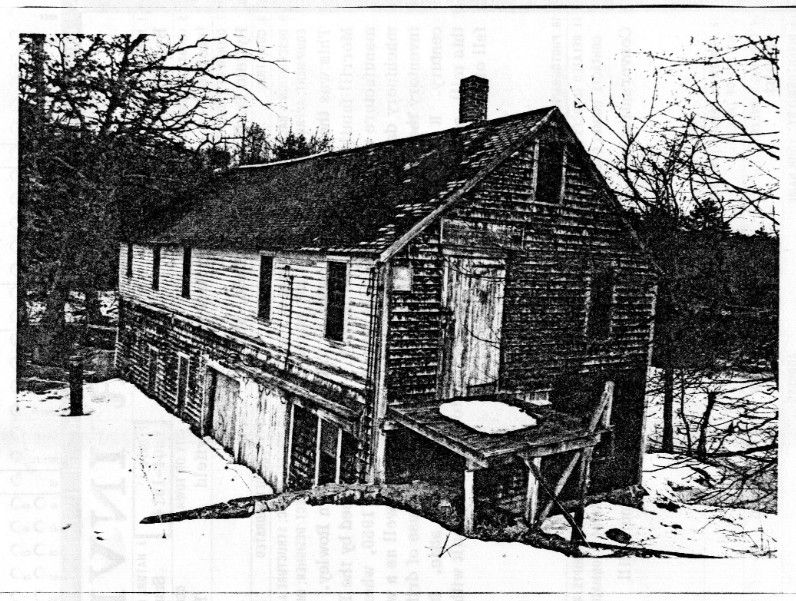
In 1986, the Byfield Snuff Company Mills closed down, officially bringing the manufacturing industry in Byfield to an end.
In 1998, the Byfield Elementary School closed after a larger school was built.
Sources:
Elwell, John Louis. The Story of Byfield: A New England Parish. George E. Littlefield, 1904.
“Byfield Seminary Collection.” Mount Holyoke and Hampshire College, aspace.fivecolleges.edu/repositories/2/resources/192
“Commercial.” Newbury Historical Commission, newbury1635.org/commercial
“Historic Burial Ground Detail: NEW.801 Old Byfield Parish Cemetery.” MACRIS, mhc-macris.net/details?mhcid=NEW.801
“Historic Building Detail: NEW.186 Byfield Snuff Company Mill #1.” MACRIS, mhc-macris.net/details?mhcid=NEW.186
“Historic Building Detail: NEW.187 Byfield Snuff Company Mill #2.” MACRIS, mhc-macris.net/details?mhcid=NEW.187
“Historic Building Detail: NEW.188 Byfield Snuff Company Sawmill.” MACRIS, mhc-macris.net/details?mhcid=NEW.188
“Historic Building Detail: NEW.307 Byfield Elementary School.” MACRIS, mhc-macris.net/details?mhcid=NEW.307
“Historic Building Detail: NEW.39 U.S. Post Office – Byfield Center Branch.” MACRIS, mhc-macris.net/details?mhcid=NEW.39
“Byfield Factory.” The Boston Courier, 15 Jul. 1848, p. 2.
“Terrible Tragedy. A Murder at Byfield, Massachusetts.” The Boston Traveler, 13 May. 1875, p. 2.
“Massachusetts. The Byfield Murder Inquest.” The Boston Transcript, 13 May. 1875, p. 9.
“The Byfield Murderer.” The Boston Globe, 16 Nov. 1875, p. 8.
“A Delightful Reunion.” The Georgetown Advocate, 23 Aug. 1884, p. 2.
“Massachusetts, Byfield.” Textile World, Nov 1893.
“Byfield Woolen Mills.” Salem Gazette, 9 Oct. 1893, p. 1.
“Byfield Woolen Mills.” Salem Gazette, 8 Jul. 1899, p. 4.
Evans, Arthur L. “Wooden Shoe-Pegs.” The Youth’s Companion, 28 Feb. 1907, p. 15.
“Employee at Woolen Mills Killed.” Newburyport Morning Herald, 20 Dec. 1911, p. 3.
“Head Crushed in Big Machine.” Newburyport Daily News, 19 Dec. 1911, p. 1.
“Hand Torn from Arm.” Newburyport Morning Herald, 11 Oct. 1913, p. 6.
“Hand Torn Off By Machine.” The Boston Herald, 11 Oct. 1913, p. 12.
“Glories of Colonial Period Retold in ‘Historic Homes.’” The Boston Herald, 20 Sept. 1914, p. 28.
Northend, Mary Harrod. “A Little New England Parish Tucked Away on the Newburyport Turnpike.” The Boston Transcript, 13 Aug. 1921, p. 38.
“Newbury Opens New Library.” Newburyport Daily News and Newburyport Herald, 11 Sept. 1926, 1.
“Fear Injury to Snuff Industry.” The Boston Post, 9 May. 1929, p. 11.
“Byfield.” Newburyport Daily News, 23 May. 1930, p. 2.
“Striking Changes in Bay State Industry.” The Boston Herald, 13 Sept. 1931, p. 92.
“Byfield Woolen Mills Burned.” The Boston Globe, 12 Aug. 1932, p. 5.
“Vacant Woolen Mill Burns at Byfield, Mass.” Nashua Telegraph, 12 Aug. 1932, p. 1.
“Fire Totally Destroys the Woolen Mills at Byfield.” Daily Evening Item, 12 Aug. 1932, p. 2.
“$200,000 Blaze at Byfield Mills.” The Boston Transcript, 16 Aug. 1932, p. 1.
“Byfield Woolen Mills Destroyed by Flames.” The Boston Globe, 13 Aug. 1932, p. 10.
“Closing of Railroad Line Will Affect Farmers and Snuff Company in Byfield.” Newburyport Daily News, 19 Jul. 1941, p. 6.
“State Trooper and Alleged Bandit Killed.” The Mount Pleasant News, 20 May. 1942, p. 1.
“Treasure Hunters Dig for Decades.” Hudson Daily Sun, 5 Feb. 1951, p. 4.
“In Essex County With William de Lue: The Great Treasure Hunt.” The Boston Globe, 26 Dec. 1951, p. 5.
“Snuff Made at Byfield.” Newburyport Daily News, 5 Aug. 1954, p. 14.