
The John Hale House is a historic Colonial-style house built for Reverend John Hale in Beverly, Massachusetts.
Built in 1694, it is a two-and-a-half-story, clapboard house with a ridge roof. Tradition states that the frame of Hale’s previous house, which was built across the street in 1665, was used in the construction of this house in 1694.
Hale was living across the street when he became involved in the Salem Witch Trials in 1692. Although he originally supported the trials, Hale later changed his mind after his wife was accused of witchcraft.
When one of the afflicted girls accused his wife in court one day, stating that Hale’s wife appeared as a bird on his shoulder in the courtroom, Hale rushed home to protect her from arrest. Fortunately, nothing came of the accusation.
It was in this house that Hale wrote his book A Modest Inquiry Into the Nature of Witchcraft in 1697, which is an important primary source on the Salem Witch Trials.
After Hale died on May 15, 1700, his eldest son Robert inherited the house. In 1745, Robert’s son, Colonel Robert Hale Jr., added a two-and-a-half-story gambrel wing to the front of the house.
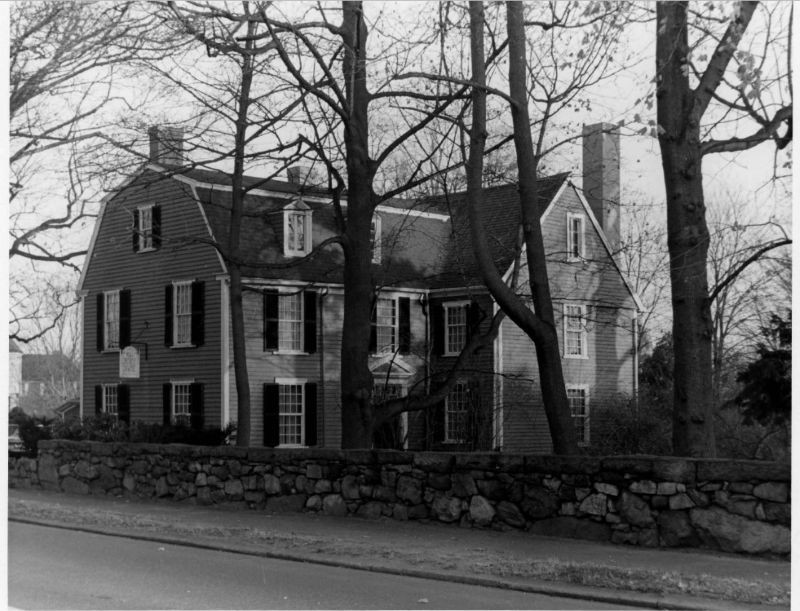
Hale Jr. also excavated the cellar, built an addition with two rooms upstairs and two rooms downstairs, and added a gambrel roof to the addition that allowed enough space for rooms on the third floor.
In 1859, three ancient beech trees were imported from England and planted in the back southwest corner of the property.
In 1881, Robert Hale Bancroft inherited the house from his mother and converted the house into a summer estate for his family, adding a wing for a new kitchen, a laundry in 1881, and servant quarters in 1898.
Between 1891 and the 20th century, various jogs and ells were added to the south and east corners of the original structure. In the 20th century, a two-story addition that served as the caretakers living quarters was built on the southeast rear corner of the house.
The house remained in the Hale family for 12 generations until Bancroft’s daughters sold it to the Beverly Historical Society in 1937, after which it was opened to the public as a historic house museum. Most of the family’s original furniture was sold at auction in 1937 but a few items still remain.
According to a 1937 news report in the Endicott Bulletin, one room in the house was found to contain a mysterious opening:
“In one of the rooms is a small opening on the level of the floor covered with a slide about a foot square. This led to the story that persons accused of witchcraft were concealed in the house and food passed to them through this aperture which led to other rooms.”
On October 9, 1974, the John Hale House was added to the National Register of Historical Places.
Visitors can view the original 1745 hand blocked English wallpaper in one of the rooms, original 18th century fireplaces, the family clock still hanging in the Pheasant Room, a spittoon that belonged to Col. Robert Hale Jr. when he was sheriff of Essex County, and Reverend Hale’s writing desk, where it is believed he wrote his book.
Sources:
“Rev. John Hale House.” Historical Marker Database, hmdb.org/m.asp?m=162189
“Hale Farm 1630 – 1930.” Historical Marker Database, hmdb.org/m.asp?m=48760
“Hale House May Be Shrine.”The Boston Traveler, 10 Jun. 1937, p. 4.
“The Observant Citizen.” The Boston Post, 27 Jun. 1937, p. 12.
Stanton, Lawrence P. “House of Last Woman Accused of Witchcraft in Salem Witch Trials.” Endicott Bulletin, 24 Aug. 1937, p. 3.
Palma, Kristi. “Explore Hale Farm, where an eyewitness wrote a 1702 book about the Salem Witch Trials.” Boston.com, 31 Jul. 2024, boston.com/travel/travel/2024/07/31/hale-farm-beverly-salem-witch-trials/
“Hale Farm.” Historic Beverly, historicbeverly.net/properties/hale-farm/
“Historic Area Detail: BEV.AZ Hale, Rev. John House.” MACRIS, mhc-macris.net/details?mhcid=BEV.AZ