
The John Whipple House is a historic First Period house at 1 South Green in Ipswich, Massachusetts.
Built in 1677, the Whipple House is a three-story wood-frame house. Originally built on Saltonstall Street by Captain John Whipple, it began as a half-house with a chimney on the right side.
At the time of its initial construction, Whipple House was a two-room, two-story house with a steep-pitched thatched roof and diamond-shaped casement windows.
Wooden pegs were used in the construction of the house instead of nails; the walls and ceilings were plastered with clam shells, and the original diamond-shaped windows were imported from England, according to the Ipswich Museum’s website.
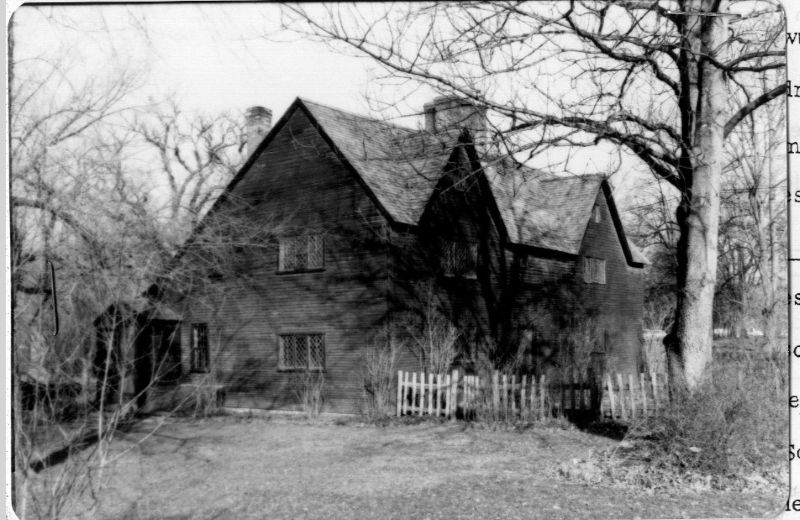
The house also features heavy oak and tamarack beams, gunstock posts, pine paneling with shadow molding, clay-and brick-filled walls, and large, 17th-century-era fireplaces.
The east half of the house was added sometime between 1680 and 1690, and the lean-to was added around 1710.
The Whipple family lived in the house for 150 years. In 1898, the Ipswich Historical Society bought and restored the house and made it their headquarters. During the restoration, the modern ceilings were removed, and replica casement windows were installed.
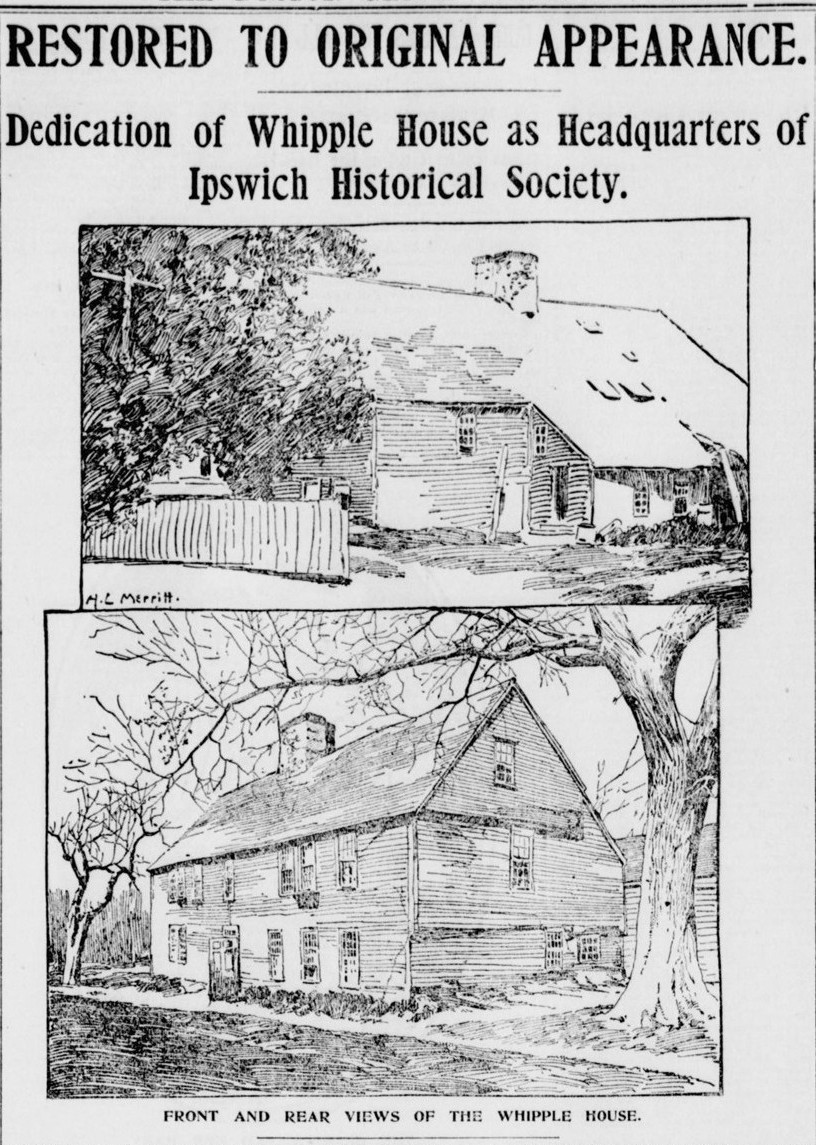
The dedication ceremony for the house was held on October 19, 1898, and the house opened to the public as a historic house museum in 1899.
In 1927, the house was moved from its original location, which was next to the railroad station where sparks from the passing trains posed a fire hazard, to its new location on the town’s South Green.
Several historical societies, such as the New England Society and the Society for the Preservation of New England Antiquities, opposed the plan to move the building, though, because they felt that the historical value of the home was connected to the site on which it stood, and they worried it would be damaged during the move.
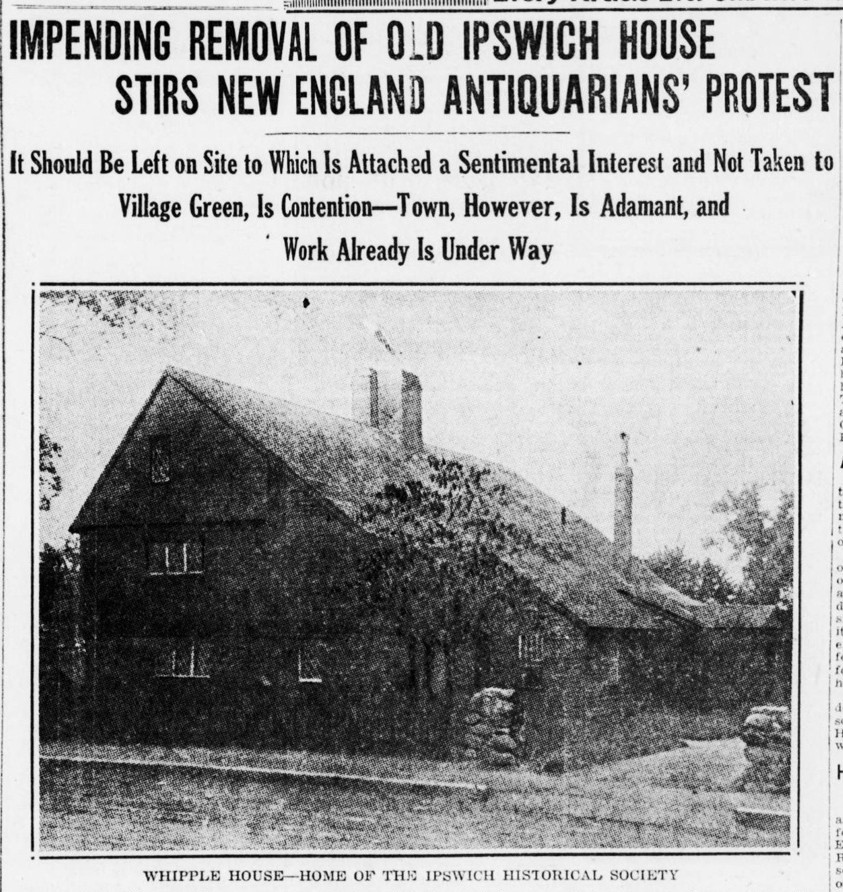
According to a news report in the Boston Globe, the New England Society argued that “the sites selected by our Puritan ancestors for the location of their homes are in themselves a matter of interest and historical value, and any house that has stood for almost 200 years on its original site acquires an added sentimental value which would be wholly lost on a new site” (“Impending Removal of Old Ipswich House,” 1927).
Despite the society’s protests, the move went ahead anyway, and the house survived the move with no damage.
The Whipple House continued to be a popular tourist attraction. In 1947, the Ipswich Chronicle reported that a record-breaking 1,985 people visited the Whipple House that year.
After extensive termite damage and dry rot were discovered in the east facade in 1953, the house was temporarily closed and underwent another restoration to repair the damage (“Restoring the Whipple House,” 1953).
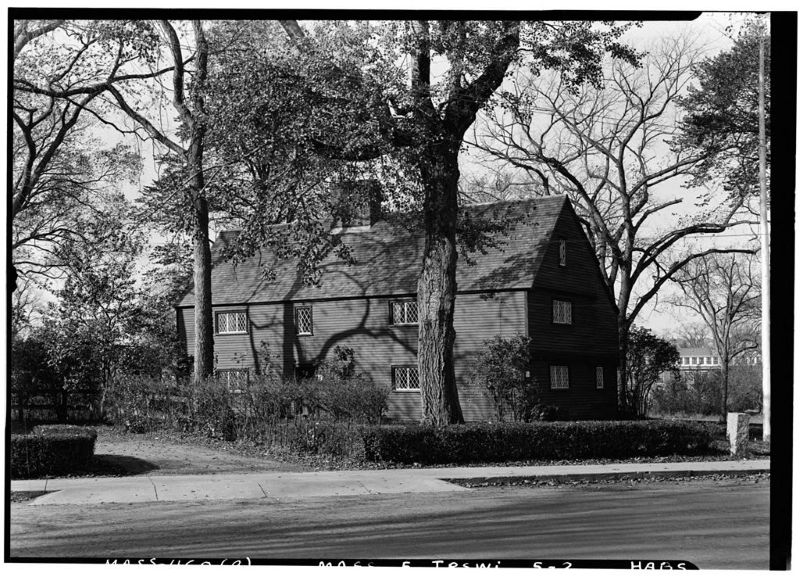
During the restoration, the gables on the front roof were rediscovered and restored; some paneling was removed and replaced with a pattern from a fragment found under the door; the wooden calmes in the casement windows were replaced with leaded calmes; and some other structural work was done.
After the New England Telephone Company proposed building an office building next door to the Whipple House in 1957, the Ipswich Historical Society started a fundraising campaign to purchase the plot of land in order to prevent the construction project.
On October 9, 1960, the John Whipple House was designated a National Historic Landmark. On October 15, 1966, the Whipple House was added to the National Register of Historic Places.
Sources:
“Historic Building Detail: IPS.40 Whipple, John House.” MACRIS, mhc-macris.net/details?mhcid=IPS.40
“Historic Properties of the Ipswich Museum.” Ipswich Museum, ipswichmuseum.org/historic-properties/
“Restored to Original Appearance.” The Boston Globe, 20 Oct. 1898, p. 7.
L.P. “’Preserved’ New England: What the Antiquarian Societies Are Doing.” Boston Evening Transcript, 22 Nov. 1913, p. 32.
“Landmarks of Massachusetts. No. 21. Ipswich – Whipple House.” The Boston Traveler, 12 Mar. 1914, p. 10.
“No. 70 – A Visit to Ipswich – The Old Whipple House.” The Boston Post, 26 Aug. 1914, p. 12.
“Whipple House Will Be Moved.” Newburyport Daily News, 11 Nov. 1927, p. 11.
“Impending Removal of Old Ipswich House Stirs New England Antiquarian’s Protests.” The Boston Globe, 9 Nov. 1927, p. 13.
“Oppose Moving Historic Home.” The Boston Herald, 4 Nov. 1927, p. 5.
“300 Year Old Ipswich House Moved Half-Mile.” The Boston Globe, 10 Mar. 1928, p. 3.
Whitney, Irma. “Whipple House in Ipswich Holds Treasured Relics of N.E. Antiquity.” The Boston Herald, 2 Oct. 1938, p. 48.
“Banner Year for Tourists Shown by Whipple House.” The Ipswich Chronicle, 11 Aug. 1939, p. 3.
“1985 Visitors Register This Year At Whipple House.” The Ipswich Chronicle, 13 Nov. 1947, p. 1.
“Restoring Whipple House.” The Boston Globe, 20 Sept. 1953, p. 165.
“Ipswich Celebration.” The Boston Globe, 5 Aug. 1956, p. 22.
“Start Fund Drive for Purchase of Whipple House.” The Ipswich Chronicle, 22 Aug. 1957, p. 1.