
The Lynn Woods Reservation is a 2,200-acre municipal forest park in Lynn, Massachusetts.
The park is the second-largest municipal park in America and features wetlands, ponds, streams, rocky outcrops of granite and volcanic rock, and over 30 miles of scenic trails.
Lynn Woods in the 17th Century:
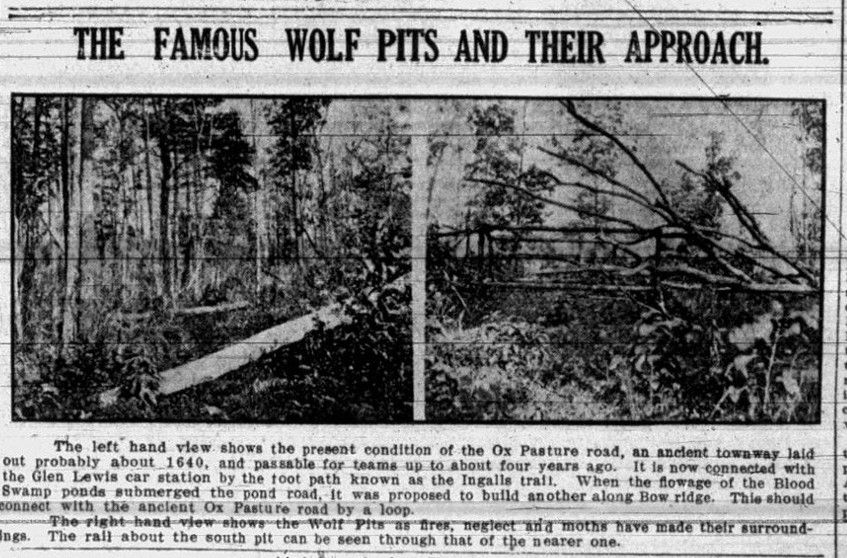
In 1658, legend states that a pirate named Thomas Veale was hiding out in a cave in the Lynn Woods, now known as Dungeon Rock, when an earthquake struck and both buried Veale and his pirate treasure inside.
Lynn Woods in the 18th Century:
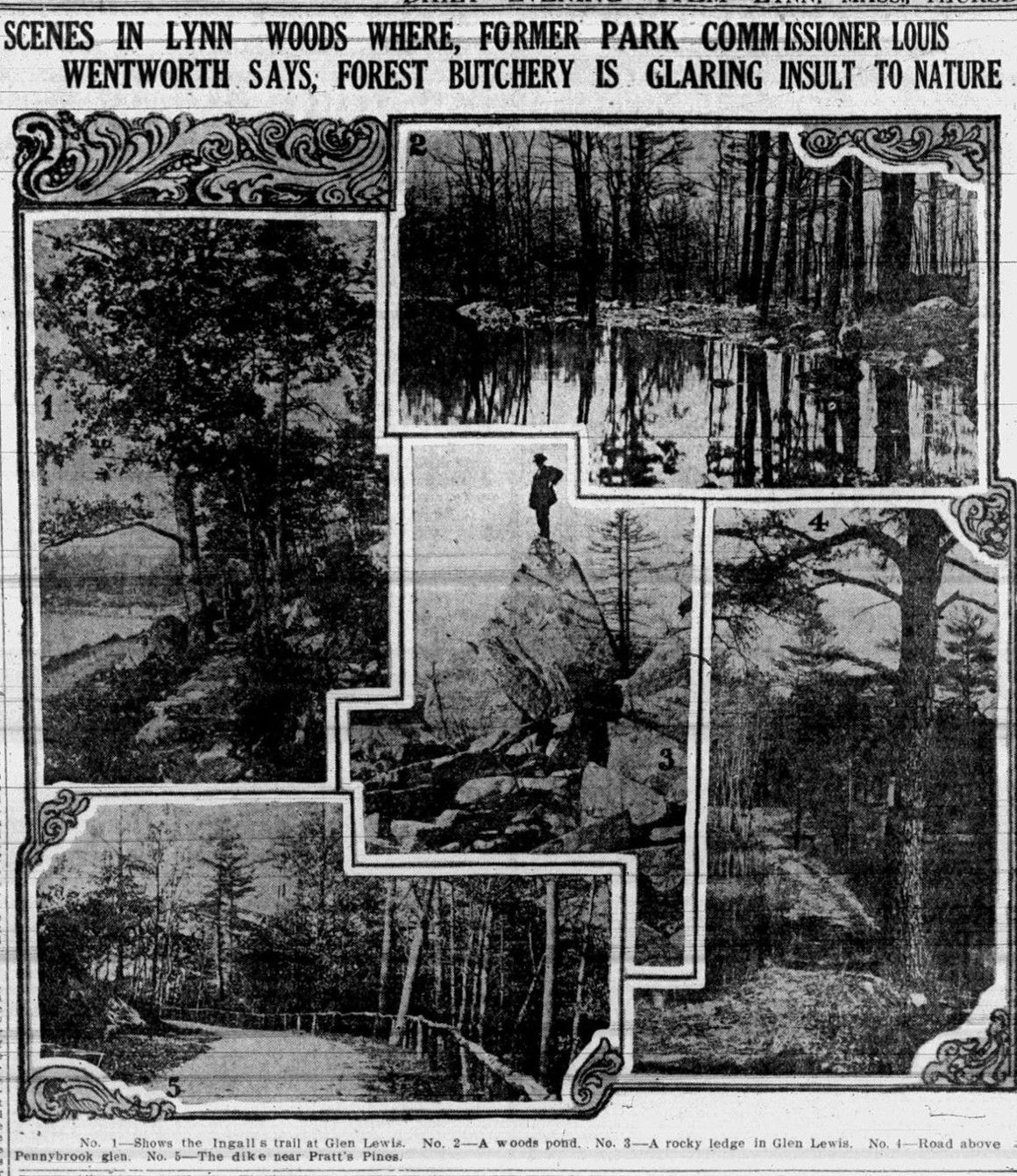
In the 18th century, Lynn Woods was used as common pastureland for the villagers’ livestock. The reservation currently features two historic stone walls and several cellars from houses built in the 18th century.
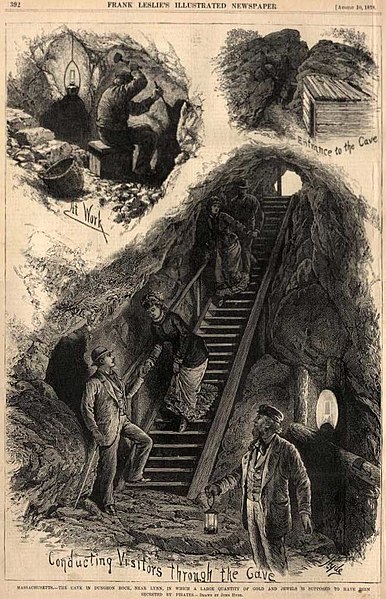
During the 18th century, farmers also built two pits in the ox-pasture woods and two pits on a grassy knoll at Breed’s Pond. The pits are believed to be wolf pits designed to trap wolves that preyed on the local livestock.
The ox-pasture wolf pits were located on common land, but the Breed’s Pond wolf pits may have possibly been dug by colonist Richard Sadler, who owned a farm on the land where the pits were located, according to an article in the Daily Evening Item (“Origin of the Ancient Wolf Pits,” 1907).
The Breed’s Pond pits were also reportedly used to store ammunition and other valuables during the Revolutionary War, according to an article in the Boston Globe (“Wolf Pits in Lynn Woods,” 1902).
Lynn Woods in the 19th Century:
During the 19th century, the Lynn Woods were used for water reservoirs and recreational sites. In 1850, the Lynn Exploring Circle was established, and the group established nature trails and camps in the woods.
In 1851, a local spiritualist named Hiram Marble purchased the plot of land where Dungeon Rock is located from the City of Lynn and began excavating the rock in hopes of finding the legendary buried pirate treasure in the cave, to no avail.
In 1878, the Lynn Water Department created a municipal water supply in the woods by damming an existing millpond. The construction of the reservoir flooded the area where the wolf pits are located at Breed’s Pond.
In 1881, a public trust was formed, the Trustees of Free Public Forest, to protect the woods as a public park. The trust managed to purchase several tracts of land.
In 1889, the Lynn Woods Reservation was established. Notable landscape architect Frederick Law Olmsted was hired as a design consultant and recommended that Lynn Woods be kept in a natural state as a wild forest.
In 1891, the wolf pits in the ox-pasture woods were rediscovered after Lynn Parks commissioner, Phillip A. Chase bought the land for the parks department. Visitors flocked to the pits in such large numbers that it endangered the walls of the pits. To protect them, the parks department cleaned up the wolf pits and installed railings around them.
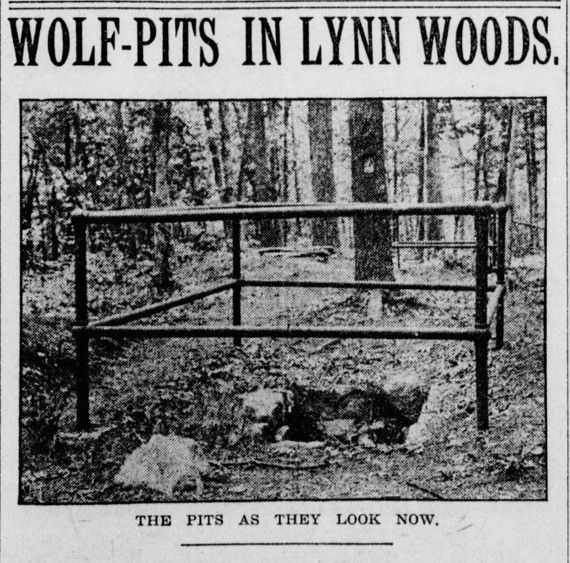
The two ox-pasture wolf pits are rectangular in shape, long, narrow, and deep and are lined with rough stone.
Lynn Woods in the 20th Century:
In 1906, Lynn Woods was devastated by a gypsy moth infestation.
In 1907, Breed’s Pond was drained for repairs to the reservoir, and the wolf pits temporarily became accessible again. The pits were about four feet deep, and the bottoms were filled with stones and earth (“Origin of the Ancient Wolf Pits,” 1907).
In the 1920s and 1930s, new recreational sites were established in the park, such as a municipal golf course, a rustic clubhouse, a picnic grove, a bandstand, and two observation towers, Steel Tower and Stone Tower.
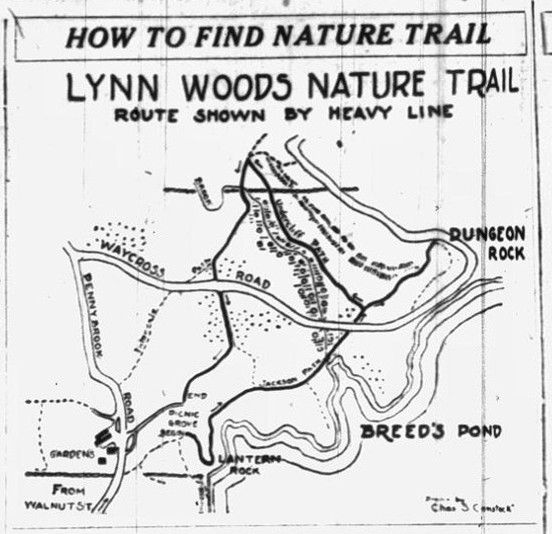
Although Lynn Woods was once home to rattlesnakes, in 1931 the parks commissioner stated that no rattlesnakes had been seen in the woods in the past 28 years.
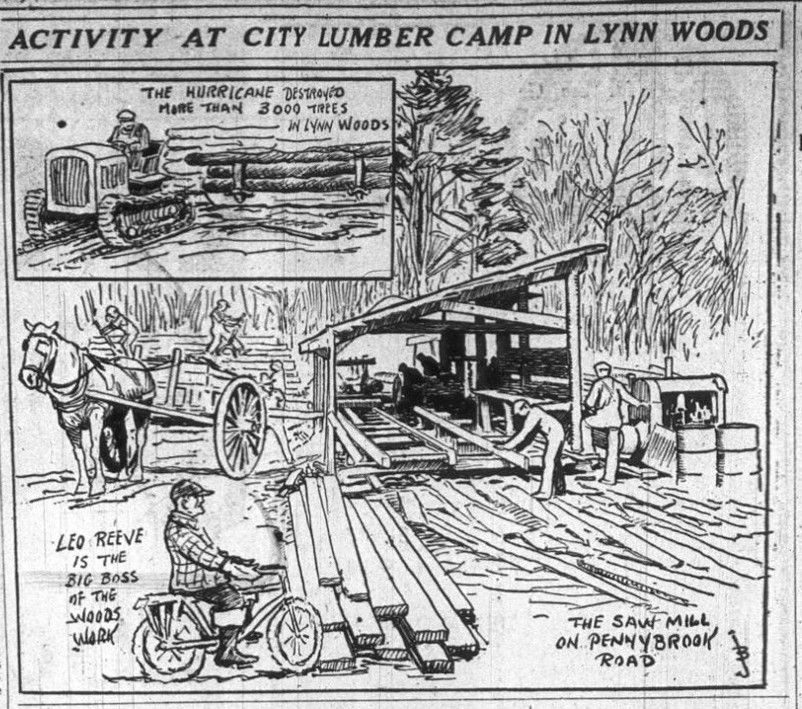
In September 1939, a hurricane felled over 3,000 trees in Lynn Woods, and the city established a temporary lumber camp in the woods to clear away and process the fallen trees (“Sawmill Keeping Lynn Woods Busy,” 1939).
In 1989, the Friends of Lynn Woods was established as a private non-profit group providing volunteer support for the maintenance of the park.
On September 6, 1996, the Lynn Woods Historic District was listed on the National Register of Historic Places.
In November 2024, a wildfire broke out in the Lynn Woods and burned over 400 acres. The fire burned from Steel Tower to Stone Tower, over Dungeon Rock, Undercliff Path, and across Waycross Road down to the Pennybrook Road entrance.
Sources:
“About Lynn Woods.” Visit Lynn Woods, visitlynnwoods.org
“Lynn Woods Historic District.” National Park Service, home.nps.gov/places/lynn-woods-historic-district.htm
Kieran, Brendan. “A Swing through Lynn Woods around 1910.” Massachusetts Historical Society, masshist.org/beehiveblog/2017/06/a-swing-through-lynn-woods-around-1910/
“Historic Other Detail: LYN.929 Lynn Woods Reservation.” MACRIS, mhc-macris.net/details?mhcid=LYN.929
“Historic Area Detail: LYN.G Lynn Woods Historic District.” MACRIS, mhc-macris.net/details?mhcid=LYN.G
“Historic Other Detail: LYN.951 Lynn Woods Wolf Pits.” MACRIS, mhc-macris.net/details?mhcid=LYN.951
“Historic Other Detail: LYN.952 Lynn Woods Flooded Wolf Pits.” MACRIS, mhc-macris.net/details?mhcid=lyn.952
“County News.” Danvers Mirror, 29 Aug. 1891, p . 2.
“In the Woods.” Daily Evening Item, 15 Oct. 1891, p. 1.
“Water Supply.” Daily Evening Item, 18 May. 1892, p. 5.
“An Old Story.” Daily Evening Item, 12 Jul. 1899, p. 6.
“Lynn Woods.” Daily Evening Item, 13 Jun. 1900, p. 9.
“Short Walks in Lynn Woods.” Daily Evening Item, 9 Aug. 1900, p. 5.
“Wolf Pits in Lynn Woods.” The Boston Globe, 26 Oct. 1902, p. 27.
“The Wolf Pits in Lynn Woods.” Wakefield Citizen and Banner, 31 Oct. 1902, p. 1.
“The Destruction Wrought By the Gypsy Moth on the Slopes of Lynn’s Water Supply and in the Great Woods.” Daily Evening Item, 1 Aug. 1906, p. 11.
“Origin of the Ancient Wolf Pits in Ox Pasture and Breed’s Pond and the Valuable Service They Rendered in Ridding the Early Settlers of their Most Dreaded Pest Nearly Three Centuries Ago.” Daily Evening Item, 6 Nov. 1907, p. 9.
“Wildest Amphitheatres.” Daily Evening Item, 3 Jun. 1911, p. 3.
“Forest Butchery Wentworth Terms Lynn Woods Work.” Daily Evening Item, 22 Apr. 1915, p. 8.
“The Great Woods of the Past and Present.” Daily Evening Item, 18 Sept. 1915, p. 8.
“Dedication of New Pennybrook Gate Tomorrow.” Daily Evening Item, 16 Jun. 1919, p. 5.
“Commends Moth Work Done in the Lynn Woods.” Daily Evening Item, 7 Jun. 1921, p. 5.
“Lynn Boy Scouts Clearing Trail to Wolf Pits.” Daily Evening Item, 29 Apr. 1925, p. 1.
“No Place for a Dress Suit.” Daily Evening Item, 23 Oct. 1929, p. 16.
“Off the Fairway.” Daily Evening Item, 31 Mar. 1930, p. 6.
“Circle Trail Opens Up New Beauties of Lynn Woods.” Daily Evening Item, 24 Jul. 1931, p. 12.
“No Rattlers in Lynn Woods Say Comstock.” Daily Evening Item, 9 Oct. 1931, p. 30.
“Comstock Says Lynn Woods Unique Park.” Daily Evening Item, 21 Dec. 1934, p. 3.
“Sawmill Keeping Lynn Woods Busy as Lumber Camp.” Daily Evening Item, 25 May. 1939, p. 4.
“WPA Approves Plans for Water Storage System in Lynn Woods.” Daily Evening Item, 25 Aug. 1939, p. 1.
“‘Impossible to stop this’: Raging wildfire scorches 400 acres in Lynn Woods.” Karedes, Drew and Kelly Sullivan. Boston 25 News, 11 Nov. 2024, boston25news.com/news/local/impossible-stop-this-raging-wildfire-scorches-400-acres-lynn-woods/3G2X5UWWTVE35M4LNG3AEJBKIM/
McDonald, Danny. “A smoldering wildfire shuts down the vast Lynn Woods for the foreseeable future.” The Boston Globe, 14 Nov. 2024, bostonglobe.com/2024/11/14/metro/lynn-woods-smoldering-wildfire/