
Northampton State Hospital was a psychiatric hospital located in Northampton, Massachusetts.
Built in 1856, it was originally known as the State Lunatic Hospital at Northampton. It was the third public psychiatric hospital built in the state, following Worcester State Hospital in 1833 and Taunton State Hospital in 1851.
Northampton State Hospital in the 19th Century:
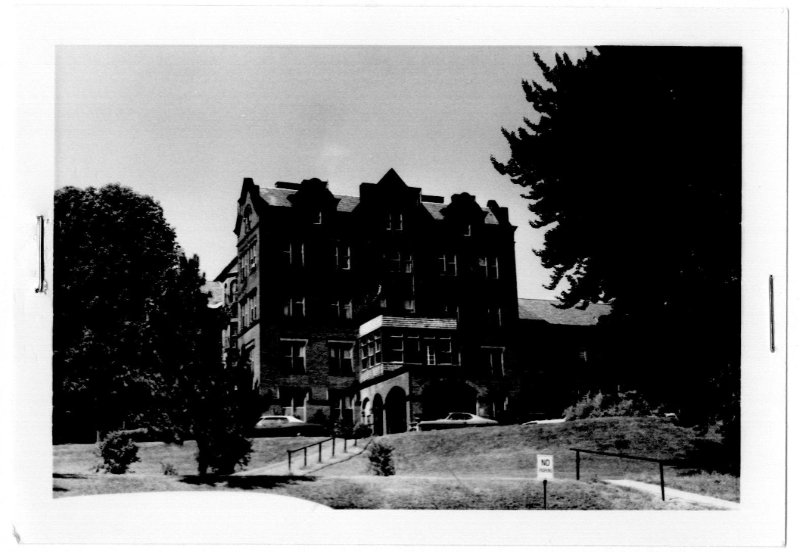
Construction on the hospital began in March of 1856. The building was designed by architect Jonathan Preston in the Elizabethan style and was based on the Kirkbride plan.
All of the building materials were locally sourced. Stone for the foundation was drawn from Florence by horse, 2 ½ million feet of lumber was obtained from local sawmills in Northampton and Ashfield, six million bricks were acquired from local brick yards, and seven thousand casks of lime for the mortar were supplied by the Berkshire Company.
The cornerstone was laid on July 4, 1856, during a special ceremony. The address was given by Dr. Edward Jarvis, the author of the 1854 report on “Insanity and Idiocy in Massachusetts.”
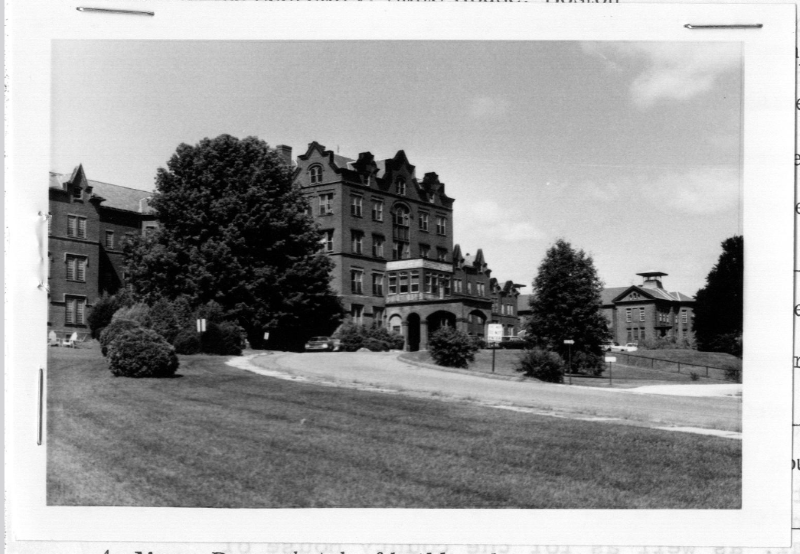
The central block of the hospital was four stories high and was capped by a cupola, which housed the superintendent’s residence and business offices and contained a large central rotunda.
The three-story wings extended from the main building’s northern and southern ends, giving a total length of 512 feet. Each wing was composed of three wards: the first wing extended from the facade of the central building but was set back a little, the second wing extended from the first but was also set back a little, and the third wing sat perpendicularly.
Each ward had a three-story bay or bow window to bring extra light into the corridors, which were wide.
To the rear of the central block was a rear wing about 105 feet in length. This wing contained the kitchen, laundry, chapel, and a dining room and sitting room for the hospital staff.
The wings were segregated by gender, with the males in the north wings and the females in the south wings.
Each ward had a dining room on each floor, as well as an attendant’s room, sitting rooms, and rooms with bathrooms.
The asylum was originally designed to house 200 patients. It received its first patients on August 16, 1858, but by October 1, around 228 patients had been admitted.
In 1862, the hospital was renamed the Northampton Lunatic Hospital.
In 1876, a Victorian-style cast-iron water fountain was constructed near the main entrance. The 185-acre hospital grounds were expanded when the state purchased an additional 90 acres of surrounding pasture land in 1877.
In 1885, another 23-acre pasture on Easthampton Road was purchased to expand the hospital grounds.
In 1898, the hospital was renamed the Northampton Insane Hospital, and in 1906, it was renamed the Northampton State Hospital.
Northampton State Hospital in the 20th Century:
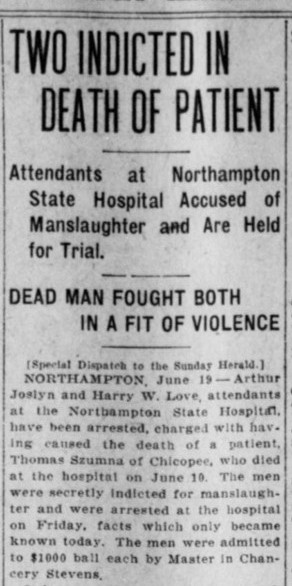
In June of 1909, two attendants at the hospital, Arthur Joslyn and Harry W. Love, were charged with manslaughter after they were accused of fatally injuring a violent patient during an outburst.
In 1922, superintendent Dr. John A. Houston told the press that unlike other psychiatric hospitals, Northampton State Hospital had stopped using restraints in the late 19th century:
“We do not use restraint here. Not a single patient has been placed under restraint in Northampton State Hospital since 1890. At that time it was generally believed by those who were in charge of treatment of the insane that what we call ‘disturbed cases’ commonly called violent, had to be restrained through the use of the strait-jacket, or by tying the hands and feet, or both. I promptly discarded that method, having been led to believe from my years of experience in mental treatment that it was unnecessary. My theory proved correct and at no time since have we restrained a patient.” (“State Hospital Bars Restraint,” 1922)
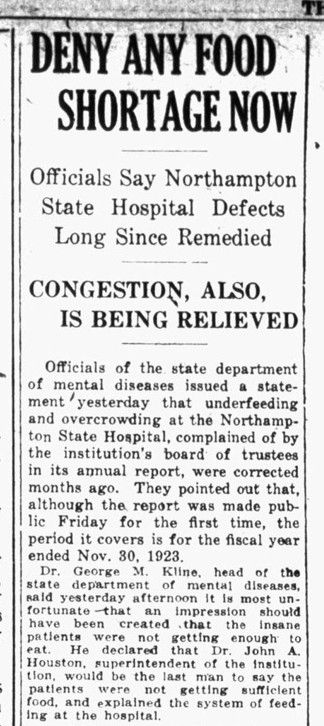
In 1924, the institution’s board of trustees accused the hospital staff of underfeeding and overcrowding the patients in its annual report. The staff later issued a statement in October that they had taken measures to correct the food shortage and were working on ways to relieve overcrowding in the facility.
In 1925, a new complex of buildings, the Memorial Complex, was completed on Prince Street. The construction of the new complex brought the hospital’s population to 2,000. A new main kitchen and dining room were constructed to accommodate the increase in patients.
In 1928, a nurses’ home, a brick Colonial Revival-style building, was constructed just south of the main complex.
In 1930, the North and South Employee’s Homes were constructed immediately north and south of the main building and were also brick Colonial Revival-style buildings.
In June of 1930, a diphtheria epidemic occurred at the hospital, and two patients died. Hospital officials insisted that although the victims had contracted diphtheria, they died of other causes instead.
In 1932, the Male Attendant’s Home, a three-story brick building, was constructed just south of the main complex.
In 1934, a dysentery epidemic occurred at the hospital, and eight patients died.
In 1935, patients complained that they were being served spoiled food, particularly rotten potatoes. State representatives asked Governor Curely to check on hospital authorities and look into the matter. An investigation was conducted, and no rotten potatoes were found in the vegetable cellar.
In 1937, the employees of the hospital attempted to unionize in order to obtain a 40-hour work week and higher wages. Their plans were thwarted by the sudden decision of Governor Charles F. Hurley to outlaw strikes in state institutions and bar employees from joining any union that called for strikes.
The movement to unionize was being led by John Lee Lomurad, an employee of the Northampton State Hospital and a field representative of the American Federation of State.
On July 19, 1937, a patient named Elizabeth Ward was found dead, and her cause of death was listed as “strangulation by a wet sheet pack.” A wet sheet pack is used to quiet disturbed patients.
In 1938, a 58-year-old patient named Felicia Persons died of poison shortly after being admitted to the hospital. An investigation was launched to determine the source of the poison and to determine if the poison was taken before or after Persons was admitted to the hospital.
In 1940, the Superintendent’s House, a 2 1/2-story Colonial-Revival-style building, was constructed on the property.
In early March of 1940, a patient named Lorenzo Bello stabbed three other patients, killing one of them, and was later transferred to the maximum security ward at Bridgewater State Farm.
In April of 1942, state and local police questioned employees of the hospital in a probe to determine the biological father of a baby born to a 30-year-old former actress who was a long-term patient at the facility (“Hunt Dad of Baby Born to Actress,” 1942).
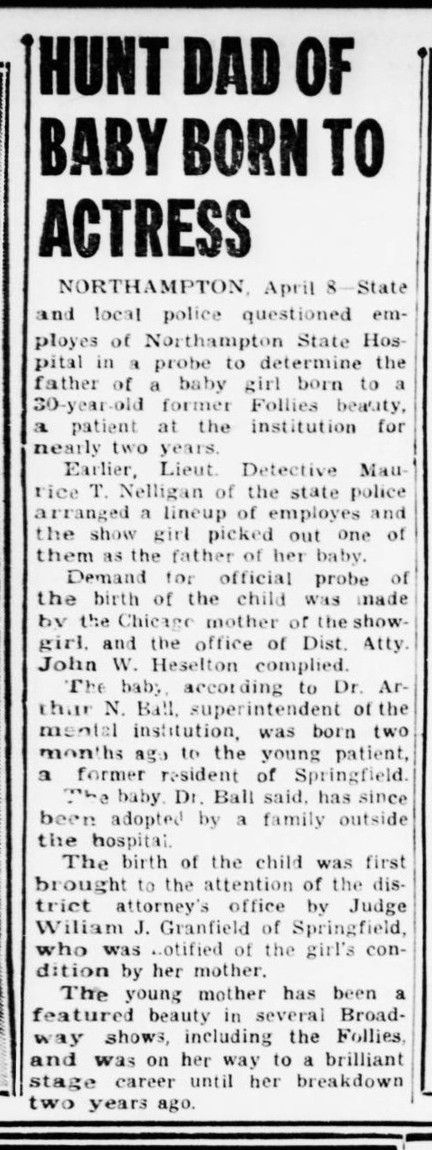
The employees were arranged in a lineup, and the woman was asked to identify the man who fathered the baby. It’s not clear from news reports if the father was identified.
Also in April of 1942, an unnamed patient was accused of fatally beating another patient, 56-year-old George A. Charron. The attacker allegedly felled Charron with an initial blow and then beat his head against the floor, causing an intracranial hemorrhage that resulted in his death.
In March of 1945, a 25-year-old patient named Walter Baraniuk escaped from the hospital and set a series of barn fires at local farms in nearby Southampton, which killed three cows and three horses and resulted in $45,000 in losses. Baraniuk was eventually captured after he was hunted down by 100 state troopers, state guardsmen, and policemen from four communities who were armed with submachine guns.
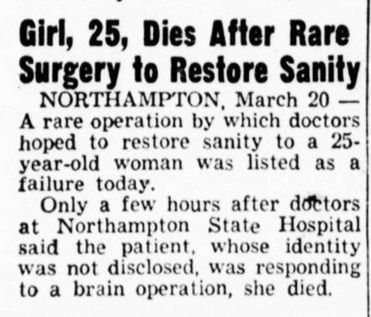
In March of 1948, the first lobotomy ever performed at the Northampton State Hospital was performed by Dr. Joseph Han on a 25-year-old female patient who had been classified as a “hopelessly insane patient.” The patient died a few hours later, and the operation was deemed a failure.
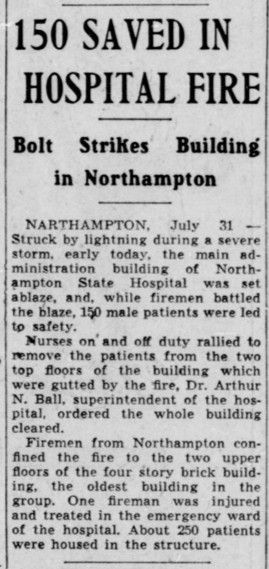
On July 31, 1949, a lightning bolt hit the main building at the hospital and started a fire that caused $10,000 in damage and forced 150 patients to flee the building (“150 Saved in Hospital Fire,” 1949).
In March of 1951, two former attendants at Northampton State Hospital were sentenced to two months in the House of Corrections after pleading guilty to assault and battery on two mental patients (“Fire Torture Jails Pair,” 1951).
The employees, Francis R. Blanchard and Francis Kellogg, were accused of using cigarette lighters to burn the hair from the bodies of the two patients, both of whom required medical treatment for their burns.
In 1953, a 21-year-old attendant, Alexander McViegh, was arrested at the hospital on accusations that he had raped a 10-year-old girl in Hadley, Massachusetts, the night before (“Young Hospital Worker Held in Girl Attack,” 1953).
In 1959, a hospital matron, Lanna L. Arthur, was accidentally killed at the hospital when she was struck by a dumbwaiter. Arthur and another employee had tugged loose a mattress, which had jammed in the shaft, and Arthur apparently looked into the shaft just as the dumbwaiter lowered, nearly decapitating her.
In 1963, an attendant at the hospital pleaded not guilty to charges that he tied up and beat a patient (“Patient Beating Case Continued,” 1963).
In December of 1968, an 84-year-old patient was found dead at the foot of a flight of stairs at the hospital. The medical examiner determined that the patient died of exposure, and no signs of foul play were found.
In the late 1960s, the hospital’s population peaked at slightly over 2,500 patients. The process of deinstitutionalization caused a steady drop in numbers. By 1981, the hospital’s population was down to 275.
In August of 1980, a former attendant at the hospital, Karle Lamson, was arraigned on charges that he raped a female patient while on an outing to a park.
In 1982, Governor Edward King proposed using Northampton State Hospital as a jail to alleviate overcrowding in the Springfield County Jail. State representatives filed a bill in May to block Governor King from doing so.
In 1986, the main building complex at the hospital was abandoned, and the remaining patients were moved to the Memorial Complex.
In the fall of 1990, the Massachusetts Association of Mental Health published a working paper suggesting that three state hospitals, Danvers State Hospital, Metropolitan State Hospital, and Northampton State Hospital, were prime candidates for closure.
In 1991, a special commission recommended closing nine mental health facilities and public health hospitals within the next three years.
The facilities slated for closure were Northampton State Hospital, Danvers State Hospital, Metropolitan State Hospital, Paul A. Dever State School, John T. Berry School, the Foxborough campus of Wrentham State School, Cushing Hospital, Lakeville Hospital, and Rutland Heights Hospital.
In 1993, Northampton State Hospital officially closed its doors.
On July 25, 1994, the Northampton State Hospital was added to the National Register of Historic Places.
Northampton State Hospital in the 21st Century:
Most of the buildings on the property were demolished between 2005 and 2008.
The main building was demolished in 2007.
The property was later redeveloped into a mixed-use residential and commercial neighborhood called Village Hill at Northampton. Village Hill features a Memorial Park built in honor of the former patients and staff of the hospital.
Sources:
“Annual reports [Northampton State Hospital (Mass.).]” Massachusetts Archives, chc.library.umass.edu/state-archives/2017/04/13/annual-reports-northampton-state-hospital-mass/
“State Hospital Memorialization.” Northampton MA, northamptonma.gov/2718/State-Hospital-Memorialization
“Historic Area Detail: NTH.I Northampton State Hospital – Main Complex.” MACRIS, mhc-macris.net/details?mhcid=NTH.I
“Historic Area Detail: NTH.H Lunatic Hospital at Northampton.” MACRIS, mhc-macris.net/details?mhcid=NTH.H
“Two Indicted in Death of Patient.” The Boston Herald, 20 Jun. 1909, p. 2.
“State Hospital Bars Restraint.” The Boston Herald, 14 Nov. 1922, p. 2.
“Deny Any Food Shortage Now.” The Boston Herald, 12 Oct. 1924, p. 7.
“Insane Suffer, Fitzgerald Charges.” The Boston American, 5 Feb. 1926, p. 6.
“Epidemic in State Hospital.” Fall River Herald News, 20 Jun. 1930, p. 3.
“Asylum Hit by Diphtheria.” The Boston American, 18 Jun. 1930, p. 4.
“Seven Patients Die of Dysentery in State Hospital.” The Meriden Daily Journal, 22 Aug. 1934, p. 3.
“Seek Cause of Hospital Affliction.” The Boston Post, 22 Aug. 1934, p. 7.
“4 New Cases in Death Epidemic.” The Boston Record, 25 Aug. 1934, p. 6.
“Says Hospital Food Decayed.” The Boston Post, 29 Jan. 1935, p. 25.
“Potatoes in Cellar Firm.” The Boston Post, 30 Jan. 1935, p. 2.
“Buckley Warns Hospital Union.” The Boston Herald, 29 Oct. 1937, p. 19.
“No Strike Edict Thwarts State Worker Union.” The Boston American, 2 Nov. 1937, p. 12.
“Charge Lee Forced Out.” Leominster Daily Enterprise, 5 Nov. 1937, p. 5.
“State Hospital Union Plans.” The Boston Globe, 15 Nov. 1937, p. 3.
“AFL Offers State No-Strike Union.” The Boston Herald, 16 Nov. 1937, p. 32.
“113 Insane Slain By Inmates in Past 10 Years.” The Boston Record, 29 Jan. 1938, p. 3.
“Death Probe Possible in Bay State Hospital Case.” The Woonsocket Call and Evening Reporter, 18 Aug. 1938, p. 3.
“Bello, Who Slew Patient, Sent to Bridgewater.” The Boston Globe, 8 Mar. 1940, p. 11.
“Hunt Dad of Baby Born to Actress.” The Boston American, 8 Apr. 1942, p. 5.
“Probe Hospital Birth to Actress.” The Boston Record, 8 Apr. 1942, p. 12.
“State Police Probe Northampton Death.” The Boston Globe, 24 Apr. 1942, p. 3.
“Grand Jury to Get Evidence in Death at State Hospital.” The Boston Globe, 26 Apr. 1942, p. 6.
“Hunt Maniac as Barns, Cows Burn.” The Boston Record, 26 Mar. 1945, p. 3.
“Berkshire Manhunt Ends with Capture of Escaped Inmate.” The Boston Globe, 27 Mar. 1945, p. 1.
“Brain Surgery May Restore Girl’s Sanity.” The Boston American, 19 Mar. 1948, p. 20.
“Girl, 25, Dies After Rare Surgery to Restore Sanity.” The Boston American, 20 Mar. 1948, p. 5.
“150 Saved in Hospital Fire.” The Boston Post, 31 Jul. 1949, p. 1.
“To Ask Funds to Repair Hospital.” The Boston Post, 1 Aug. 1949, p. 10.
“Fire Torture Jails Pair.” The Boston Record, 17 Mar. 1951, p. 20.
“Young Hospital Worker Held in Girl Attack.” The Woonsocket Call and Evening Reporter, 17 Dec. 1953, p. 9.
“Girl, 10, Attacked in Car; Hospital Watchman Held.” The Boston Globe, 17 Dec. 1953, p. 1.
“State Hospital Escapee Caught in Holyoke Home.” The Boston Globe, 3 May. 1956, p. 6.
“Northampton State Hospital Escapees Trapped in Attic.” The Boston Globe, 6 Jul. 1958, p. 26.
“Dumb-Waiter Kills Hospital Matron.” The Boston Globe, 28 Oct. 1959, p. 26.
“Patient Beating Case Continued.” The Boston Globe, 12 Dec. 1963, p. 16.
“Hospital Patient Found Dead.” Lewiston Evening Journal, 10 Dec. 1968, p. 5.
“Patients Released at Halfway House Makes the Town Nervous.” Lewiston Evening Journal, 21 Mar. 1979, p. 43.
D’Alcomo, Joanne. “Rape Case Highlights Dilemma Over Records.” The Telegraph, 26 Aug. 1980, p. 3.
“Officials Fight Proposal to Use Hospital as a Jail.” The Telegraph, 17 May. 1982, p. 11.
“9 Mass. Mental Hospitals to Close.” Record-Journal, 20 Jun. 1991, p. 33.