
The Gloucester Sea Serpent was a creature reportedly seen near the coast of Gloucester, Massachusetts. The sea serpent was described as a giant snake-like creature with a large head.
The sightings of the sea serpent began in the 17th century and continued well into the 20th century. According to an article in the Boston Globe in 1941, the sea serpent was reported 87 times between Gloucester and Boston during the early 19th century.
One of the first recorded sightings of the sea serpent was in 1638. A local man claimed to have seen a sea serpent coiled up on a rock at Cape Ann on June 26, 1638, and told colonist John Josselyn about it, who wrote about the sighting in his book An Account of Two Voyages to New England.
The man said that a boat passed by with some Englishmen and two Native Americans onboard, and the natives persuaded the Englishmen not to shoot at the serpent because “if he were not kill’d outright, they would all be in danger of their lives.” (Josselyn 22).
Sightings in the 19th Century:
In August 1817, the sea serpent was spotted numerous times in Gloucester Harbor. On August 14, 1817, the creature was approached by a boat and was fired upon but sank under the waves and reappeared 100 yards away.
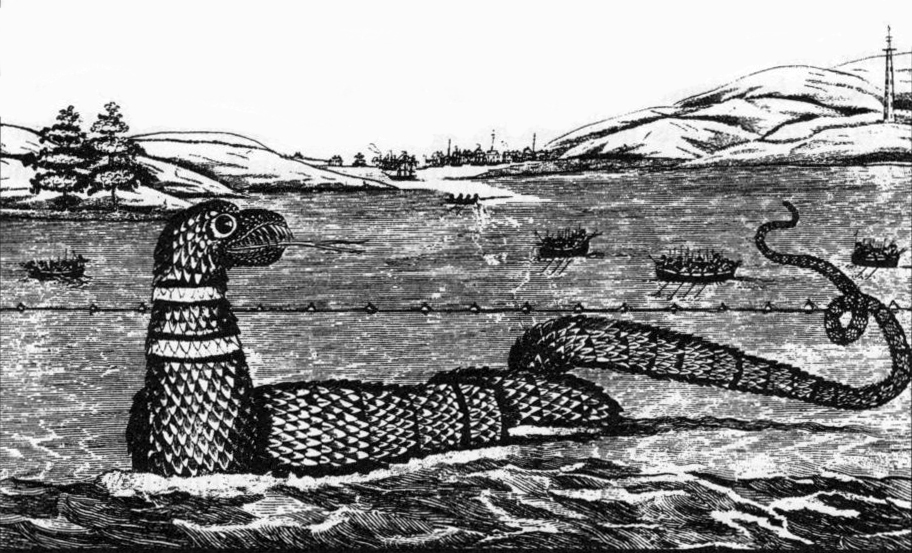
On Wednesday, September 10, 1817, it was reported in the news that the sea serpent had not been spotted in Gloucester Harbor for almost a week, and the quest to capture the creature was unsuccessful.
Yet, sometime that week, Captain Tappan of Newburyport reported seeing the creature in the vicinity of Cape Ann swimming very rapidly with his head raised several feet out of the water. A few days later, two fishing boats from Sandy Bay Harbor in Rockport were sent to search for the creature but failed to find it.
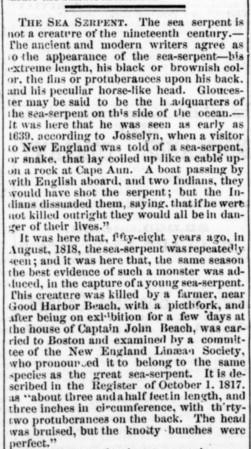
Sometime in 1817, the Linnaean Society of New England formed a committee for the “purpose of collecting any evidence which may exist respecting a remarkable animal, denominated a Sea Serpent, reported to have been seen in and near the Habour of Gloucester.”
In August or September 1817, a farmer killed a sea creature with a pitchfork on Good Harbor Beach and put it on display for a few days at the house of Captain John Beach.
The farmer then brought the creature to the Linnaean Society in Boston, who declared it was the same species as the sea serpent. On October 1, 1817 a local newspaper, The Register, described the creature as “about three and a half feet in length, and three inches in circumference, with thirty-two protuberances on the back. The head was bruised, but the knotty bunches were perfect” (Maine Farmer 1875.)
In July 1818, the sea serpent was spotted again in Gloucester Harbor when it surfaced in front of a fishing boat, terrifying the man and two boys on board. They described it as 100 feet in length with a small head and large eyes as big as those of an ox.
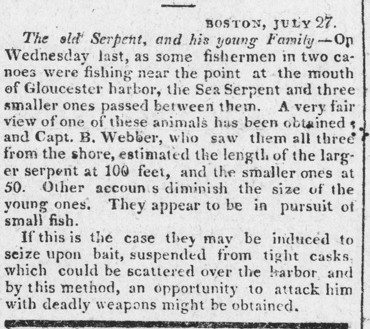
In late July 1818, Captain B. Webber reported seeing from shore the sea serpent accompanied by three smaller sea serpents at the mouth of Gloucester Harbor. Webber estimated the length of the larger serpent was 100 feet and the smaller ones were 50 feet, and they appeared to be in pursuit of small fish.
In early August 1818, a group of men, Timothy Hodgkins, Joseph Chase of Brunswick, N.H., and two other unnamed men, reported seeing the sea serpent at Squam Harbor, which they described as about 120 feet in length with about 20 humps along the length of its body.
The men said the creature made a noise like “water running rapidly over loose pebbles,” and it almost sounded like it was hissing, but the noise actually came from the ripple in the water made by the bunches on its back as it swam.
The men said the creature’s head was as large as a barrel and it was dark brown in color and had a glossy appearance like a seal and that its body was the size of a 60 or 80 gallon cask. It didn’t appear to have any fins or gills, and its head was elevated above the water as he swam.
The men said the creature seemed indifferent to the ship’s presence and headed towards Rye Beach, and they lost sight of it when it got about four miles away.
On August 18, 1818, it was reported that Captain Webber and his crew spotted the sea serpent off Cape Ann Harbor and struck it several times with a harpoon, to no avail, and fired at the creature with guns as well, but it dove under the water and disappeared.
Sometime that same week, three men, W. Sargent, Francis Proctor, and another unnamed man, saw the sea serpent while they were fishing near Ten Pound Island. Sargent said it came within eight to 10 feet of his boat with its head raised above the water.
Sargent said its head resembled a toad’s and it had three horns, the middle one the largest, lying flat on its head. Its body was dark brown in color with large scales, and it also had large protuberances on its body, and it was about 70 to 100 feet in length. After Sargent struck the water with an oar to scare it away, the creature sank beneath the surface and disappeared.
On August 20, 1818, Captain Richard Rich reported that he harpooned the sea serpent near the Annisquam River, and it took his boat for a short ride and even broke part of the boat that the harpoon rope passed through, but the harpoon came loose, and the sea serpent disappeared:
“After several unsuccessful attempts, we have at length fastened to this strange thing called the Serpent. We struck him fairly, but the harpoon soon drawed, and he has not been seen since. I fear the wound he has received will make him more cautious how he approaches this shore….Be assured all has been done that could be, and we shall continue to do all in our power; but he is a difficult thing to strike with a harpoon, as he can lay down as long as he pleases, and seldom shews himself except in a calm” (Oudemans, 1892, p. 16).
On Sunday, August 23, 1818, the sea serpent was spotted in Gloucester Harbor and was chased again for several hours by Captain Rich and his crew, but they were unable to harpoon the creature.
In June 1819, the sea serpent was spotted by Captain Wheeler of the sloop Concord near Race Point in Cape Cod, and it was described as being at least 50 feet in length with a number of “protuberances” along its body, and its head was about four to five feet above the water with large black eyes about the size of a horse’s eyes. The creature was again seen a few days later near Cohasset Rocks.
In early or mid-August 1819, Captain Pierce of Dover, NH, reported seeing the sea serpent off the coast of Cape Ann and said that it was about 100 feet in length and covered in humps that looked like tar barrels. Several other Dover men were on board and corroborated Pierce’s story, including Noah Robinson, Robert Munsey, and bookseller Jesse Varney. Munsey stated that he was originally a skeptic of the sea serpent story but was now a believer after seeing it for himself.
On August 26, 1819, a U.S. Navy schooner spotted the sea serpent in Gloucester Harbor, and the men onboard described it as about 100 feet in length with about 14 “bunches” on its back, dark brown in color with white under the throat, and they reported that it swam exactly like a snake does in water and was surrounded by a flock of birds.
In August of 1823, the sea serpent was spotted again near Squam Bar and then, the following day, in Sandy Bay Harbor in Rockport. The news report said it was visible about 50 yards from shore in Sandy Bay Harbor and was fired at numerous times with muskets, and two musket balls were even seen striking it and bouncing off.
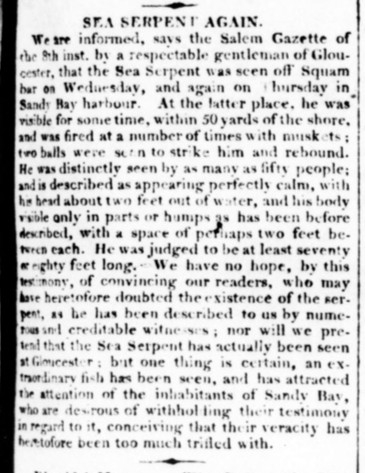
About 50 people also reportedly witnessed the serpent in the harbor that day, and they said that his head was raised about two feet out of the water and his body was covered in humps and was about 70 to 80 feet in length.
On June 17, 1826, Captain Holdredge, of the ship Silas Richards, reportedly saw the sea serpent while en route to New York and described it as a dark, dingy black color and said its body was covered in “protuberances.”
In May 1828, Captain Abraham Small discovered an unknown sea creature floating dead near Cape Cod that matched the description of the sea serpent. Small said it was shaped like a serpent with no fins and had the tail of a fish and was about 75 feet long. Its back was black and hard like an alligator’s back, and the belly was yellow.
Small could only manage to bring the skull and jawbone to shore due to the stench of the dead animal, and the bones were later put on display for the public, although it’s not clear from the news reports where exactly. Some believed the creature could be the sea serpent or a member of its family.
In 1835, the Gloucester Democrat newspaper reported that the sea serpent was spotted near Race Point Light in Cape Cod by the crew of the brig Monhegan. The crew said the creature was about 200 to 250 feet long, looked like a snake, and raised his head out of the water about seven or eight feet.
In 1840, the sea serpent was spotted again in Gloucester Harbor by several residents of the Old Fort neighborhood.
In July 1846, the sea serpent was spotted again in Gloucester and was reportedly harpooned by the crew of a boat, but the creature twisted himself off and disappeared.
In September of 1855, the sea serpent was reportedly seen by a group of people, including a few clergymen, on a fishing expedition near Eastern Point in Nahant again. It was reported that its body was about 60 feet or more in length and was covered in humps.
In August of 1886, a sailing party, which consisted of George W. Scott; John H. McCormick, president of the common council; Charles A. Brown, of the Boston Custom House; and Captain David Worth, reported a large sea serpent about 100 feet in length off the coast of Gloucester.
When their ship approached the creature, it reportedly lifted its head several feet above the water and looked at the men with two “glittering eyes” before it disappeared beneath the water and then came to the surface again some distance away. It then disappeared again under the surface of the water.
The news reports at the time were quick to point out that the men had been drinking during this sailing expedition.
In October 1886, writer and teacher Granville B. Putnam, of the Franklin School, published his account in the New York Tribune of seeing the sea serpent in Pigeon Cove in Rockport after being alerted to its presence by the town clerk of Rockport, Calvin W. Pool. Putnam said the creature was dark brown in color and was about 80 feet long.
Putnam said the creature appeared again a week later and was also seen by Reverend David Brewer, assistant pastor of Park Street Church in Boston, and his wife.
Putnam also included a chronological list of the sea serpent’s other sightings during the 19th century:
“Gloucester…..June 20, 1815
Gloucester…..August 10, 28, 1817
Gloucester…..August 1818
Nahant…..August 19, 1819
Swampscott…..August 10, 1820
Nahant….July 12, 1823
Nahant….1826
Lynn….July 1833
Swampscott…..July 1849
Nahant…..July 30, 1875
Gloucester…..July 15, 1877”
In early September 1891, the sea serpent was spotted off Wells Beach, between Beverly and Manchester, but disappeared suddenly.
On September 24, 1891, numerous newspapers reported a sighting by Gloucester fishermen of a sea serpent on the Flemish bank fishing cape that season.
The sea serpent was reportedly 80 feet in length and “resembled a giant squid” and reportedly made a noise similar to the rumbling of train cars as it plowed through the water like a steamship.
The fishermen reported that the creature had two horns projecting from its head and was last seen heading north.
Another news report of that sighting stated that the “reptile destroyed nearly all the trawls and capsized the dories of the schooner G.P. Whitman.”
In July 1896, a local lobster fisherman, William Henry Sargent, reported seeing a large sea serpent while hauling lobster pots off the coast of Lanesville in Gloucester, Massachusetts. Frightened, he rowed ashore and summoned a large crowd to the shore who had also seen the creature.
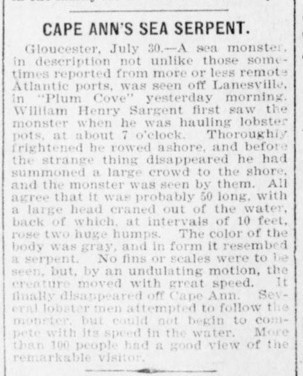
The crowd agreed that the creature was probably 50 feet long, with a large head craned out of the water, and had two huge humps at intervals of about 10 feet on its body.
Sargent said the creature resembled a serpent, didn’t have any fins or scales, and had a gray body and moved rapidly before disappearing under the water. Sargent said several lobstermen persued the creature but couldn’t keep up and lost sight of it.
Sightings in the 20th Century:
In May 1931, Captain Roy Marden and his crew of 22 fishermen arrived at the fishing pier in Gloucester and reported seeing a gigantic sea serpent a week earlier, about 20 miles east of Boston Lightship. They said the creature had a head like a horse and a tail like a shark and was about 50 feet in length.
In 1935, a local fisherman, Adelbert Langthorne, aboard the Gloucester schooner Imperator, arrived at the fishing pier in Gloucester and reported seeing a sea serpent while on the fishing trip to Nova Scotia. He said the serpent was 70 feet long, with a large crocodile head and a snake-like body.
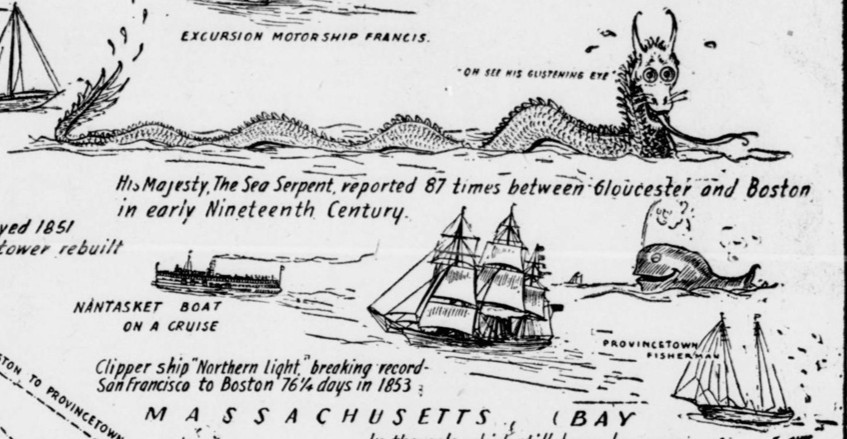
In the summer of 1950, the sea serpent was spotted again off the coast of Gloucester.
In July 1960, two fishermen and about a half dozen other people reportedly spotted a sea serpent off the coast of Gloucester. The two fishermen, Harry and Warren Heath, reportedly saw a “strange water animal with a black and white head and two bulging eyes” as they were tending to their traps.
Harry Heath said the creature was about 14 to 16 feet long and “looked like the shallow keel of an overturned whaleboat.” The two men said they didn’t move and they just stood there and watched it while it watched them.
There have not been anymore reported sightings of the sea serpent since 1960.
Sources:
Josselyn, John. An Account of Two Voyages to New England. William Veazie, 1865.
“We Learn From Gloucester That the Sea Snake…” New Hampshire Sentinel, 23 Aug. 1817, p. 3.
“A ‘Sea Serpent.’” Newport Mercury, 23 Aug. 1817, p. 2.
“The Sea Serpent.” The Geneva Gazette, 10 Sept. 1817, p. 3.
“The Sea Serpent.” Daily National Intelligencer, 5 Sept. 1817, p. 2.
“A Young Sea Serpent.” Essex Register, 1 Oct. 1817, p. 2.
“The Gloucester Sea Serpent.” Salem Gazette, 28 Oct. 1817, p. 3.
“The Sea Serpent – Again.” Essex Register, 25 Jul. 1818, p. 2.
“The Old Serpent, and His Young Family.” The New Hampshire Gazette, 28 Jul. 1818, p. 2.
“The Sea Serpent.” Savannah Republican, 15 Aug. 1818, p. 2.
“The Sea Serpent.” The Reflector, 25 Aug. 1818, p. 2.
“Attack Upon the Sea Serpent.” The New Hampshire Gazette, 25 Aug. 1818, p. 3.
“The Sea Serpent Was in Gloucester Harbor.” The Boston Commercial Gazette, 27 Aug. 1818, p. 2.
“A New Interview with the Sea Serpent.” Richmond Enquirer, 28 Aug. 1818, p. 3.
“The Sea Serpent in Our Bay Again!” Essex Register, 9 Jun. 1819, p. 3.
“The Sea Serpent Again Our Bay.” The North-Carolina Star, 25 Jun. 1819, p. 2.
“The Sea Serpent.” New Hampshire Sentinel, 21 Aug. 1819, p. 2.
“Sea Serpent.” Salem Gazette, 10 Sept. 1819, p. 3.
“Sea Serpent Again.” Salem Gazette, 12 Aug. 1823, p. 2.
“Sea Serpent Again.” Saturday Evening Post, 16 Aug. 1823.
“Sea Serpent Again.” Newburyport Herald, 11 Sept. 1827, 2.
“Natural Curiosity.” Lancaster Gazette, 4 Nov. 1828, p. 2.
“Sea Serpent.” Pawtucket Chronicle and Rhode Island and Massachusetts Register, 10 Apr. 1835, p. 2.
“Sea Serpent.” American Traveller, 25 Aug. 1840, p. 3.
“The Sea Serpent Was Seen Lately Off Gloucester, Mass.” The Georgia Constitutionalist, 20 Jul. 1846, p. 3.
“The Sea Serpent.” The Daily Dispatch, 7 Sept. 1855, p. 1.
“The Great Sea Serpent Snake Seen Again.” The Boston Daily Atlas, 30 Aug. 1855, p. 2.
“The Sea Serpent.” The Boston Transcript, 20 Aug. 1869, p. 1.
“The Sea Serpent.” Worcester Daily Press, 19 Aug. 1875, p. 1.
“The Sea Serpent.” The Boston Globe, 18 Aug. 1875, p. 4.
“The Sea Serpent.” Maine Farmer, 28 Aug. 1875.
“Had Been Drinking.” Urbana Daily Citizen, 23 Aug. 1886, 4.
“Had Been Drinking.” The Western Sun, 27 Aug. 1886, p. 8.
“The Sea Serpent Was Again Seen Off Gloucester…” Salem Register, 26 Aug. 1886, p. 2.
“The Gloucester Sea Serpent of 1817.” Cape Ann Advertiser, 17 Sept. 1886, p. 2.
“The Sea Serpent.” New-York Tribune, 31 Oct. 1886, p. 11.
“The Sea Serpent.” Gloucester Daily Times, 14 Jul. 1888, p. 2.
“The Sea Serpent.” Cape Ann Advertiser, 20 Jul. 1888, p. 2.
“Say They Saw a Sea Serpent.” The Evening Herald, 24 Sept. 1891, p. 4.
“Eighty Feet of Sea Serpent.” The Quebec Daily Mercury, 25 Sept. 1891, p. 4.
“Sea Serpent Eighty Feet Long.” The Daily Argus News, 25 Sept. 1891, p. 4.
“Eighty Feet of Sea Serpent.” The Ithaca Democrat, 1 Oct. 1891, p. 8.
“Cape Ann’s Sea Serpent.” Salem Gazette, 30 Jul. 1896, p. 2.
“The Annual Sea Serpent.” Plattsburg Daily Press, 30 Jul. 1896, p. 1.
“Report Sea Serpent.” The Indianapolis Times, 25 May. 1931, p. 7.
“Tells of a Sea Serpent.” Beverly Evening Times, 13 Sept. 1935, p. 6.
“Historical and Pictorial Map of Massachusetts Bay.” Boston Globe, 1 Jun. 1940, p. 86.
“Sea Serpents.” The Boston Post, 16 Aug. 1950, p. 18.
“Observer Tells What He Saw of Cape Ann Sea Serpent of 1817.” The Falmouth Enterprise, 26 May. 1950, p. 60.
“Sea Serpent Spotted Off Gloucester.” Fall River Herald News, 14 Jul. 1960, p. 15.
“Fishermen Report Seeing Sea Serpent Off Gloucester.” The Sanford Herald, 13 Jul. 1960, p. 1.
“Sea Serpent Spotted?” Newburyport Daily News, 13 Jul. 1960, p. 10.
Thomas, Miriam Stover. “Sea Serpents Myths or Actuality? You Decide for Yourself.” Lewiston Evening Journal, 5 Jun. 1965, p. 19.
“Sea Serpents for Centuries Have Always Fascinated Mankind.” Lewiston Evening Journal, 9 Dec. 1978, p. 24.
Rath, Arun and Diego Lopez. “Regaling tales of the Gloucester Sea Serpent, a forgotten legend of cryptozoology.” WGBH, 22 May. 2024, wgbh.org/news/local/2024-05-22/regaling-tales-of-the-gloucester-sea-serpent-a-forgotten-legend-of-cryptozoology