
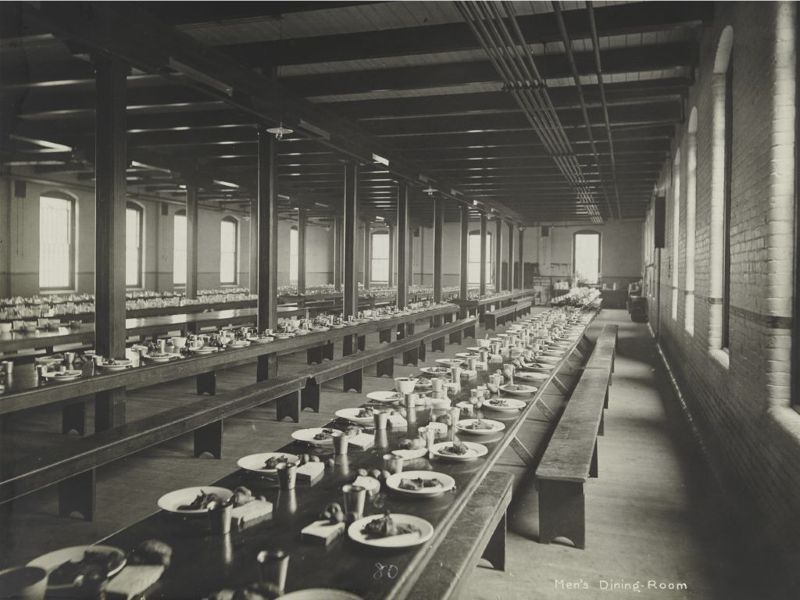
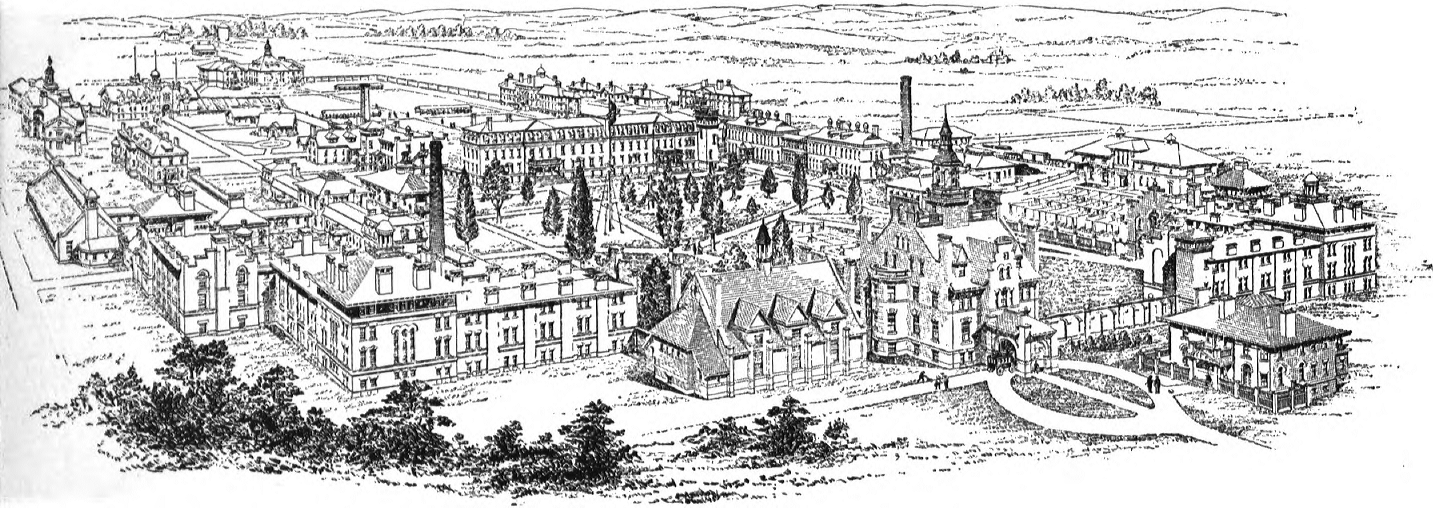
On February 4, 1938, a 79-year-old patient at the Tewksbury State Hospital shot and killed three fellow patients in their beds and critically wounded two more.
The attacker, John Mack, a 6’3” tall retired lumberjack from Chelsea, got out of bed at 4am that morning, after the night attendant left the ward to perform his other duties, and made his way to each of his victim’s beds and shot them with a pistol while they slept.
The victims were:
Michael O’Keefe, 65, of Boston. Shot through the lower abdomen and thigh.
James Magee, 78, of Amherst. Shot in the lower left abdomen.
Edward Mercier, 70, of Springfield. Shot in the abdomen and thigh.
John Lewis, 76, of Lowell. Shot in the groin.
Joseph O’Donnell, 55, of Stoneham. Shot in the back and the bullet exited through the chest.
Attendants rushed to the scene and saw Mack fleeing down the fire escape. Mack was captured three hours later by a Lowell policeman, Thomas Maguire, after the officer heard reports about the escaped patient and saw a man matching his description walking down Gorham Street in Lowell.
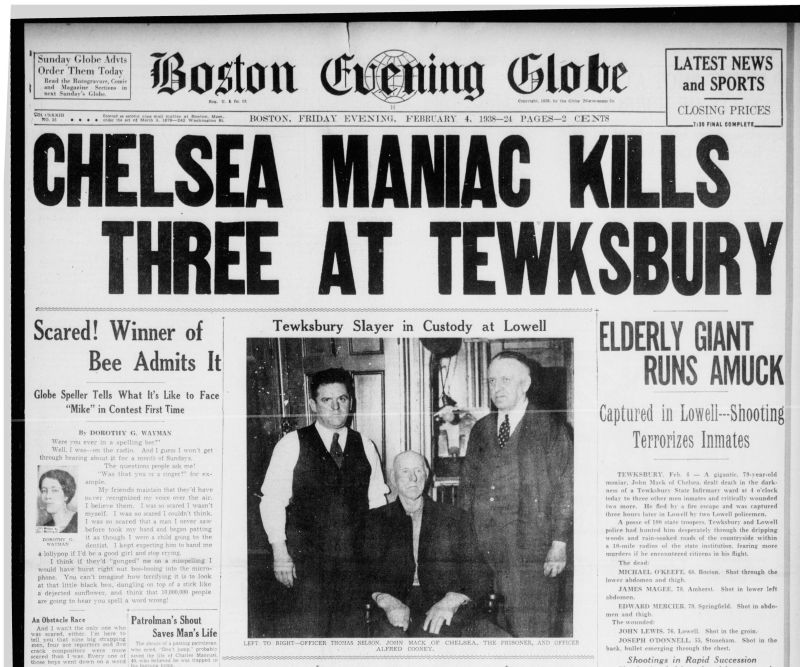
An off-duty Lowell policeman, Thomas Hickie, was waiting for a bus nearby when he saw Maguire approach Mack, and he ran over to assist in the arrest.
Mack had already discarded his pistol and didn’t resist the officers when he was arrested. The murder weapon was later found under a ramp near the Boylston Street Bridge.
About 50 state troopers had been mobilized to search for Mack in the woods surrounding Tewksbury State Hospital, where they thought he may be hiding out. Mack had instead walked six miles along the railroad tracks to reach Lowell and said he had planned to flee to Alaska.
After bringing him to the station, the police officers said Mack appeared to be dazed while they searched, fingerprinted, and photographed him. He was then booked on a charge of murder and held in a cell to await arraignment.
Mack confessed to the police after his capture, telling them he had been planning the shooting for two years and that he smuggled a pistol into the facility so he could shoot his five victims, who he claimed were bullying him.
“Sure I knew what I was doing,” Mack said. “I told them. They muttered things at me and when I was eating they called names at me under their breath. I knew them. I got them. I wish the gun had one more bullet for me. Did I miss [name redacted], well I didn’t mean to. He got under the bed and that’s why.” (“Chelsea Maniac Kills Three at Tewksbury,” 1938).
Mack said that he shot O’Donnell first because his bed was closest to his and then ran across the aisle to shoot Magee. He then shot Lewis in the adjoining bed.
Mack then ran through a door to the next dormitory and shot O’Keefe in his bed and then Mercier. At some point during the attack, Mack also shot at a patient named Leonard Lewis, but he missed because Lewis hid under the bed.
Mack had been in and out of Tewksbury State Hospital since 1932 and was most recently admitted on October 1, 1937. He had not been regarded as mentally ill and had been admitted to the hospital, which also served as an almshouse, as a pauper and was assigned to the ward for aged men.
Due to the fact that the men in his ward were elderly and not deemed mentally ill, there was no guard on duty in his ward the night of the attack.
Mack said he had obtained the gun, which was a cheap, .38-caliber Spanish-type revolver, by saving up his money and ordering it through a mail-order catalog from a New York sporting good store. He then stored the gun in a tin can in the woods near the Tewksbury State Hospital for over two years.
When he was arraigned later that day, it was revealed in court that Mack had recently cut off his own toe. When the judge, Francis F. O’Donnell, asked him why, he simply said that it had bothered him:
“I just took a chisel and cut my toe off. It bothered me. They found it in the bed the next day.” (“Chelsea Maniac Kills Three at Tewksbury,” 1938)
When he was also asked why he killed the men, he also said, “They bothered me.”
The fifth victim, Joseph O’Donnell, who was hospitalized in critical condition but eventually recovered, told police that Mack “lied when he says I teased him.” (Fourth Victim of Slayer Dies,” 1938).
Leonard Lewis also told police he didn’t know why Mack targeted him. “I don’t know why. I never bothered him,” he said.
Lewis described the shooting in an interview with the Boston Globe:
“It was one of the most horrible things I ever saw. The groanings of the wounded men and screams of different ones waking up to find what was happening were horrible to hear. No one dared move. We didn’t know where he had gone or when he’d start shooting again. We just stayed still and tried to hide. I was sure lucky he didn’t hit me.” (“Patient Shot at Tells of Horror,” 1938).
Mack pleaded not guilty to the three charges of murder and was held without bail at the East Cambridge Jail until his next hearing.
As Mack’s fourth victim, John Lewis, lay dying in his hospital bed, his last words were of forgiveness for Mack.
“I forgive him-I forgive him. You can tell him that. He must have gone crazy. I forgive h-.” he said as he died (Mannion 1938, 1).
About 12 hours after the shooting occurred, John Lewis died of his wounds, and Mack was charged with his murder as well.
On April 25, 1938, John Mack was found not guilty by reason of insanity and sentenced to life in prison at the Bridgewater State Hospital. Mack was reportedly unhappy about his sentence and told the judge, “If it’s all the same to you, I would like to have you send me to the electric chair.” (“Slayer of Four Asks for Chair,” 1938).
On July 9, 1942, John Mack hanged himself in his hospital room at Bridgewater State Hospital.
The Tewksbury shooting occurred while the state was in the middle of investigating about 500 violent deaths in mental hospitals since 1926. Hospital authorities and employees were being questioned, and records were examined of the various violent deaths in the 12-year period.
Sources:
“Chelsea Maniac Kills Three at Tewksbury.” The Boston Evening Globe, 4 Feb. 1938, p. 1.
Howard, Stanley W. “Patient Shot At Tells of Horror.” The Boston Globe, 4 Feb. 1938, p. 2.
“Kills Three Who Call Him Names.” Kentucky New Era, 4 Feb. 1938, p. 1.
“Aged Man Kills Three Inmates of Infirmary.” Spokane Chronicle, 4 Feb. 1938, p. 8.
“Man Kills 3 Hospital Inmates.” The Telegraph-Herald, 4 Feb. 1938, p. 1.
“Madman’s Gun Toll Increases to Four.” Youngstown Vindicator, 4 Feb. 1938, p. 41.
“Bullets Kill 3 Aged Men in Infirmary.” Reading Eagle, 4 Feb. 1938, p. 1.
“Slayer’s 4th Victim Dead.” The Boston Record, 5 Feb. 1938, p. 28.
“Vengeance Slayings Now Four.” The Telegraph, 5 Feb. 1938, p. 1.
“Inmate Who Slew Four Faces Trial.” The Milwaukee Journal, 5 Feb. 1938, p. 3.
“Accused of Killing Four at Asylum.” Reading Eagle, 5 Feb. 1938, p. 3.
“Fourth Victim of Shots Dies.” Spokane Chronicle, 5 Feb. 1938, p. 68
“Tewksbury Slayer Faces Arraignment on Fourth Murder Charge.” The Boston Transcript, 5 Feb. 1938, p. 1.
“Tewksbury Slayer in Daze at Court.” The Boston Globe, 9 Feb. 1938, p. 3.
“Indict Inmate for Tewksbury Deaths.” The Boston Post, 9 Feb. 1938, p. 4.
Mannion, John S. “Fourth Victim of Slayer Dies.” The Boston Post, 5 Feb. 1938, p. 1.
“Slugger of Three Under Observation.” The Boston Globe, 7 Feb. 1938, p. 3.
“Arraign Mack in Farm Killings.” The Boston Record, 10 Feb. 1938, p. 14.
“Precaution Taken as Three Slugged at State Asylum.” Springfield Republican, 10 Feb. 1938, p. 14.
“Slayer of Four Asks for Chair.” The Boston Globe, 25 Apr. 1938, p. 2.
“Giant Slayer Hangs Self in Prison.” The Nashua Telegraph, 10 Jul. 1938, p. 1.