
The Green Dragon Tavern was a public house located on Union Street in Boston, Massachusetts. It was a popular meeting place for the Sons of Liberty and the Freemasons during the American Revolution.
The land that the tavern was located on was originally granted to colonist James Johnson in 1635. Sometime around or before June 1676, the land came into the possession of the Salem Witch Trials judge William Stoughton. After he died in 1701, his niece Mehitable Cooper inherited the property.
It’s not clear exactly when the brick building that the tavern was located in was constructed, although various sources date it to 1680, but there was a two-story brick public house on the property by at least 1714.
The building was 50 feet long and 35 feet wide with a pitch roof, a long wing in the rear, and a garden behind the building. The property also had a large stable and a well. At the time the building was constructed, Union Street was known as Green Dragon Lane.
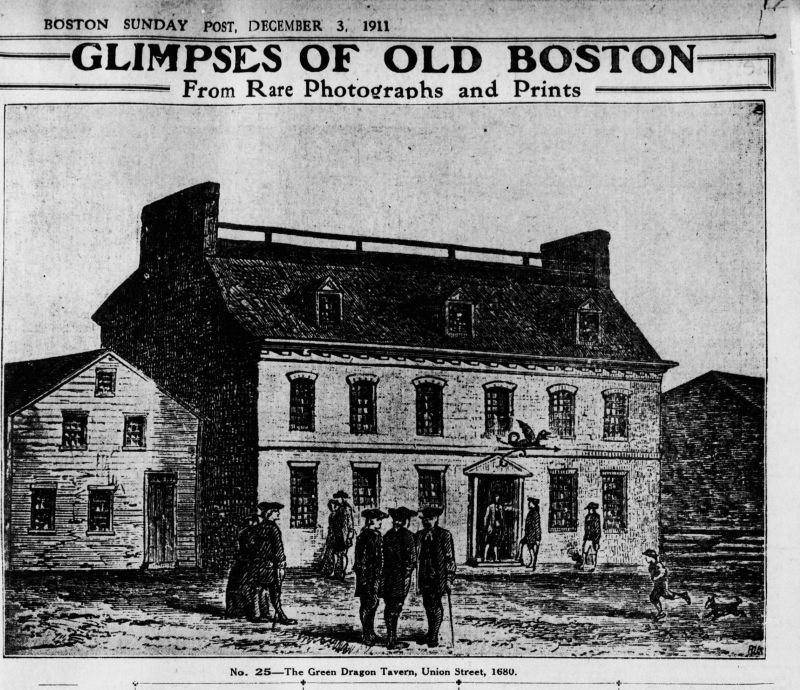
After Mehitable Cooper died in 1738, the property was inherited by her son, Reverend William Cooper, who later sold it to Dr. William Douglass in 1743. Douglass lived in the brick building on the property, which he called his “mansion house.”
After Douglass died in 1752, the property passed to his sister, who sold it to the Lodge of Saint Andrew for £500 in 1764.
Up until that point, Freemason lodges in Boston had previously met in the Bunch of Grapes Tavern starting in 1733. After the Great Fire of 1760 damaged the Bunch of Grapes Tavern in March of that year, these lodges began meeting in the Green Dragon Tavern instead. The Saint Andrew Lodge then purchased the Green Dragon Tavern on March 31, 1764.
The Green Dragon Tavern, which got its name from a copper sign in the shape of a dragon over its door, continued to operate in the basement of the building while the upper floors were used by the lodge for meetings.
According to various sources, the lodge changed the tavern’s name to the Freemason’s Arms after purchasing it and even placed a square and compass above the door (Boston Transcript 1868).
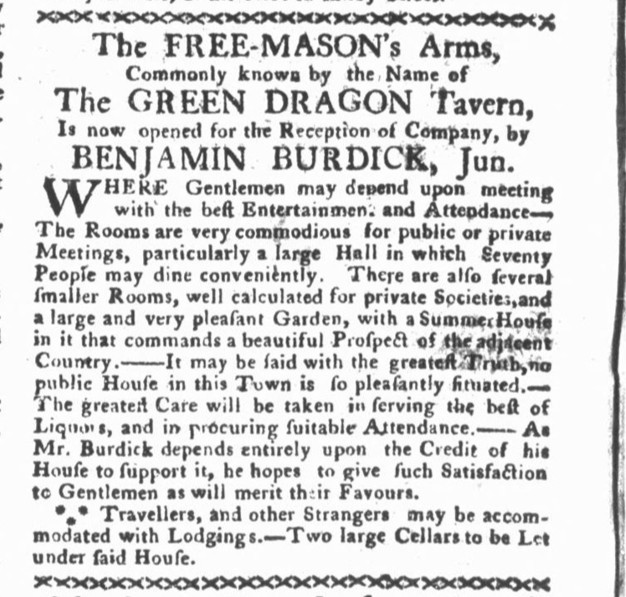
The new name didn’t stay for long, though, and the lodge rooms became known as Mason’s Hall, while it seems the tavern remained the Green Dragon Tavern.
It is believed that the Boston Tea Party was planned at the Green Dragon Tavern, which later prompted Daniel Webster to nickname it “the headquarters of the Revolution.”
Just prior to the Siege of Boston, the lodge held a meeting at the Green Dragon Tavern on Friday, March 3, 1775, which was presided over by General Warren. Having finished their business, the lodge made plans to reconvene on the first Friday in June.
That planned meeting in June did not take place, though, because the Battles of Lexington and Concord kicked off the Siege of Boston, during which the patriots fled the city and British troops were blockaded inside Boston. No meetings were held at the lodge again until December of 1776, many months after the siege had ended.
According to a news report in the Boston Herald in 1903, the Green Dragon Tavern building was used as a hospital for people of low income during the Revolutionary War.
In 1780, the Green Dragon Tavern became home to a young ladies’ academy, run by Benjamin Dearborn. Dearborn also opened a bookstore on the first floor of the building. Dearborn’s school soon outgrew the building, and he relocated to Milk Street.
In 1788, many of Boston’s mechanics, who were local artisans, craftsmen, and laborers, held a meeting at the Green Dragon Tavern, headed by Paul Revere, to make resolutions about the proposed federal constitution to give to Samuel Adams. When Adams read the resolutions, he asked Revere:
“How many mechanics were at the Green Dragon Tavern when these resolutions passed? ‘More, sir, than the Green Dragon can hold.’ ‘And where were the rest, Revere?’ ‘In the streets, sir.’ ‘And how many were in the streets?’ ‘More, sir, than there are stars.’” (Boston Commonwealth 1895.)
The first meeting of the Massachusetts Charitable Mechanic Association was held at the Green Dragon Tavern on January 15, 1795. Paul Revere presided as chairman during the meeting and was later elected the first president of the association on April 16, 1795.
On March 12, 1802, the Boston Commandery, which is now the oldest Knights Templar organization in the U.S., also held its first meeting at the Green Dragon Tavern.
In April 1825, the Green Dragon Tavern and its stable were made available for lease, according to a newspaper advertisement from that time.
Then in January 1826, the Green Dragon Tavern was put up for sale. The advertisement, which was placed by a man named Benjamin Smith, said the tavern was three stories tall, 52 by 40 feet in size, had a full cellar, was located on 12,000 square feet of land, and came with the large brick stable and well.
While the building was up for sale, ads for a two-year lease of the property continued to run in the local newspapers.
On September 26, 1828, Green Dragon Lane was widened and renamed Union Street, and some sources say the building was torn down at this time (Boston Globe 1886, 1963.) The building was being leased or operated at the time by Daniel Simpson.
Other sources say the building was instead either destroyed in a fire or was demolished in 1832. Whenever the building was demolished, the original green dragon sign is believed to have been lost.
Yet, an 1873 news report in the Boston Herald states, “At the time the old tavern was demolished, the old swinging sign with a gilt model of the dragon was preserved, and is now in the possession of an aged Mason.” It is not clear who this freemason was since he was not identified.
In 1854, the Lodge of Saint Andrew, who still owned the land, rebuilt the building as a warehouse. A new sign in the shape of a dragon was created for the building, but it was made out of sandstone instead of metal, according to an article in The Historical Magazine:
“In 1854, a Committee of St. Andrew’s Lodge was appointed to put in the new building, that stands upon the site of the old one, a memorial to commemorate the old house; and they inserted in the wall, on the first of November, 1855, a stone effigy, elaborately carved in sandstone, in a most skilful and artistic manner, by a workman in the employ of Mr. Thomas Bailey, of this city,…”
In December of 1873, the Boston Herald reported that a portion of the rear of the Green Dragon warehouse building was going to be torn down due to the extension of Washington Street. The article also said the building had been occupied for years by the late Edward Riddle as a “carriage mart.”
On August 19, 1892, a commemorative plaque was placed on the building, which read:
“On this spot stood
THE GREEN DRAGON TAVERN
The secret meet place of the
Sons of Liberty,
And in the words of Webster, the
Headquarters of the Revolution.
To mark a site forever as
Memorable as the birthplace of American freedom,
this tablet is placed by the
Massachusetts Society of the Sons of Revolution.”
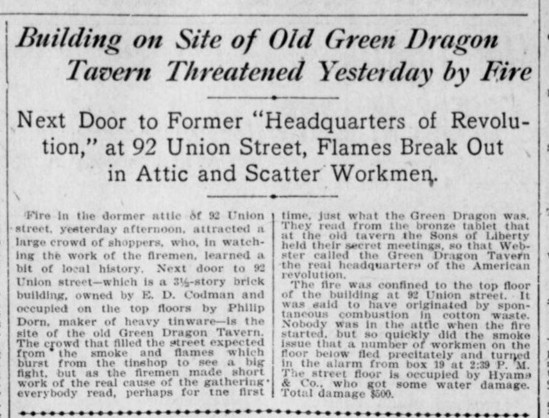
On December 22, 1904, a fire broke out in the attic of 92 Union Street, the building next door to the old Green Dragon Tavern building, but it was quickly contained (Boston Herald 1904).
The Green Dragon Tavern warehouse building was eventually torn down sometime in the 1960s during an urban renewal project, and, according to a 1963 Boston Globe article, the plaque was supposed to be removed and held in the headquarters of the Bostonian Society (which later became the Revolutionary Spaces organization).
According to Nathaniel Sheidley, President and CEO of Revolutionary Spaces, the plaque does not appear to currently be in their collection, but he said it’s possible it was added to the collection and then later removed at some point.
Sources:
Barleen, Steven D. The Tavern: A Social History of Drinking and Conviviality. ABC-Clio, 2019.
“The Green Dragon Tavern, or Freemason’s Arms.” The Square Magazine, thesquaremagazine.com/mag/article/202204the-green-dragon-tavern/
Drake, Samuel Adams. “Coffee Urn Used in the Green Dragon Tavern.” Old Boston Taverns and Tavern Clubs. W.A. Butterfield, 1917, pp. 88-89.
“The Free-Mason’s Arm’s.” The Boston Gazette, 1 Jul. 1771, p. 4.
“To Let for One Year.” The Boston Advertiser, 13 Apr. 1825, p. 2.
“Real Estate for Sale.” The Boston Advertiser, 3 Jan. 1826, p. 4.
“To Let, on a lease of two or more years, the Green Dragon Tavern, in Union Street.” The Boston Advertiser, 1 Jun. 1826, p. 4.
“Real Estate for Sale.” The Boston Advertiser, 13 Oct. 1826, p. 4.
“Green Dragon Stable.” The Boston Patriot, 8 Jul 1826, p. 4.
“Common Council.” The Boston Messenger, 18 Sept. 1828, p. 3.
“Seventeenth of June. Inauguration of the Warren Statue.” The Boston Messenger, 24 Jun. 1857, p. 1.
“Ancient Landmarks of Boston…No. 2. The Green Dragon Tavern.” The Boston Times, 21 Apr. 1867, p.2.
“The Green Dragon Tavern.” The Boston Transcript, 16 Nov. 1868, p. 2.
Shurtleff, Nathaniel B. “The Green Dragon Tavern Boston.” The Historical Magazine, Vol. 1, Henry B. Dawson, 1872,-3, pp. 28-31.
“The ‘Green Dragon’ Building.” The Boston Herald, 23 Dec. 1873, p. 2.
“From the Archives. Sketch of the Boston Commandry.” The Boston Daily Globe, 31 Jan. 1883, p. 1.
“The Old North End.” The Boston Globe, 11 Nov. 1886, p. 4.
“The ‘Old North End.’” Arlington Advocate, 12 Nov. 1886, p. 4.
“Mass. Charitable Mechanic Association.” The Boston Times, 3 Jul. 1887, p. 3.
“Hotel Notes.” The Boston Budget, 24 Dec. 1893, p. 15.
“Founded by Paul Revere.” The Boston Sunday Post, 17 Jan. 1895, p. 6.
“Paul Revere Its President.” The Boston Traveler, 9 Mar. 1895, p. 3.
“The Mechanics Association Celebrated the Centennial of Their Formation Last Spring.” Boston Commonwealth, 5 Oct. 1895, p. 3.
“Old Boston Landmarks. Green Dragon Tavern.” Roxbury Gazette and South End Advertiser, 13 Sept. 1902, p. 5.
“Famous Taverns of New England that Figured.” The Boston Herald, 17 May. 1903, p.48.
“Building on Site of the Old Green Dragon Tavern Threatened Yesterday by Fire.” The Boston Herald, 23 Dec. 1904, p. 12.
“7704. J.F. Writes of a Fire Society in Portsmouth Formed in 1780.” The Boston Transcript, 20 Feb. 1909, p. 30.
“No. 25-The Green Dragon Tavern, Union Street, 1680.” The Boston Sunday Post, 3 Dec. 1911, p. 34.
“Curiosity Corner.” The Boston Record, 5 Oct. 1920, p. 7.
“Genealogical.” The Boston Transcript, 31 Jan. 1921, p. 11.
“The Green Dragon Tavern.” The Boston Globe, 20 Aug. 1932, p. 6.
“The Green Dragon Tavern.” The Boston Globe, 30 Nov. 1936, p. 26.
“Knights Templar of Boston Mark Sesquicentennial.” The Boston Globe, 9 Mar. 1952, p. 11.
Harriman, Jane. “Where Samuel Adams and Revere Plotted. New Boston Gulps Green Dragon Birth Site of the Revolution.” The Boston Globe, 27 Jan. 1963, p. 73.
Bell, J.L. “The Real Green Dragon Tavern.” Boston 1775, 21 Aug. 2011, boston1775.blogspot.com/2011/08/real-green-dragon-tavern.html
“The Green Dragon Tavern Sign’s Winding Legacy.” Scottish Rite, NMJ, scottishritenmj.org/blog/green-dragon-tavern
“Green Dragon Tavern Historical Marker.” The Historical Marker Database, hmdb.org/m.asp?m=18091