
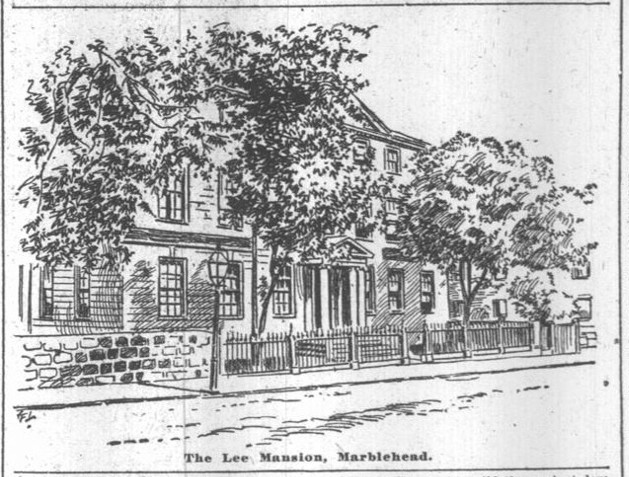
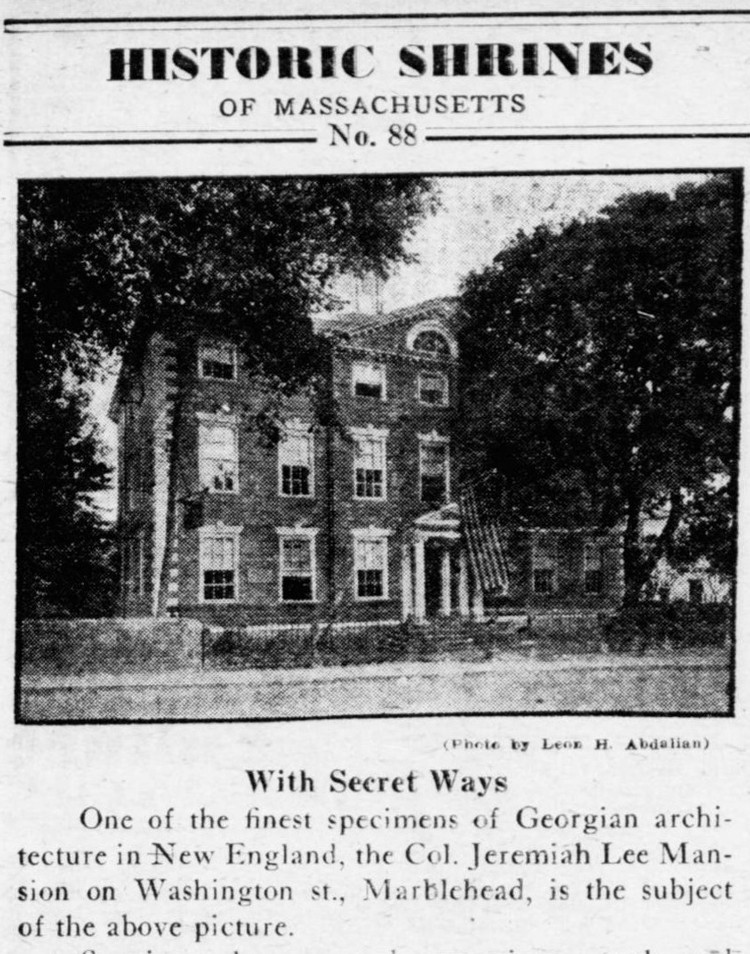
Built in 1767, the Jeremiah Lee Mansion is a Georgian-style house built for Jeremiah Lee on Washington Street in Marblehead.
The mansion is a three-story wooden Georgian-style house with rusticated wood blocks.
While living in the Lafayette House, Jeremiah Lee and his brother Samuel designed and began building this house in 1766, completing it in 1768.
At the time, Jeremiah Lee was a local merchant and a supporter of the American Revolution, serving as a member of the Committee of Safety.
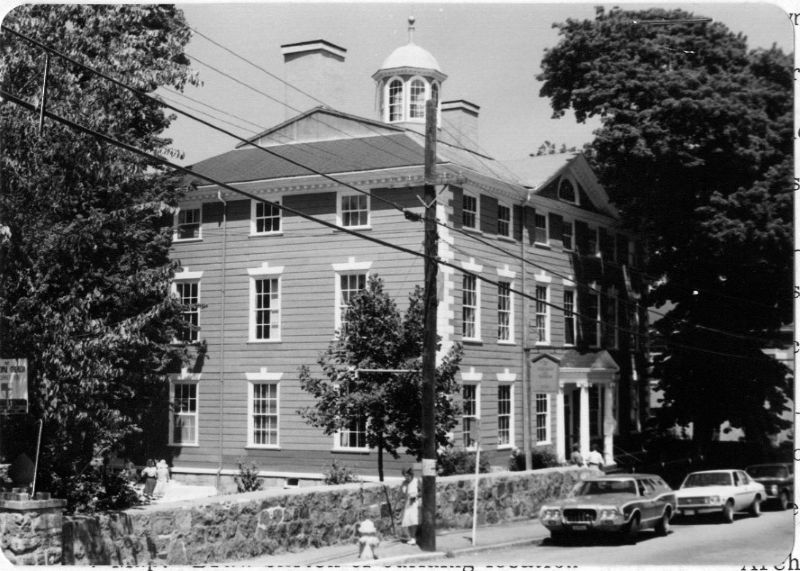
The house is 64 feet by 46 feet in size, has 15 rooms, and has a mahogany staircase brought from England; hand-carved mantels; rare original wallpapers also from England; carved mahogany wainscoting and mahogany railings; and a cupola with six small cathedral windows.
The massive front door opens upon the broad front hall, which extends the length of the house, and the main staircase, which is nearly seven feet wide.
On either side of the downstairs hall are the banquet room, which is paneled from floor to ceiling and features a mantel carved with fruit and flowers, and the parlor room, or dining room, which features paneled wainscoting, a carved frieze, and a fireplace with panels bordered by carved Corinthian pilasters.
At the rear of the dining room is the kitchen containing a massive fireplace. Just above the landing of the main staircase is a large cathedral window bordered by two Corinthian columns.
The four chambers on the second floor are the same size as the first floor rooms and feature paneled wainscoting, carved frieze, tiled fireplaces, and brass knobs.
The third floor is divided by two hallways, one running north and south, the other east and west. Two large chambers open off the former hall, and two small rooms are connected to them.
The east entrance to the mansion is located just off the back staircase and opens onto the yard, which is partially paved with gray cobblestones and some white stones engraved with the date 1768 located directly in front of the wide granite steps.
Not far from this side entrance is the stairway leading to the cellar, which is paved with bricks and features large brick storerooms.
According to an article published in the Boston Record in 1930, the house also has several secret hidden features, such as a secret stairway hidden behind a cupboard door that leads to a chamber above and a small panel disguised to look like a decorative part of a chimney piece but actually opens on hinges to reveal a bricked-in safe (“Historic Shrines of Massachusetts No. 88,” 1930).
A two-story brick building on the east side of the mansion served as slave quarters back in the day and used to be connected to the main house by a covered passageway that has since been removed.
In 1775, Jeremiah Lee died from a fever he developed from exposure while trying to evade British troops in Concord on the night of Paul Revere’s midnight ride.
Lee died insolvent, and his house was later sold to Chief Justice Samuel Sewall, who was the great-grandson of Judge Samuel Sewall of the Salem Witch Trials.
Sewall later sold it to the Marblehead National Bank in 1804, who used the first floor for banking business and the upstairs as a residence for the banker.
In 1900, the Marblehead Historical Society began using the old slave quarters on the property as its headquarters.
An article published in the Boston Globe in 1904 refutes the rumors and stories about secret stairways in the house, saying that one or two of the upper rooms are connected by stairways leading from large closets, but there is nothing secret about them (“Historic Marblehead Building To Go,” 1904).
In 1904, it was announced that the Marblehead National Bank was going out of business and the mansion would be sold.
In 1909, hearing that the building had been recently sold at auction and might be renovated or altered, the Marblehead Historical Society bought the mansion for $5,500 and restored it to its original condition by tearing down partitions, opening and retiling fireplaces, and reproducing damaged sections of the original wallpaper.
According to an article in the Marblehead Messenger, the date of the mansion’s construction was relatively unknown until the restoration:
“When restoration began on the mansion an old resident remarked ‘why don’t you dig up the date?’ He then proceeded to explain that the date was under the sod in the East yard. A foreman with hoe and shovel uncovered a pavement of brown cobblestones at the base of the granite side steps with 1768 outlined in white stones among the brown.” (“Jeremiah Lee Mansion,” 1948)
On October 9, 1960, the Jeremiah Lee Mansion was designated a National Historic Landmark. On October 15, 1966, it was added to the National Register of Historic Places.
Sources:
“Historic Building Detail: MAR.253 Lee, Jeremiah Mansion.” MACRIS, mhc-macris.net/details?mhcid=MAR.253
“Relics of Brave Old Days.” New York Times, 2 Sept. 1894, p. 20.
“Historic Marblehead Building To Go.” The Boston Globe, 6 Mar. 1904, p. 9.
Beede, Carl Greenleaf. “A Colonial Merchants Home.” Christian Science Monitor, 20 Aug. 1927, p. 9.
“The Lee Mansion Membership Drive.” Marblehead Messenger, 16 Sept. 1927, p. 1.
“Historic Shrines of Massachusetts No. 88.” The Boston Record, 7 Aug. 1930, p. 20.
“Jeremiah Lee Mansion.” Marblehead Messenger, 24 Jun. 1948, p. 2.
“Open House in Retrospect.” Marblehead Messenger, 19 Aug. 1954, p. 5.