
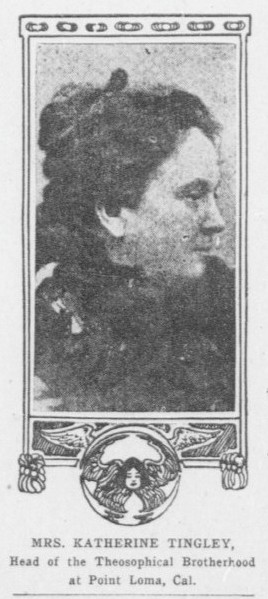
Katherine Augusta Westcott Tingley was a social worker who later became the leader of an esoteric occult group called the Theosophical Society.
Tingley was born in Newburyport, Massachusetts, to James P. and Susan Westcott on July 6, 1847. She grew up in a house near the Moseley estate and was educated in public schools in Newburyport.
Her grandfather was the Grand Master of the Masonic order in Massachusetts and Rhode Island, was a student of mysticism, and reportedly tutored his granddaughter in the ways of mysticism.
When Katherine was around 10 years old, her parents sent her to a Roman Catholic convent in Quebec in an attempt to cure her of her claims of visions and psychic experiences.
After leaving the convent, Katherine started working in prison reform, became involved in charitable work for impoverished people, and also developed an interest in spiritualism.
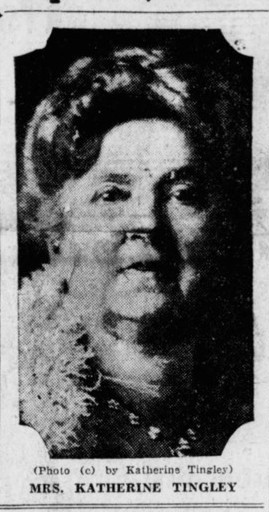
After two unhappy marriages, Katherine married her third husband, Philo B. Tingley, an inventor, in 1888, and they lived at Point Loma, California.
Tingley was working as a social worker in New York City when she met the leader of the Theosophical Society, William Quan Judge, in 1892/93. She officially joined the Theosophical Society on October 13, 1894.
After Judge died on March 22, 1896, Tingley became his successor, becoming the high priestess of the society, earning her the nickname the “Purple Mother” because she wore the color often. In June 1896, she began a world tour to spread the word of Theosophy across the globe. The world tour ended on April 4, 1897.
In 1897, the New-York Tribune published an article about Tingley in which it described her as “a woman of striking appearance, stoutly built, but possessed of a tall, well-balanced figure and dignity of movement. Her nose and mouth are small and refined. Her eyes are very unusual, large, of a soft brown color, with an ever-changing expression and a power of penetration which is characteristic of the adept seer.”
Also in 1897, Tingley established a summer home in New Jersey for children from the East Side of New York City and established a Wayfare Home in Buffalo, New York, for destitute women. Tingley also established the New Century, a weekly newspaper that she edited herself. The paper’s name was later changed to Century Path.
On January 13, 1898, Tingley formed the Universal Brotherhood in New York City. That June, Tingley established the Isis League of Art, Music, and Drama in New York City, and in August she established an emergency hospital at Montauk, Long Island, for sick soldiers returning from the Cuban campaign. She also established numerous Boys’ Brotherhood Clubs throughout the world that year.
In February 1899, Tingley organized an expedition for relief work in Cuba during the Spanish-American War on behalf of the International Brotherhood League Work.
In 1900, Tingley moved the international headquarters of the society from New York City to Point Loma, where she founded the Theosophical commune, Lomaland, in Point Loma, San Diego. It was here that Tingley established the Raja-Yoga School and College, the Theosophical University, and the School for the Revival of the Lost Mysteries of Antiquity.
In July 1901, Tingley began construction on the first open-air Greek theater in America, which was completed in November.
In November of 1902, Tingley’s adopted son, Henry Baron, told the press he recently escaped from Point Loma and went into hiding in San Francisco, where he made plans to sue Tingley for the recovery of papers that he believed would reveal the secret of his parentage.
Baron also claimed that members of the Theosophical Society were being starved and mistreated at Point Loma, according to an article in the Salt Lake Herald:
“I left Point Loma because I am discouraged and broken-hearted. I am disheartened by the way the poor people are treated there. I do not believe some of them get enough to eat. Those who are not rich enough to pay their way must work for the others. There are mothers over there who are not allowed to see their children. Mrs. Tingley says that mother love breeds selfishness. So they keep the children by themselves.”
In November of 1902, eleven Cuban children being brought to the United States to be educated at Point Loma were detained at Ellis Island due to allegations from the Prevention of the Cruelty to Children that Point Loma was unfit for children.
That same month, according to a news report in the Boston Herald, Elbridge T. Gerry, the president of the Society for the Prevention of Cruelty to Children, filed numerous affidavits in the case against the Theosophy School in California, which were deemed too scandalous to print in the newspaper.
The board of inquiry overseeing the case later recommended that the U.S. Immigration Commission should not admit the children. Yet, after Immigration Commissioner Frank P. Sargent reviewed the case and visited Point Loma to examine the conditions at the school, he was so impressed that he ordered the children to be released.
In December of 1902, Tingley sued the Los Angeles Times over an interview it published in October of 1901 with Mrs. M. Leavitt, a rival member of the Theosophical Society.
The article, titled “Outrages at Point Loma: Exposed by an `Escape’ from Tingley. Startling Tales told in this City. Women and Children starved and treated like Convicts. Thrilling Rescue,” claimed Tingley starved her followers, mistreated them, and forced them to do hard labor.
During the trial, many former members of Point Loma gave depositions against Tingley. One such deposition was given by the former bookkeeper for the Theosophical Society, Louis S. Finch, who stated that Tingley was a very controlling leader who starved her followers and controlled where they lived, who they talked to, and what they did at all times.
Another former member, Jerome A. Anderson, also stated that Tingley enslaved her followers and taught them nothing but “hatred, suspicion, calumny, deceit, lies, and everything that is bad.”
Another deposition was given by Matilda Kratzer, who stated that she was forced to work long hours in the kitchen at Point Loma during the spring and summer of 1900, and she also described the strange costumes and ceremonial rituals that she witnessed in the commune.
Tingley won the libel suit against the Los Angeles Times in 1903, after the Times was unable to substantiate its claims, but the jury only awarded $7,500 instead of the $50,000 Tingley sought.
Also in 1903, a man named E.W. Schmidt of Los Angeles was arrested on charges of trying to extort Katherine Tingley.
In July 1906, Tingley established the Women’s International Theosophical League. She then began construction on the Cuban International Theosophical Headquarters in November 1908.
In 1909, Tingley purchased a tract of land on the San Juan Heights battlefield in Cuba and built a memorial archway at the entrance to the property to honor those who had died in the Spanish-American War.
On March 18, 1909, Tingley purchased the historic Timothy Dexter House in her hometown of Newburyport, Massachusetts, renamed it Laurel Terrace, and began plans to establish a New England school of Theosophy there.
Between 1910 and 1913, Laurel Terrace was targeted repeatedly by burglars and arsonists in what appeared to be an attempt to uncover hidden objects or documents in the house. Tingley refused to comment on the case.
In the summer of 1910, a wealthy member of the Theosophical Society, Mrs. Thurston, died suddenly at Tingley’s estate in Newburyport.
After learning that Thurston left money in her will to the society and that a significant amount of money was missing from her accounts, Thurston’s family filed suit against Tingley for having “undue influence” over her at the time of her death. Tingley lost the suit and agreed to split the inheritance with Thurston’s family.
In October 1911, Tingley established the Men’s International Theosophical League of Humanity.
In the spring of 1914, Tingley sold Laurel Terrace in Newburyport and began looking for another property in Newburyport where she could continue her plans to establish a school.
On June 22, 1915, Tingley founded the Parliament of Peace and Universal Brotherhood, and she demanded a retraction from the New York World newspaper for statements made in an article about her. The publication printed a retraction the following month.
Also in 1915, Tingley published her book Theosophy and Some of the Vital Problems of the Day with the Theosophical University Press.
In 1919, Tingley founded the Theosophical University at Point Loma. Tingley also established several theosophical branch centers in America and in Europe and a summer school for children in Sweden. She also established the publicity department for Theosophy for special propaganda work.
In September of 1915, another wealthy member of the society, A.G. Spaulding, died at the Point Loma commune and left his $200,000 fortune to the society. His family later contested the will, claiming Tingley had “undue influence” over him at the time of his death.
In December 1919, Tingley acquired possession of her childhood home, Laurel Crest, on the banks of the Merrimack River in Newburyport and planned to open a Theosophy school there.
In 1921, Tingley lost a $100,000 suit filed by Irene Mohn, the wife of a member of the society, Dr. George W. Mohn, for having alienated the affections of Dr. Mohn. The district court later reversed the decision.
In 1921 and 1922, Tingley published two more books: Marriage and the Home and Theosophy, the Path of the Mystic.
In 1923, Tingley lost her appeal to the California Supreme Court in the Mohn case and was ordered to pay $100,000 to Irene Mohn.
Katherine Tingley died in Germany on July 11, 1929, after succumbing to injuries sustained during a car accident while on a European lecture tour. Her body was cremated, and her ashes were buried in Point Loma, California, that autumn.
Sources:
“Brief Chronology of Some Important Events in the History of the Theosophical Movement.” Marriage and the Home. Theosophical Publishing Company, 1921, pp. 41-46.
Kirkley, Evelyn A. “Starved and Treated Like Convicts.” The Journal of San Diego History, sandiegohistory.org/journal/1997/january/theosophical/
“Tingley v. Times Mirror.” Casemine, casemine.com/judgement/us/5914cef1add7b0493481df88
“Tingley v. Times Mirror Company.” Studicata.com, studicata.com/summaries/supreme-court-of-california/tingley-v-times-mirror-company-1907-6bvuoq/
Smith, Jeff. “The Many Trials of Madame Tingley, Part Four.” San Diego Reader, sandiegoreader.com/news/2014/jun/11/unforgettable-many-trials-madame-tingley-part-four/
Rasmussen, Ceilia. “San Diego Theosophists Had Own Ideas on a New Age.” Los Angeles Times, 3 Aug. 2003, latimes.com/archives/la-xpm-2003-aug-03-me-then3-story.html
“Katherine A. Tingley: A Leader of the Theosophical Movement Throughout the World.” New-York Tribune, 11 Apr. 1897, p. 18.
“A Busy Worker.” Spokane Chronicle, 22 Oct. 1898, p. 5.
“Deserted Point Loma.” The Salt Lake Herald, 18 Nov. 1902, p. 3.
“Purple Mother Scandal.” The Boston Herald, 19 Nov. 1902, p. 11.
“Cuban Children Detained.” Sun Journal, 1 Nov. 1902, p. 17.
“Point Loma Institution.” Pullman Herald, 27 Dec. 1902, p. 6.
“Tells of Life at Point Loma.” The San Francisco Call, 31 Dec. 1902, p. 5.
“Mrs. Tingley Has Schmidt Arrested.” The Savannah Morning News, 14 Jan. 1903, p. 1.
“Monument for San Juan Hill.” Evening Star, 17 Jan. 1907, p. 12.
“Will Found a School Here.” Newburyport Daily News, 8 Aug. 1907, p.
“Purple Mother to Live in Bay State.” The Boston American, 21 Mar. 1909, p. 9.
“Mrs. Katherine Tingley Tearfully Denunciative.” The Boston Record, 31 Jan. 1912, p. 6.
“Katherine Tingley Loses in $217,000 Will Contest.” The Daily Phoenix, 20 Mar. 1912, p. 16.
“Purple Mother Robbed.” New-York Tribune, 31 May. 1931, p. 7.
“His Fortune Goes to the Theosophy Cult.” The Telegraph-Herald, 16 Oct. 1915, 6.
“Live News Summary.” The Daily Ardmoreite, 15 Apr. 1921, p. 6.
“Tingley Alienation Case to be Reheard.” The Boston American, 12 May. 1921, p. 13.
“The Purple Mother.” The Evening News, 23 Jul. 1923, p. 7.
“San Diego Court Brands Cult Head $100,000 Vampire.” Edmonton Journal, 26 Jul. 1923, p. 5.
“Mrs. Tingley Seriously Hurt in Auto Crash.” The Boston Globe, 1 Jun. 1929, p. 1.
“Mrs. Katherine Tingley, Noted Theosophist, Dies.” The Boston Traveler, 11 Jul. 1929, p. 1.
“Services for Mrs. Tingley Tomorrow.” The Boston Globe, 13 Jul. 1929, p. 6.
“Cults, the Occult, and Theosophy.” The Theosophical Society in America, theosophical.org/component/content/article/cults-the-occult-and-theosophy?catid=25&Itemid=1107
“Theosophy: Cult of the Occult.” Time Magazine, 19 Jul. 1968, time.com/archive/6636378/theosophy-cult-of-the-occult/