
Richard More was a Mayflower passenger and an indentured servant to Pilgrim William Brewster.
More was born on November 13, 1614, in Corvedale, England, and was baptized at St. James Parish in Shipton, Shropshire, England. He had three siblings: Elinor, Jasper, and Maria.
Their parents, Samuel More and Katharine More, were second cousins who entered into an arranged, or possibly even forced, marriage in 1610 in order to keep Katherine’s estate in the family.
In 1616, Samuel More accused his wife of adultery, and in later court proceedings, Katherine Moore admitted that she had been unfaithful to her husband with a tenant farmer on their property, Jacob Blakeway. Although it was never proven, Samuel More suspected that their children were not his own.
Samuel More learned of the Separatist’s voyage to the New World from his employer, Lord Zouche, who was an investor in the expedition, and decided to rid himself of the children by placing them as servants of various influential families on the ship.
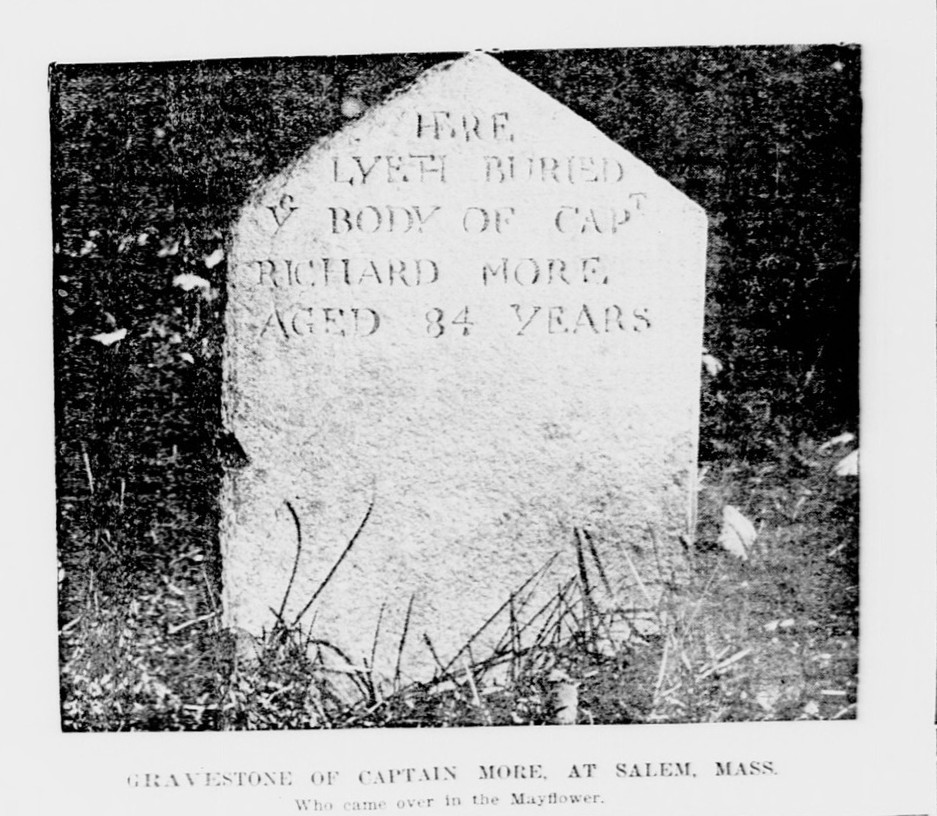
Upon arriving in the New World, Richard was the only one of the More children to survive the first winter in Plymouth Colony. In the fall of 1621, Richard More attended the First Thanksgiving at Plymouth.
Richard continued living with the Brewster family and was listed as their servant in a document from 1627. Richard’s indentured servitude ended in 1627, and the following year he was apprenticed to Isaac Allerton, a merchant seaman, and accompanied him on voyages along the coast selling grain, fish, and tobacco.
At some point, Richard More returned to England because in 1635, at the age of 20, he was listed as a passenger on a ship called the Blessing, which was traveling from England to New England. It was during the long voyage that Richard met a young woman onboard named Christian Hunt.
On October 20, 1636, More married Christian Hunt in Plymouth, Massachusetts. They lived on a farm in Duxbury until 1637, when More sold his 25 acres of land for £21 and moved to Salem, Massachusetts, where he was granted half an acre of land.
Richard More and Christian Hunt had seven children: twins Samuel and Thomas, Caleb, Joshua, Richard, Susanna, and Christian, who were all born and baptized in Salem between 1642 and 1652.
More became a ship captain, captaining ships that carried supplies to New York, Virginia, Nova Scotia, and the West Indies.
During his marriage to Hunt, More reportedly also married a woman named Elizabeth Woolnough in England, according to a marriage record for a “Richard More of Salem in New England Maryner” at St. Dunstan’s, Stepney, Middlesex, England, on October 23, 1645, and the couple reportedly had a daughter named Elizabeth. Yet, some historians debate if this is actually the same Richard More of Salem or a different Richard More.
In April of 1646, More was summoned to appear before the High Court of Admiralty in England on charges of being intoxicated in the company of a prostitute and a child, believed to be his daughter Elizabeth, but he failed to show because he reportedly fled to New England.
In 1653, More fought a naval battle against the Dutch near New York. In 1654, he joined a fleet of English ships to capture the French fort at Port Royal.
In 1674, More opened a tavern in Salem where he sold beer and cider. When King Philip’s War broke out the following year, More marched with a militia to South Kingstown and fought in the Great Swamp Fight.
When More’s wife, Christian, died in March of 1676, More married Jane Hollingsworth Crumpton in 1678. Also in 1678, More was caught performing “gross unchastity” with another man’s wife and was censured by the Salem elders.
In 1679, More sued Thomas Chubb for an unpaid debt in a case known as Capt. Richard More v. Thomas Chubb and had him arrested and imprisoned, according to court records.
On October 8, 1686, More’s wife, Jane, died and was buried in the Old Burying Point Cemetery in Salem.
More was caught again with another man’s wife in 1688, and, on July 1, at the age of 74, he was excommunicated from a church in Salem for the crime. More accepted the punishment, made a public repentance, and was later restored to the church in 1691.
When the Salem Witch Trials began in the late winter of 1692, Richard More didn’t participate in the trials, but he knew many of the accused personally, particularly John Proctor and Giles Corey.
Captain Richard More died sometime between March 19, 1693, and April 20, 1696. More was buried next to his two wives, Christian Hunt and Jane Crumpton, at the Old Burying Point Cemetery in Salem.
In 1901, Richard More was officially identified as a Mayflower passenger, and the Old Burying Point Cemetery made national news for having the only original Mayflower passenger headstone still in existence.
The headstone was discovered by George Ernest Bowman, editor of the Mayflower Descendant magazine, and the news was first printed in an article in the magazine titled “The Only Mayflower Gravestone.”
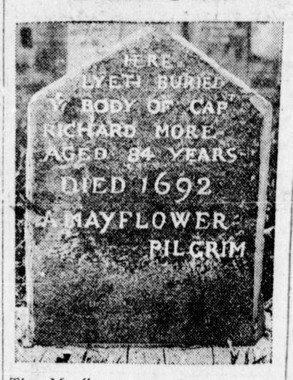
Due to the discovery, an unknown person incorrectly decided More had died in 1692 and later added the words “Died 1692 A Mayflower Pilgrim” to the bottom of his headstone in 1918, according to a news article written by Bowman in the Boston Herald in 1920. Bowman referred to the engraving as a desecration, adding that it was inaccurate and inappropriate:
“Even if it had been accurate, appropriate and properly executed, it would still have been extremely poor judgment to cut a gravestone which had stood unaltered for more than two centuries any addition to the original inscription.”
In June of 1930, the Colonel Timothy Pickering chapter of the Daughters of the American Revolution placed a memorial marker at the former site of Richard More’s property, which is located on the grounds of the Lydia Pinkham Memorial Clinic on Derby Street in Salem, MA. The bronze tablet on the marker reads, “This land was once owned by Richard More, the only Mayflower passenger to move from Plymouth to Salem.”
In 1970, historians also discovered that More and his siblings were the only Mayflower passengers with known royal ancestry, as they were descendants of King David I, King Edward I of England, Alfred the Great, and Charlemagne.
Sources:
Records and Files of the Quarterly Courts of Essex County, Massachusetts: 1678-1680. Essex Institute, 1919.
Lindsay, David. Mayflower Bastard: A Stranger Among Pilgrims. Thomas Dunne Books, 2007.
“Richard More.” The Historical Marker Database, hmdb.org/m.asp?m=249419
“Richard More: The Pilgrim Saint Who Sinned a Lot.” New England Historical Society, newenglandhistoricalsociety.com/richard-more-the-pilgrim-saint-who-sinned-a-lot/
Ferguson, Diane. “Richard More: the Shropshire outcast who sailed to riches on the Mayflower.” The Guardian, 15 Feb. 2020, theguardian.com/education/2020/feb/15/richard-more-shropshire-outcast-who-sailed-to-riches-mayflower
“Memorial Unveiled To Salem Mariner.” The Boston Globe, 15 Jun. 1930, p. 12.
“Patriotic Historical Societies.” The Boston Evening Transcript, 22 Oct. 1930, p. 32.
“Lays Wreath on Pilgrim Ancestor’s Grave.” The Boston Evening Transcript, 26 Sept. 1928, p. 9.
Bowman, George Ernest. “History Falsified by Desecration.” The Boston Herald, 14 Nov. 1920, p. 28.
Bowman, George Ernest. “Only Known Gravestone of Pilgrim Voyager Desecrated.” The Boston Post, 7 Nov. 1920, p.65.
Bowman, George Ernest. “Another Pilgrim Ancestor Found.” The Boston Globe, 24 Oct. 1920, p. 45.
“Gravestone at Salem, Mass., Of One of Those Who Came Over in the Mayflower With the Pilgrims in 1620.” New York Tribune, 17 Aug. 1902, p. 38.
“The More Family.” The Mayflower Society, themayflowersociety.org/passenger-profile/passenger-profiles/the-more-family/
“Found a Mayflower Grave.” The Sun (New York), 24 Mar. 1902.
“A Mayflower Tombstone.” The Camden Chronicle, 4 Jul. 1902.