
In November of 1838, the Worcester State Hospital, known at the time as the Worcester Lunatic Asylum, held a Thanksgiving feast for its patients, during which they had a traditional Thanksgiving meal and danced to live music.
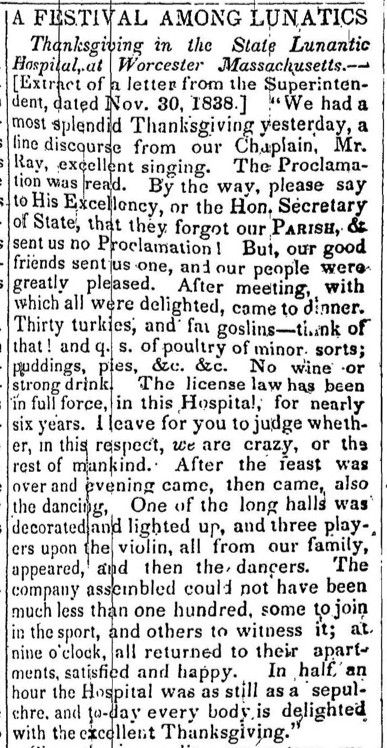
Details of the celebration came from a letter, written by the superintendent of the asylum, dated November 30, 1838, which was published in numerous newspapers across the country.
The letter started off by complaining that the Secretary of State forgot to send the asylum’s chapel a Thanksgiving Proclamation, but the asylum managed to secure one anyway and read it at a special Thanksgiving service.
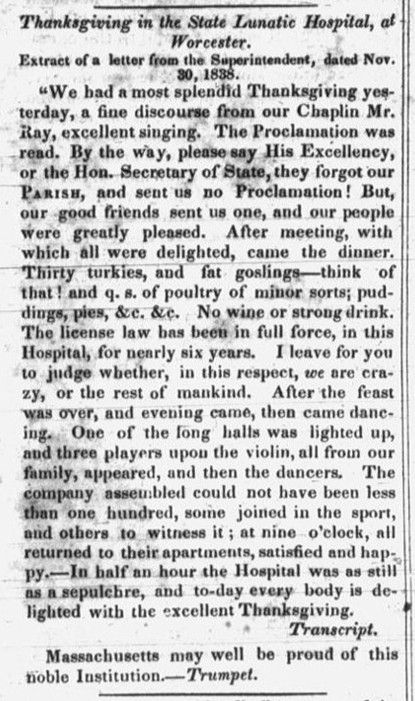
After the service, the superintendent said that around 70 to 80 patients enjoyed a Thanksgiving meal in the great hall where they feasted on 30 turkeys, various types of poultry, puddings, and mince pies. No wine or “strong drink” was served, probably because the majority of the patients suffered from intemperance.
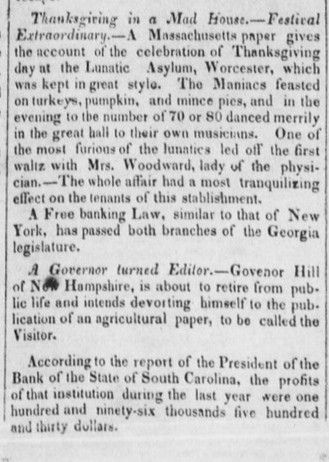
After the meal was over, the patients danced to live violin music played by some of their fellow patients in one of the long halls. The superintendent estimated that around 100 patients attended the dance, and some joined in while others merely watched. According to one news report, one of the patients even danced with Mrs. Woodward, the wife of the hospital’s physician:
“One of the most furious of the lunatics led off the first waltz with Mrs. Woodward, lady of the physician. The whole affair had a most tranquilizing effect on the tenants of this stablishment.” (Columbus Democrat 1839)
The celebration ended around 9pm, and the patients all returned to their rooms “satisfied and happy,” and the hospital was as “still as a sepulcher” within a half hour.
In late January of 1839, an unnamed woman sent a letter to the editor of a local newspaper, explaining that she was a former patient at the hospital and that she was present at the Thanksgiving celebration that year. She confirmed that the hospital held Thanksgiving services at the chapel that day and that they were then served a feast of turkey, chicken, and pies and “everything which could be desired.”
The woman said that at 7pm, one of the long halls was decorated with evergreens and decorative lights and that two violin players performed music for them, beginning with a march. She estimated that there were about 70 to 80 patients at the dance.
She also confirmed that Dr. Woodward was at the dance with his two youngest children and his wife and that one of Woodward’s patients, who was usually in a high state of mania most days, was calm and happy that night and politely asked to dance with Mrs. Woodward, which she accepted.
She said that some of the patients preferred not to dance and instead sat on benches and settees dressed in nice clothes with flowers and bows in their hair and that the overall scene was very joyous:
“I can only wish you had been eye witness, for it is impossible for me to do justice to the scene. What a blessing to the community is this institution!” (“A Festival Among Lunatics,” 1839)
She said the patients retired to their rooms after the dance with “hearts overflowing with gratitude to their kind friend, Dr. Woodward, who is ever ready to favor them all, according to their capacity for rational enjoyment, and whose greatest happiness seems to consist in affording them all the gratification in his power.”
Sources:
“Thanksgiving in the State Lunatic Hospital at Worcester.” The Boston Advocate, 6 Dec. 1838, p. 2.
“Thanksgiving in the State Lunatic Hospital, at Worcester.” Hingham Patriot, 15 Dec. 1838, p. 3.
“Thanksgiving in a Mad House.” Columbus Democrat, 12 Jan. 1839, p. 2.
“A Festival Among Lunatics.” Wooster Journal and Democratic Times, 23 Jan. 1839, 1.
“Thanksgiving in a Mad House.” Arkansas Gazette, 30 Jan. 1839, p. 4.