
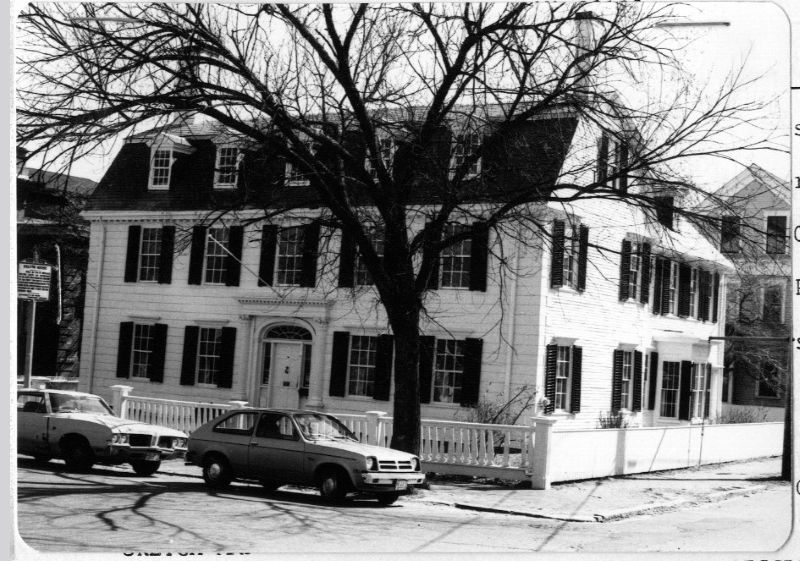
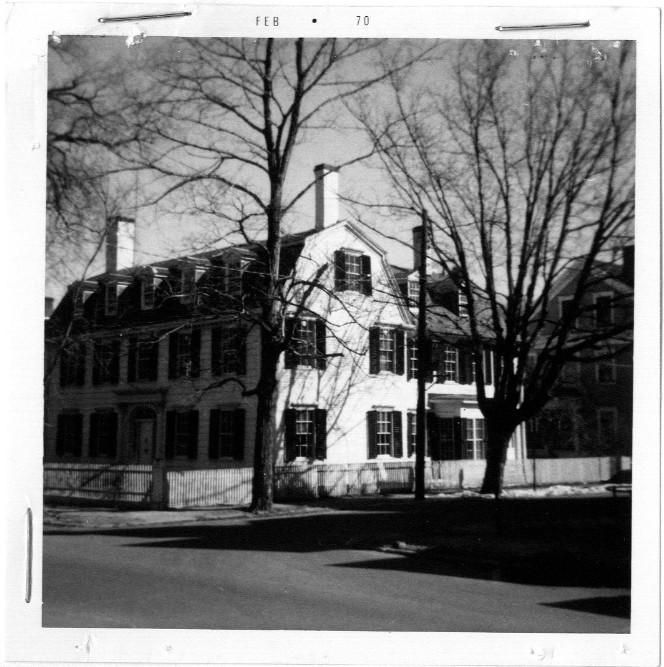
The Michael Dalton House is a historic Georgian-style house on State Street in Newburyport, Massachusetts.
Built in 1747 for local mariner Michael Dalton, it is a 2 1/2-story wood frame house with a slate gambrel roof. The facade of the house is made of rusticated wood, while the sides are clapboarded.
The house contains 25 rooms and features a spiral staircase, dormer windows, and three chimneys. The house originally had a roof balustrade, which has since been removed.
The entrance leads to a large hall with wall paneling on each side. The drawing room is a large room just to the left of the hallway. It features a hand-carved fireplace and large panels above it, which display the Dalton coat of arms. It also has recessed windows with window seats and shutters.
To the right are double parlors, which also feature paneling but very little of the elaborate hand carving.
At the rear of the house are the servant’s quarters. The house originally also had stables at the rear of the house, just behind a courtyard, and three acres of gardens and grasslands.
The stairs lead to a wide landing with a colonial window, and the second flight of stairs leads to the second floor, where the hall corresponds with the lower hall and the rooms correspond with the rooms below.
The hall is finished with wall panels, but the door casings and fireplaces are hand carved. The third floor was used for guest rooms.
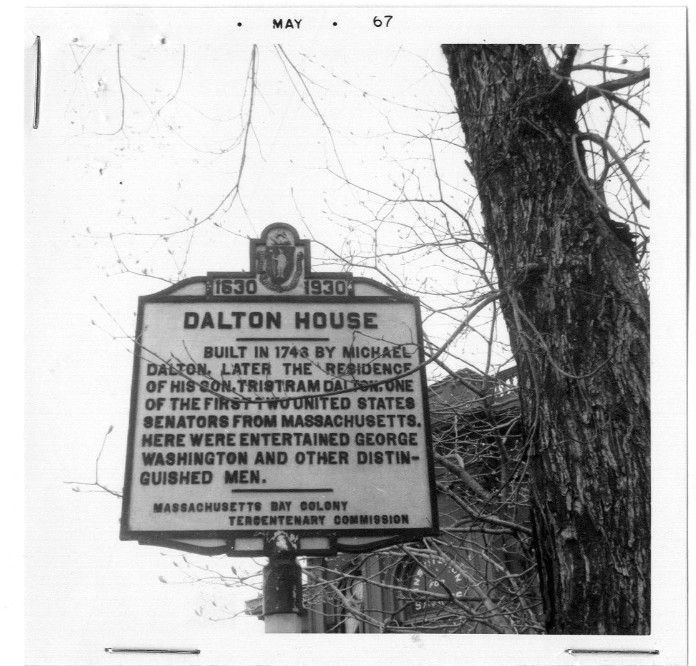
In 1764, Dalton deeded the house to his son Tristam. During the American Revolution, Tristam was a delegate in the Provincial Congress, a representative to the General Court, a Speaker of the Massachusetts House, and a delegate to the ratifying convention of 1788 in Massachusetts.
After the Revolutionary War, Tristam Dalton became one of the first United States senators from Massachusetts. When Dalton owned this house, it was visited by many notable figures such as George Washington; Thomas Jefferson in 1784; John Quincy Adams; James Monroe; and Marquis de Lafayette in 1824.
Another notable visitor to the house was Colonel Benedict Arnold, who dined at the house with Dalton on September 13, 1775, before sailing off to take part in the capture of Quebec.
In 1791, Dalton sold the house to local merchant Moses Brown. In 1827, the house was willed to Brown’s son-in-law and daughter, William and Sarah Bannister.
In 1880, Frank A. Hale purchased the house. Then in 1887, Charles H. Coffin bought it and owned it for two years until local businessman and land developer, E.P. Shaw, bought it in 1889. It seems that E.P. Shaw sold the house that same year to Timothy Remick, who owned it until 1897.
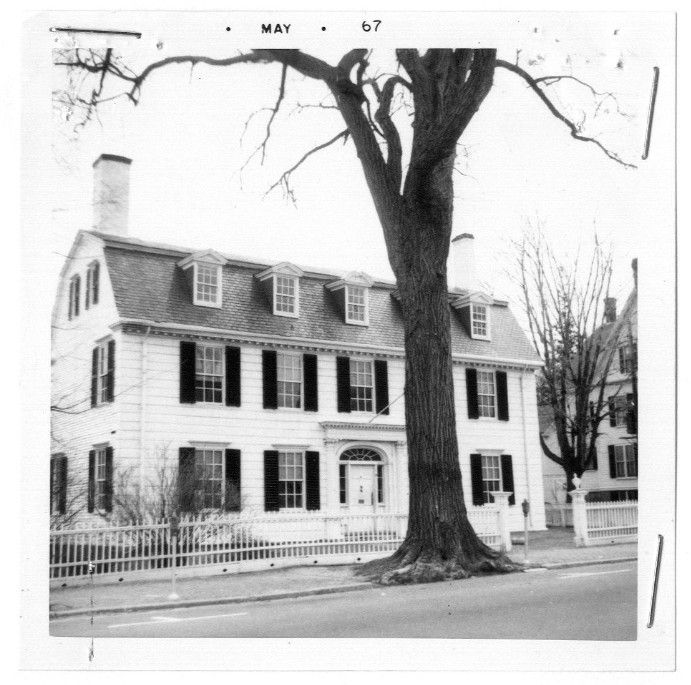
In 1897, the Dalton Club, which was a men’s social club, bought the house to use as a clubhouse. They still own it today and continue to use it as a clubhouse.
On March 29, 1978, the Dalton House was added to the National Register of Historic Places, and it was included in the Newburyport Historic District on August 2, 1984.
Sources:
Hale, Albert. Old Newburyport Houses. W.B. Clarke Co., 1912.
Northend, Mary H. “The Dalton House.” Historic Homes of New England, Little, Brown and Company, 1914, pp. 189-203.
“Historic Building Detail: NWB.366 Dalton, Michael House.” MACRIS, mhc-macris.net/details?mhcid=NWB.366
“New Club House Coming.” Newburyport Daily News, 5 Jan. 1897, p. 4.
“Dalton House Ready.” Newburyport Daily News, 15 Sept. 1897, p. 1.
“Many Congratulations. Dalton Club Members Happy in Their New Quarters.” Newburyport Daily News, 17 Sept. 1897, p. 3.
“The Dalton Club.” Newburyport Daily News, 18 Sept. 1897, p. 2.
“Dalton Club Receives.” Newburyport Daily News, 1 Dec. 1897, p. 1.