
Davis, Massachusetts, is an abandoned mining village that was once the site of the Davis Pyrite Mine in the town of Rowe, Massachusetts.
The Davis Pyrite Mine was once the largest pyrite mine in the state. Pyrite was a mineral that could be processed into sulfur, which was used to make sulfuric acid.
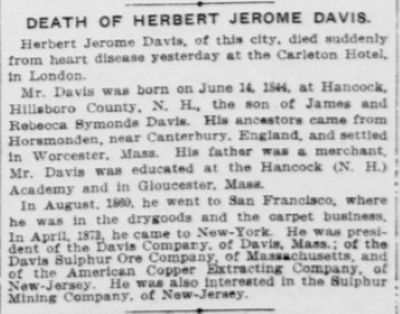
Established in 1882, the Davis Mine was owned by New York City entrepreneur Herbert Jerome Davis.
After an iron pyrite outcrop was discovered in Rowe by geology students from Amherst College, Davis viewed the samples discovered by the students and visited the town, where he managed to convince some of the local farmers to help him search the soil for a pyrite vein for $5 a day.
According to an article in the Boston Post in 1905, Davis literally stumbled upon the location of his future mine:
“As Mr. Davis used to say, he was lucky enough to fall into a fortune. This is said to have been true in a literal sense for, in his search for the ore slightly more than 23 years ago, when he had about given up the hope of finding it, he caught his foot on a trailing vine and rolled down into the little ravine filled with a tangle of brush and briars, and came directly on the outcropping ledge of ore.” (“Fortune from a Massachusetts Mine,” 1905)
Davis then secured a loan from some friends and purchased the local C.C. Brown farm, where the ledge was found, and officially launched the Davis Sulfur Ore Company. He later bought some of the neighboring properties for $100 an acre, for a grand total of $750 for the entire site.
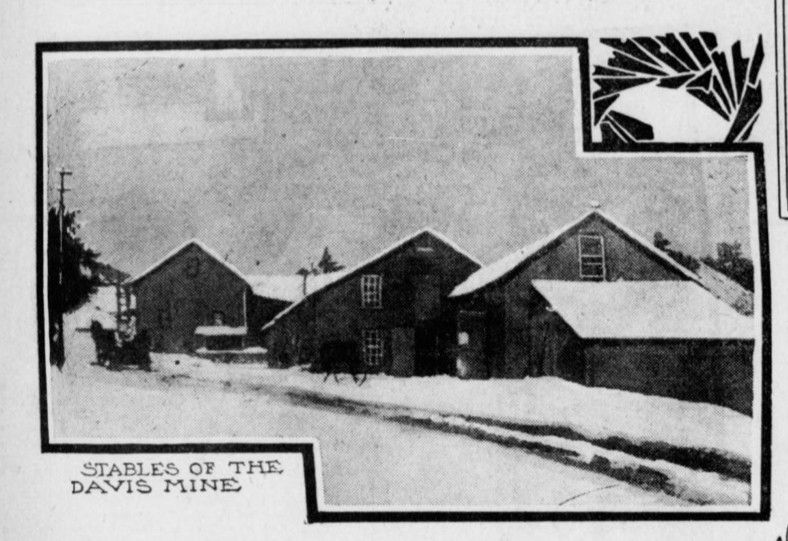
In January of 1883, the mine began production and was producing 20 tons of ore a day. A mining camp was established at the site, and by 1890, 10 buildings had been constructed around the mine for ore processing, boilers, machinery, blacksmithing, and housing for workers.
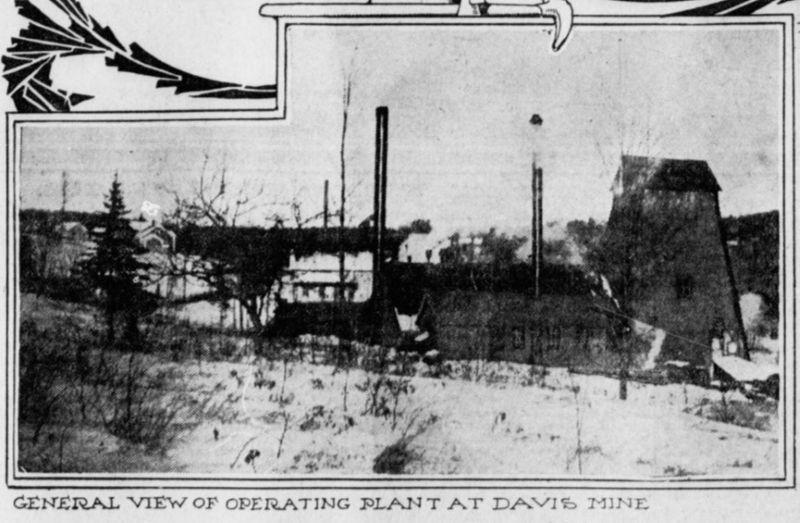
A tramway for hauling away mining waste, a U.S. Post Office, a company store, and the Davis Mining School were also constructed in the 1890s.
The mining production also drew tourists to the area. By the early 1890s, an observation tower was constructed to give these tourists a better view of the working mine.
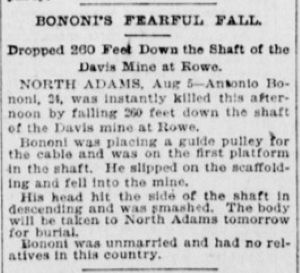
As with many mines, accidents sometimes occurred. In 1897, a 24-year-old miner, Antoni Bononi, was killed when he slipped and fell down a 260-foot-deep shaft, hitting his head on the side of the shaft in the fall.
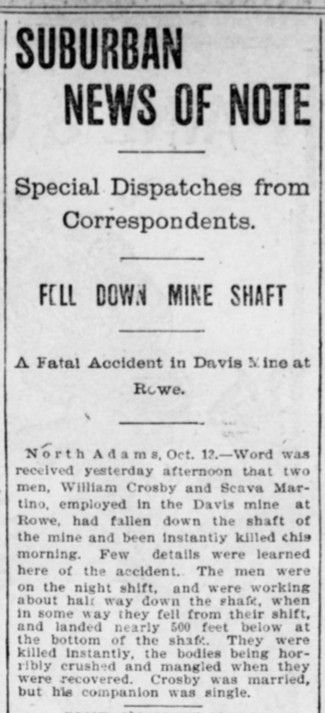
In 1900, two more miners, William Crosby and Scava Martino, were killed when they fell nearly 500 feet down the mine shaft. The men were working the night shift and were about halfway down the 1,000-foot-deep mine shaft when they both fell. They were both killed instantly, and their bodies were reportedly crushed and mangled when recovered (“Fell Down Mine Shaft,” 1900).
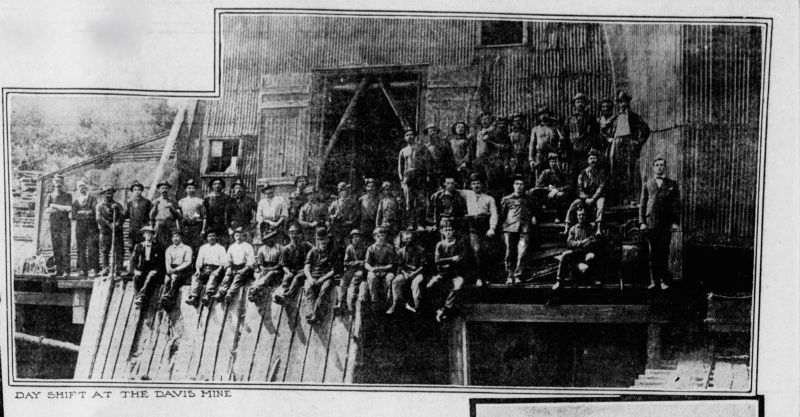
By the early 1900s, the Davis Mine was producing 50,000 tons of ore each year and had around 150 employees working on site.
On January 28, 1905, Davis died unexpectedly of heart failure in the Carleton Hotel in London, and the mine became run-down over the next few years due to weak leadership and poor maintenance. Timber supports were neglected, which led to cave-ins.
In July of 1905, selectmen in nearby Charlemont passed new regulations banning vehicles carrying more than five tons. The new regulations were due to complaints from the townspeople that the heavy loads of ore being transported from the mine to the B & M railway station in Charlemont were weakening bridges and roads and endangering drivers on the road.
After a series of small cave-ins occurred throughout the mine, a major cave-in occurred in July of 1909, which shut down most of the mining operations.
In 1911, near-surface mining operations ceased. It was not profitable enough to keep the mine going after, so it closed in 1912. The Davis Sulfur Ore Company eventually sold the property to John Davenport.
The Davis Mining School was eventually shut down 12 years later in 1924. The school was abandoned and was still standing in the 1970s but was badly deteriorated.
The mine is now located in a deeply wooded area on private property on Davis Mine Road. All that remains are four capped mine shafts, some sulfur ore, several foundations of old buildings, and some old machinery.
Sources:
McCarthy, Helen. The Story of the Davis Mine, Rowe, Massachusetts. Rowe Historical Society, 1967.
McCarthy Earls, Eamon. Industrial History of Rowe, Massachusetts.
“Bononi’s Fearful Fall.” The Boston Globe, 6 Aug. 1897, p. 3.
“Fell Down Mine Shaft.” The Springfield Daily Union, 13 Oct. 1900, p. 3.
“Death of Herbert Jerome Davis.” New-York Tribune, 29 Jan. 1905, p. 3.
“Fortune from a Massachusetts Mine.” The Boston Post, 12 Mar. 1905, p. 36.
“Lighter Loads Ordered.” The Boston Globe, 9 Jul. 1905, p. 10.
“Buried Treasures of Charlemont.” The Boston Herald, 13 Jan. 1907, p. 40.