
The Boston Massacre Marker is a memorial to the victims of the Boston Massacre, which took place on March 5, 1770, in front of the old State House during the American Revolution. The marker is made up of 13 rings of cobblestones and a center stone marked with a star.
This marker was originally placed on the corner of State and Exchange Street in 1887, by the Bostonian Society, to mark the exact spot where one of the victims of the Boston Massacre, Crispus Attucks, fell dead after being shot by British soldiers.
Yet, according to an article in the Boston Post in 1937, a marker was first placed on the site of the massacre in 1805 by the Boston Antiquarian Society. Whether that original marker still existed when the current one was placed in 1887 is unclear.
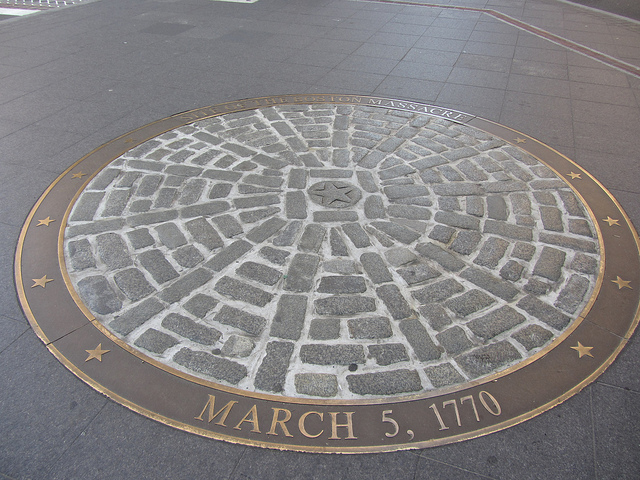
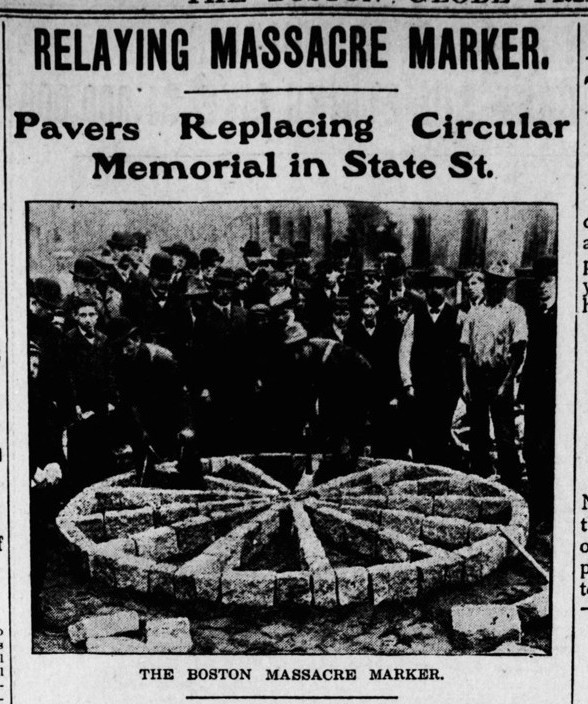
In 1903, the city government temporarily removed the 1887 marker to allow construction of the Boston subway underneath and then moved it and redesigned it at a nearby site where another victim, James Caldwell, had died.
In 1924, the marker was temporarily removed again when State Street was resurfaced and it was redesigned again.
In August of 1937, the marker was temporarily removed again during reconstruction of State Street and placed back in the original wagon wheel design from 1805. The design featured white porcelain cement made from a special grain of sea sand from Newport, R.I.
A news report in the Boston Globe at the time stated that a box was located under the marker, which had been placed there by the Boston Antiquarian Society. The box reportedly contained newspapers and souvenirs from whenever it was buried, but it was not removed or opened during the renovations to the site.
During the 1960s, the city underwent an urban renewal that led to the relocation of many streets, during which the marker was moved to a traffic island in front of the Old State House.
In 2011, the marker was removed again in order to upgrade the State Street subway station underneath and was placed at its current location at the intersection of Congress, Devonshire, and State Streets, which is on the sidewalk in front of the Old State House.
The sidewalk there was also expanded to make room for the memorial, and the stones were placed inside a bronze ring to make it more noticeable.
Sources:
The Bostonian Society. Proceedings of the Bostonian Society at the Annual Meeting, January 10, 1882. Old State House Order of Directors, 1883.
“The Boston Massacre. A Tablet Placed Where the First Blood of the Revolution was Shed.” The Boston Globe, 6 Nov. 1886, p. 6.
“Relaying Massacre Marker.” The Boston Globe, 9 Oct. 1903, p.7
“To Restore Old Wagon Wheel Design of 1805.” The Boston Post, 17 Aug. 1937, p. 9.
“Boston Massacre Marker Replaced Today.” The Boston Globe, 17 Aug. 1937, p. 15.
“White Cement Used in Redesigned Marker at Boston Massacre Site.” The Boston Globe, 17 Aug. 1937, p. 4.
“Move Marker of Boston Massacre.” The Boston Globe, 16 Aug. 1937, p. 2.
“Mayor Mansfield Replaces White Marker at Boston Massacre Site.” The Boston Globe, 18 Aug. 1937, p. 28.
“The Boston Massacre.” Freedom Trail Foundation, thefreedomtrail.org/freedom-trail/boston-massacre.shtml
“What was the Boston Massacre?” Boston Massacre Historical Society, bostonmassacre.net