
Dana, Massachusetts, was a town in the Swift River Valley that was lost when the town was submerged due to the Quabbin Reservoir project.
Dana was originally settled in 1763 as part of the towns of Hardwick and Petersham. It then became its own town and was officially incorporated on February 18, 1801.
The town was named after the Massachusetts statesman Judge Francis Dana. On March 17, 1801, Dana held its first town meeting.
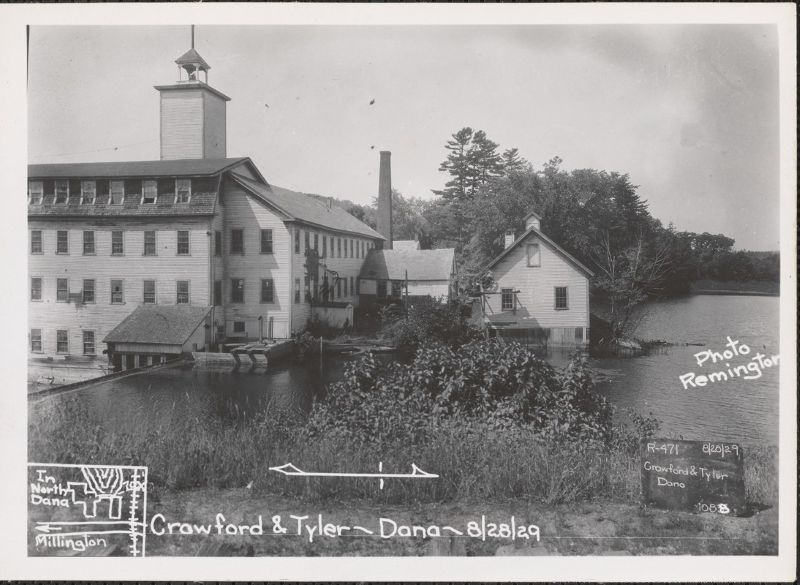
In 1810, the population of Dana was 625, and a sawmill was erected in North Dana in 1812.
In 1820, the population of Dana was 664, and the Dana post office opened in 1823.
In 1830, the population of Dana was 623. In 1835, the Flagg Tavern (later called the Eagle Hotel) was constructed in Dana.
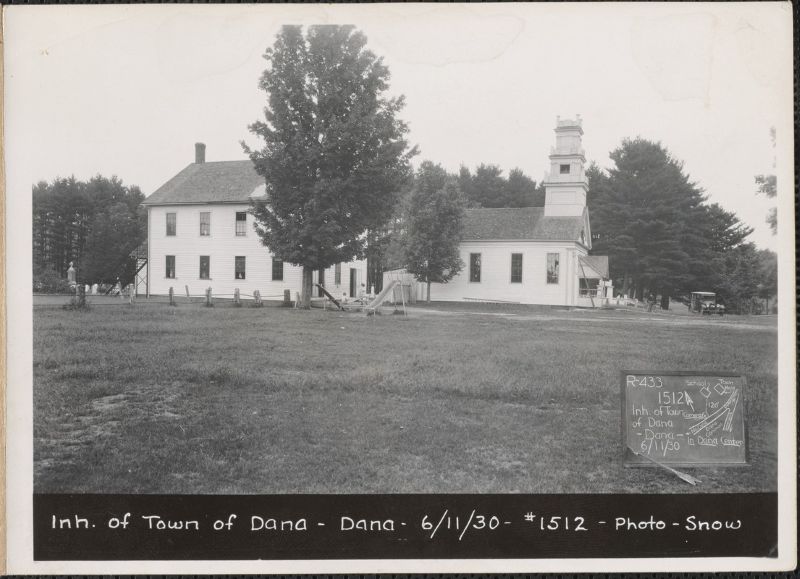
Between 1840 and 1850, most of Dana’s oldest buildings were constructed around Dana Common.
In 1840, the population of Dana was 691. In 1842, Dana added parts of Hartwick and Petersham to its town boundaries.
In 1850, the population of Dana was 842, and it was 824 in 1855.
In 1860, the population of Dana was 876, but it had dropped to 789 by 1865.
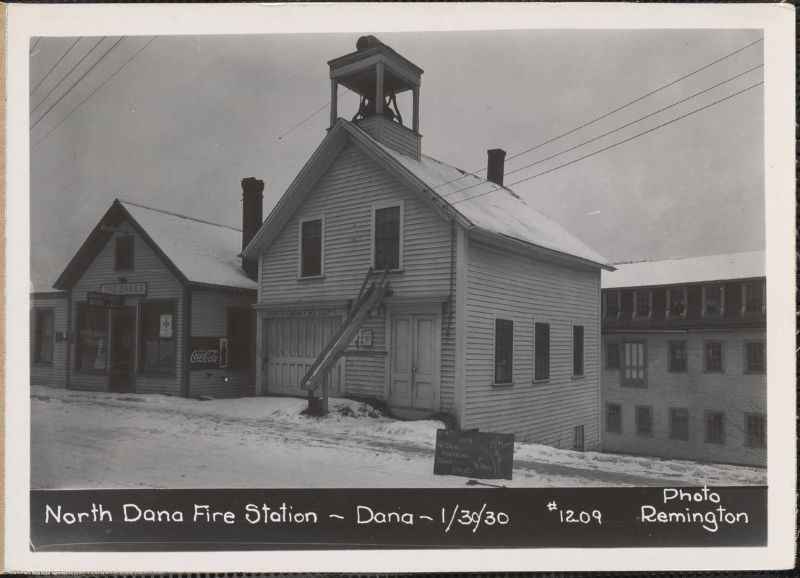
In 1870, the population of Dana was 758. In 1875, the population of Dana was 760, and a railroad was constructed in North Dana.
In 1880, the population of Dana was 736. In 1885, the population of Dana was 695, and the Mount L Hotel was built in North Dana.
In 1890, the population of Dana was 700. A school was built next to the town hall, and the Dana Public Library opened in December of 1892. In 1895, the population of Dana had increased slightly to 717.
In 1900, the population of Dana was 790.
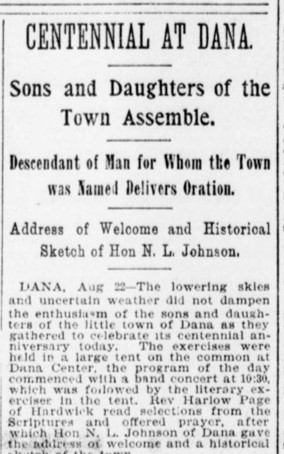
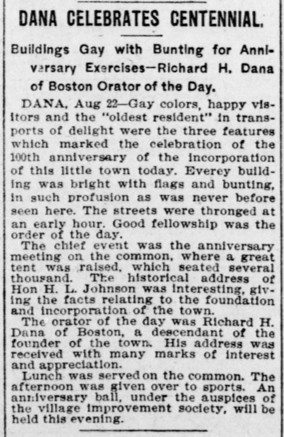
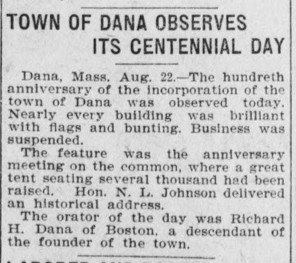
On August 21, 1901, Dana celebrated its centennial. Buildings were decorated with flags and bunting, and businesses closed for the day to celebrate. Several thousand people gathered on Dana Common to hear speeches by the Honorable N.L. Johnson and Richard H. Dana, a descendant of Judge Francis Dana. Lunch was later served on the common, and a basketball game between the Dana and Hardwick teams took place. An anniversary ball was held that evening (“Dana Celebrates Centennial,” 1901).
In 1910, the population of Dana was 736, but it had decreased to 599 by 1920.
In 1925, the population of Dana had grown slightly to 657.
On July 5, 1926, the town held a celebration for its 125th anniversary. Since plans for the Quabbin Reservoir were already in the works, the event was considered more of a memorial for the doomed town than a celebration, according to the book Quabbin: The Lost Valley:
“The forthcoming finale of Dana pervaded the speeches as well as the anniversary ode, but every effort was made by the grownups to put on a brave front to provide at least the youngsters with pleasure and a good time” (Howe 395).
The event was held on Dana Common and drew a crowd of 1,500 people, most of them former residents. A parade was held in the morning, and a band concert took place in the afternoon.
In 1930, the Metropolitan District Water Supply Commission purchased 40,000 acres of land for the Quabbin Reservoir project. A majority of residents in the center of Dana voluntarily gave up their land. The population of Dana at the time was 595.
By 1934, the Metropolitan District Water Supply Commission had purchased 60,000 acres of land in the Swift River Valley for the Quabbin Reservoir project.
In 1935, the population of Dana had dropped to 387.
In 1938, all the remaining land for the Quabbin Reservoir project was seized by eminent domain. All residents of North Dana, Enfield, and Greenwich were ordered to vacate their homes by April 1 so that the flooding of the Swift River Valley could begin when the Winsor Dam was finished (“Must Vacate by April 1,” 1938).
Families with school children were allowed to stay until June, and a few families were granted extensions for a variety of reasons.
In March of 1938, Dana held its last town meeting.
On April 28, 1938, Dana was disincorporated. The school closed in June after a final graduation ceremony.
On August 14, 1939, the Quabbin Reservoir began to fill. Since Dana sits at a higher elevation than the other towns flooded in the Quabbin Reservoir project, much of Dana has remained unsubmerged.
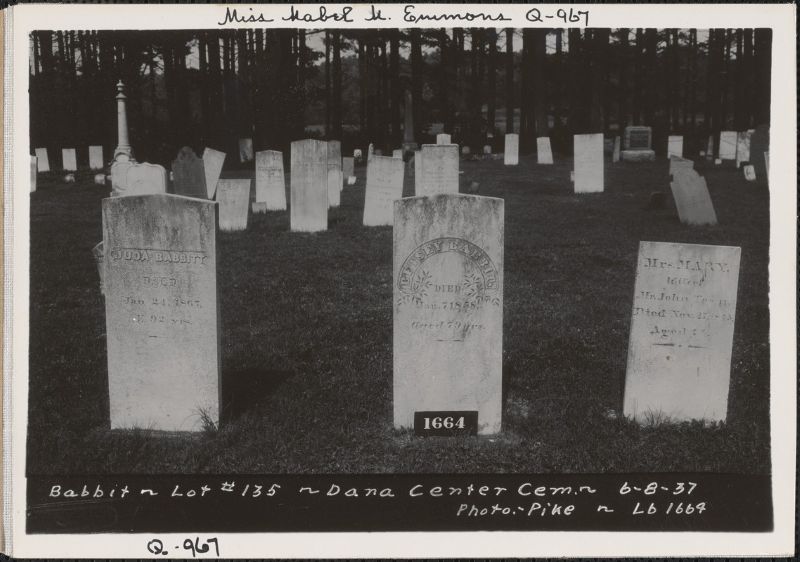
All that remains in the town are old foundations from the town’s schoolhouse, town hall, hotel, and homes; an empty field where the town cemetery once was; and the old town common.
Governor Michael Dukakis declared 1988 as the official Year of Remembrance for the 50th anniversary of the disincorporation of Dana and the other Swift River Valley towns, and a celebration was held at the University of Massachusetts in Amherst.
In 1996, a memorial stone marker was erected on Dana Common that reads: “SITE OF DANA COMMON 1801-1938 To all those who sacrificed their homes and way of life (Erected by Dana Reunion, 1996).”
On March 4, 2013, Dana Common and a 68-acre area of land in the center of Dana were added to the National Register of Historic Places as the Dana Common Historic and Archaeological District.
Although the old road to Dana is closed to vehicles, pedestrians can still hike into the town on Old Dana Road and visit it. Dana Common is located 1.7 miles from Gate 40, off Route 32A in Petersham.
Sources:
Howe, Donald W. Quabbin: The Lost Valley. The Davis Press, Inc., 1951.
Vital Records of Dana, Massachusetts, to the Year 1850. Burr Printing Company, 1925.
Quabbin Facts and Figures. Friends of Quabbin, Inc., 1991.
“Dana Common.” National Park Service, nps.gov/places/dana-common.htm
“Dana Celebrates Centennial.” The Boston Globe, 22 Aug. 1901, p. 7.
“Town of Dana Observes its Centennial Day.” The Worcester Spy, 23 Aug. 1901, p. 1.
“Centennial at Dana.” The Boston Globe, 23 Aug. 1901, p. 7.
“Must Vacate by April 1.” Clinton Daily Item, 14 Jan. 1938, p. 2.
Barnes, George. “’Lost’ Quabbin town up for historic status.” Telegram & Gazette, 24 Dec. 2012, telegram.com/story/news/state/2012/12/24/lost-quabbin-town-up/49195882007/
“Exploring the Road to Dana Common.” DCR, 12 Sept. 2025, storymaps.arcgis.com/stories/60857ad50e454635b19d02f62da37bac
“Dana (Mass.) Collection.” University of Massachusetts Amherst, findingaids.library.umass.edu/ead/mums012