
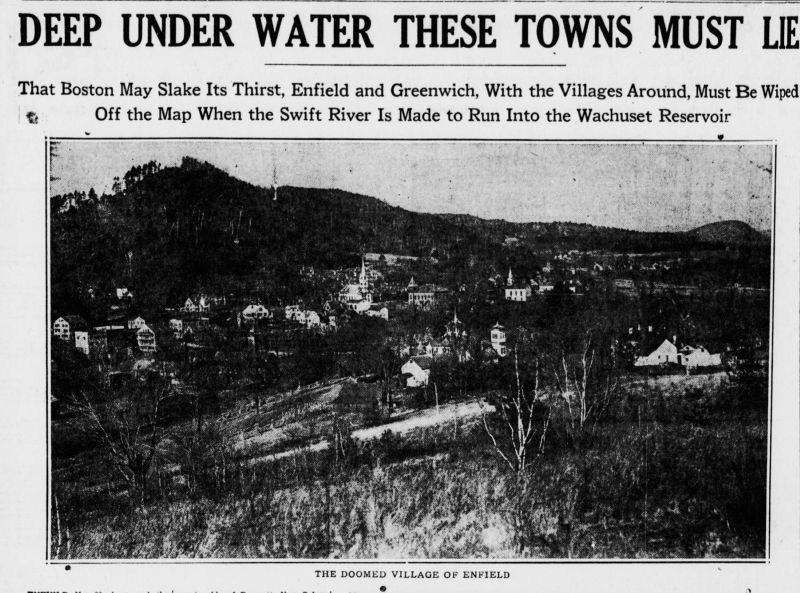
Enfield, Massachusetts, was a town in the Swift River Valley that was lost when the town was submerged due to the Quabbin Reservoir project.
Enfield was settled by Robert Fields, whom it is named after, in June 1787. It was fully incorporated as its own town on February 15, 1816.
On March 3, 1816, Enfield held its first town meeting during which the town budget of $1,667 was approved. By 1830, Enfield’s population had reached 1,056.
By 1850, the population of Enfield was 1,100, making it one of the largest of the Quabbin towns. It was primarily a farming community but also had a number of textile mills and factories.
In 1884, Enfield’s brick town hall was built at a cost of $12,000. By 1900, Enfield’s population was 1,036.
In 1916, Enfield celebrated its centennial. The celebration kicked off with a special church service, followed by street parades, historical pageants, band concerts, fireworks displays, and outdoor sports and festivities.
In 1920, Enfield’s population had decreased to 790.
In 1930, the Metropolitan District Water Supply Commission purchased 40,000 acres of land in the Swift River Valley for the Quabbin Reservoir project. At the time, Enfield’s population was 497.
By 1934, the Metropolitan Water Supply Commission had purchased 60,000 acres of land in the Swift River Valley for the reservoir project. By 1935, Enfield’s population had shrunk to 495.
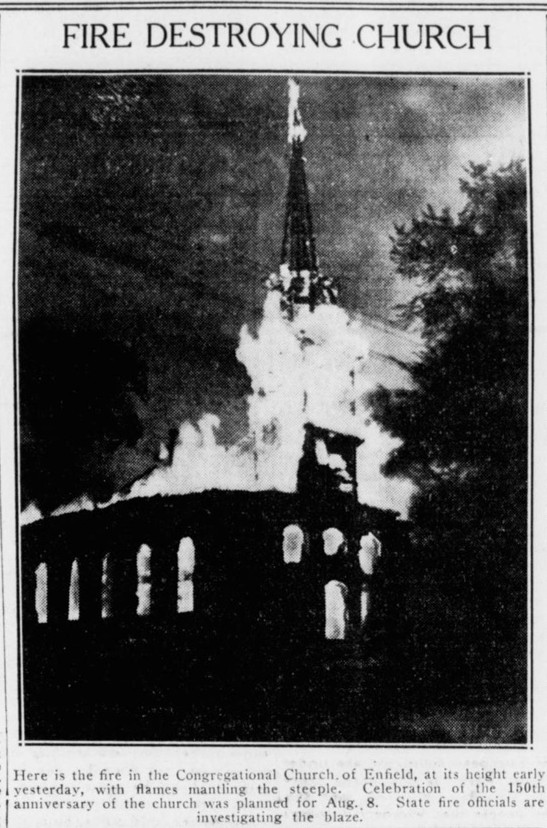
On August 2, 1936, the Enfield Congregational Church and a nearby house were destroyed by arsonists on the day of the church’s 150th anniversary (“Firebug Destroys Church in Enfield,” 1936).
In 1938, the remaining land in the Swift River Valley was seized by eminent domain. All residents of North Dana, Enfield, and Greenwich were ordered to vacate their homes by April 1 so that the flooding of the Swift River Valley could begin in September when the Winsor Dam was projected to be finished (“Must Vacate by April 1,” 1938).
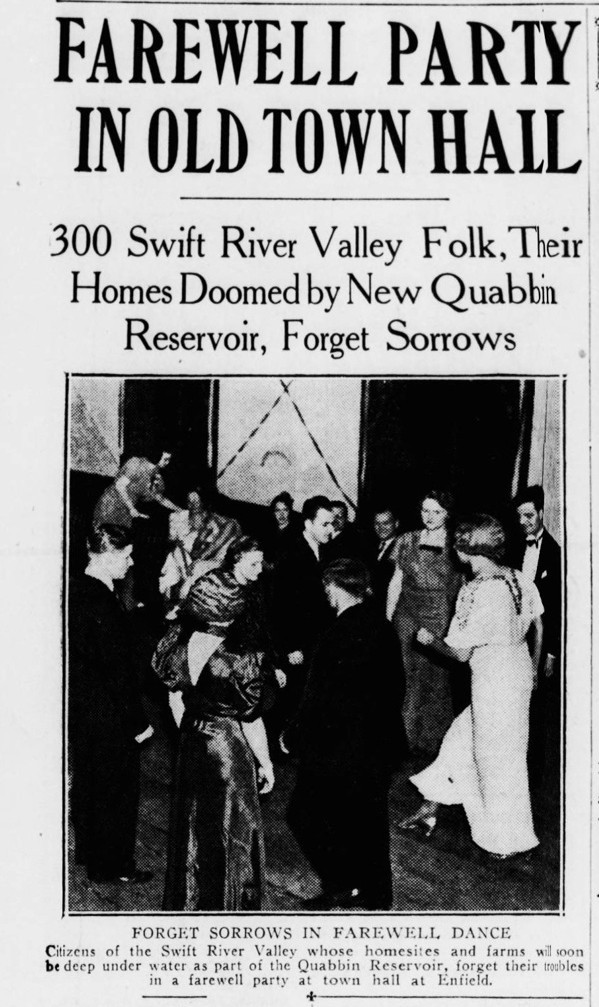
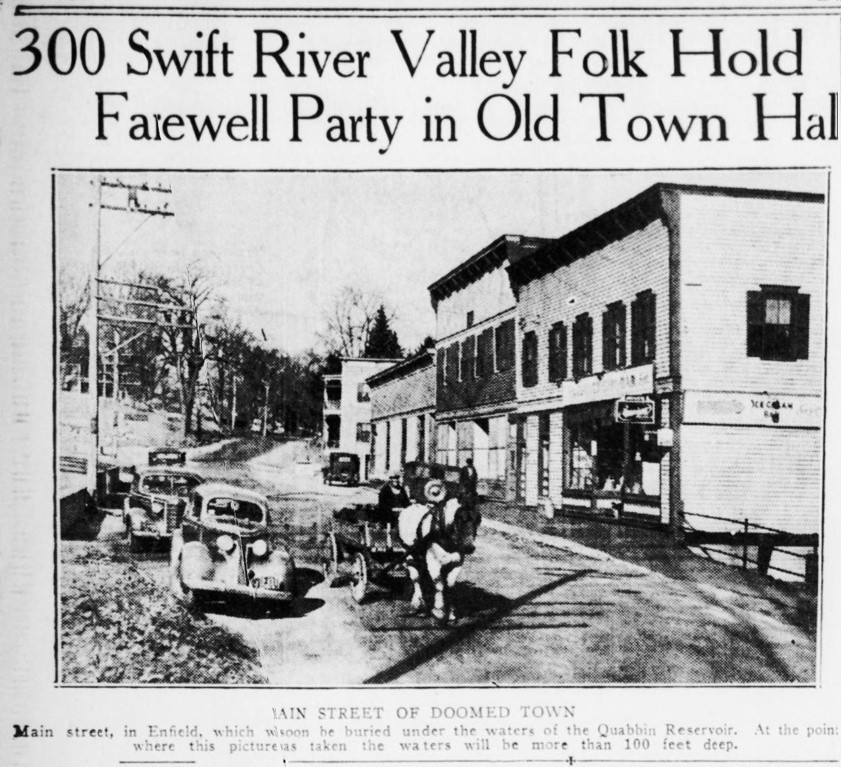
In March of 1938, officials held a farewell party at Enfield’s Town Hall for the residents being displaced by the reservoir project. Around 300 people attended the party where they danced and gathered together one last time before leaving their homes and towns forever, according to a news report in the Fall River Herald News:
“There were a few tears in the eyes of some of the elder townspeople, most of whom have lived here all their lives. Across the street from Town Hall is the cemetery. Most of the graves have been dug up and transferred. Bones of Revolutionary War heroes were disturbed to make way for modern progress. Still standing, but waiting inevitable fate, are the headstones of some 40 to 50 Civil War heroes, around a G.A.R. Monument” (“Town is Abandoned at Dance,” 1938).
One Enfield resident, Albert House, told the Boston Post how difficult it was for residents to say goodbye to their town, according to a news report in the Boston Post:
“It isn’t so hard for the young ones. But for us old fellows it isn’t so good. The State has been fair enough about it in a way. But a farm and a home is more than money to us. Money can’t replace them. Yes, sir, some of us are going to miss this little town and miss it a lot” (“Farewell Party in Old Town Hall,” 1938).
On April 1, workers began stripping Enfield, tearing down buildings and leveling trees.
On April 28, 1938, Enfield was disincorporated due to the Quabbin Reservoir project, and on August 14, 1939, the reservoir began to fill.
The areas of Enfield that remained above water were annexed to Belchertown, New Salem, Pelham, and Ware.
In April of 1988, a dance was held at the University of Massachusetts in Amherst to celebrate the 50th anniversary of the farewell party held at Enfield’s town hall in 1938.
More than 100 former residents and 300 descendants of the Swift River Valley towns, Dana, Enfield, Prescott, and Greenwich, that were lost to the reservoir project attended the dance.
Two attendees, Lucille Webster Thresher and her husband Harrison, were the last couple married in Enfield, and they had also attended the farewell party in 1938, which Lucille remembered well:
“My mother was crying. The older people were heartbroken…There was such a crowd at the town hall that night we young people couldn’t get in…We climbed the fire escape and looked in the windows.” (“Anniversary Recalls Death of Four Towns,” 1938).
When the clock struck midnight at the anniversary dance, a bell that once hung in the Dana Town Hall rang out.
The High Sheriff of Hampshire County, Robert Garvey, then led the attendees in singing “Auld Lang Syne” just as the original attendees had done back in 1938.
“Our home was in the center of town. It now lies under the deepest part of the reservoir,” said former resident Joy Dickinson Bock. (“Anniversary Recalls Death of Four Towns,” 1938).
Sources:
“Enfield (Mass.) Collection.” University of Massachusetts Amherst, findingaids.library.umass.edu/ead/mums010
“Old Massachusetts Homestead.” The Republican, 5 Dec. 1905, p. 6.
“Centennial of Massachusetts Town.” Jacksonville Daily Journal, 2 Jul. 1916, p. 11.
“Deep Under Water These Towns Must Lie.” The Boston Globe, 21 Nov. 1926, p. 87.
“Enfield and Prescott Ready for Their Last Presidential Election.” The Boston Globe, 2 Nov. 1936, p. 19.
“Church to Observe 150th Anniversary.” The Boston Herald, 1 Aug. 1936, p. 14.
“Firebug Destroys Church in Enfield.” The Boston Herald, 2 Aug. 1936, p. 16.
“Fire Destroying Church.” The Boston Post, 2 Aug. 1936, p. 7.
“Must Vacate by April 1.” Clinton Daily Item, 14 Jan. 1938, p. 2.
“Town is Abandoned at Dance; Site Will Become Reservoir.” Fall River Herald News, 26 Mar. 1938, p. 5.
“Town of Enfield Disappears – Quabbin Reservoir Brings New Beauty to Map of Massachusetts.” The Boston Transcript, 6 Apr. 1938, p. 4.
Carberg, Warren. “Farewell Party in Old Town Hall.” The Boston Post, 26 Mar. 1938, p. 1.
“Anniversary Recalls Death of Four Towns.” The Lewiston Journal, 28 Apr. 1988, p. 5.