
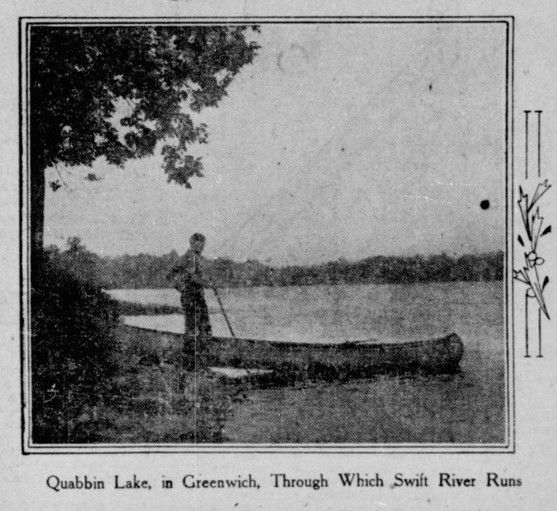
Greenwich, Massachusetts, was a town in the Swift River Valley that was lost when the town was submerged due to the Quabbin Reservoir project.
On January 14, 1746, the General Court granted the land for the town, about 1,200 acres, to descendants of the veterans of King Philip’s War and was originally named Quabbin.
These first settlers were James Patterson, Robert Fenton, Edward Miller, James Wheeler, John Patterson, Andrew Turner, Thomas Powers, Arthur Cary, Robert Evans, Robert Carlisle, a man named Thorp, and another man named Holden (Howe 1951).
Greenwich was comprised of three small communities: Greenwich Plains, Greenwich Village, and South Parish. The town was primarily a farming community but also had a number of textile mills and factories in Greenwich Village.
In 1744, the first church in the Swift River Valley was established in Greenwich, and, in 1745, a saw and grist mill were constructed in the town.
On April 20, 1754, the town was officially incorporated as Greenwich, being named for a Scottish duke, Duke of Greenwich, by the large number of settlers of Scotch descent. The first town meeting was held at the meetinghouse on August 15, 1754.
In 1810, the Greenwich post office opened. Then, on May 28, 1824, the Greenwich Village post office opened.
By 1830, the population of Greenwich was 813.
In 1865, James E. Cooley deeded part of the Azriah Cooley farm to the town to establish Cooley’s Home for the Poor.
By 1880, the population of Greenwich was at its height at 1,400. Only 20 years later, in 1900, the population had dropped significantly to 491.
On August 2, 1904, Greenwich celebrated the 150th anniversary of its incorporation. Every building in the town was decorated, including churches and private houses. A large tent was erected on the common where speeches were held. A parade was held with military veterans, town officials, and women’s organizations, and a band concert took place later in the day.
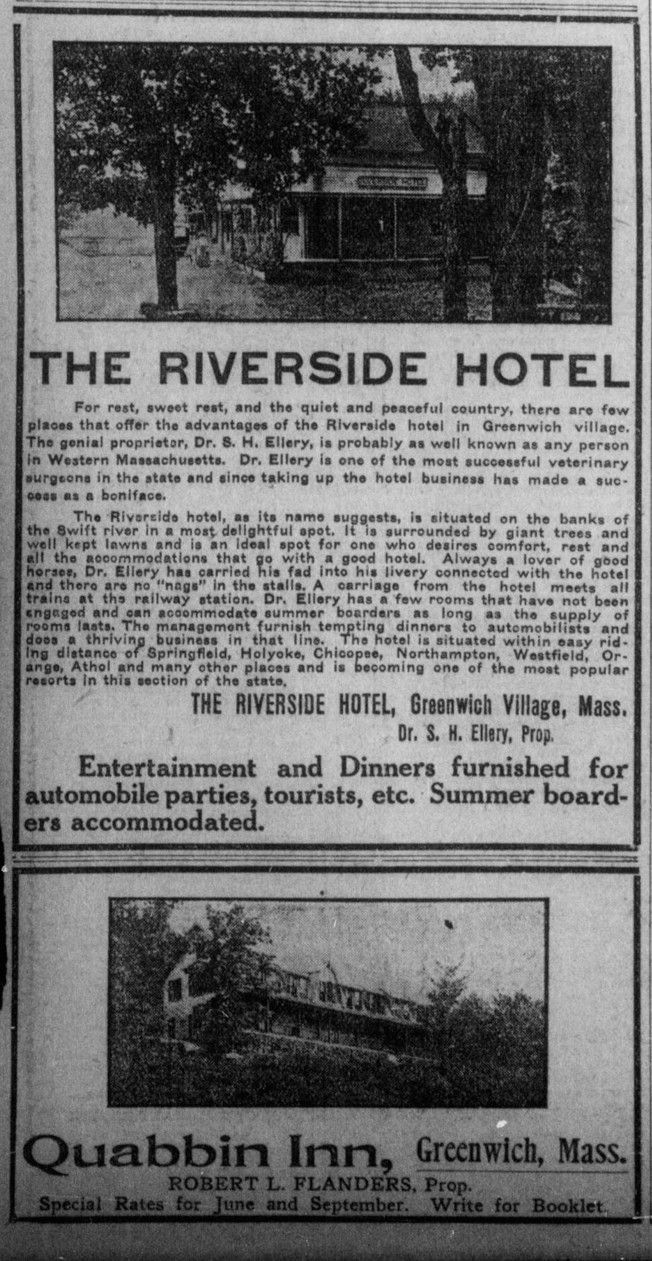
By 1910, the population of Greenwich was 452. The following year, in 1911, a fire destroyed the Riverside Hotel.
By 1920, the population of Greenwich had decreased again to 399. Yet, five years later, in 1925, the population had actually risen slightly to 452.
In 1930, the Metropolitan District Water Supply Commission purchased 40,000 acres of land in the Swift River Valley for the Quabbin Reservoir project.
By this time, the population of Greenwich had dropped to 238. On April 10, 1930, the Greenwich post office was discontinued, and mail was processed at the Greenwich Village post office instead.
By 1934, the Metropolitan District Water Supply Commission purchased 60,000 acres of land for the Quabbin Reservoir project. By the following year, in 1935, the population of Greenwich was down to 219.
In 1936, an engineer living in Greenwich while working on the Quabbin Reservoir project found a large number of Native American stone relics in Greenwich and other areas in the valley. The relics include hundreds of arrowheads, some fire-making stones, corn grinders, hoes, war clubs, tomahawks, and other tools.
In 1938, all remaining land in the Swift River Valley was seized by eminent domain. All residents of North Dana, Enfield, and Greenwich were ordered to vacate their homes by April 1 so that the flooding of the Swift River Valley could begin when the Winsor Dam was finished (“Must Vacate by April 1,” 1938).
Families with school children were allowed to stay until June, and a few families were granted extensions for a variety of reasons.
In March of 1938, a farewell party was held for the residents of the Swift River Valley towns at Enfield’s Town Hall, and over 300 people attended.
On April 21, 1938, Greenwich held its last town meeting, which was a special gathering to mark the end of the town’s existence. Around 65 people attended the meeting, including newspaper reporters, photographers, townspeople, and numerous visitors from out of town.
On April 28, 1938, Greenwich was disincorporated as part of the Quabbin Reservoir project. The Greenwich Village post office was discontinued a few months later on August 31, 1938.
In late August of 1938, the Greenwich Public Library’s collection of 4,000 books was given to New Salem, Massachusetts.
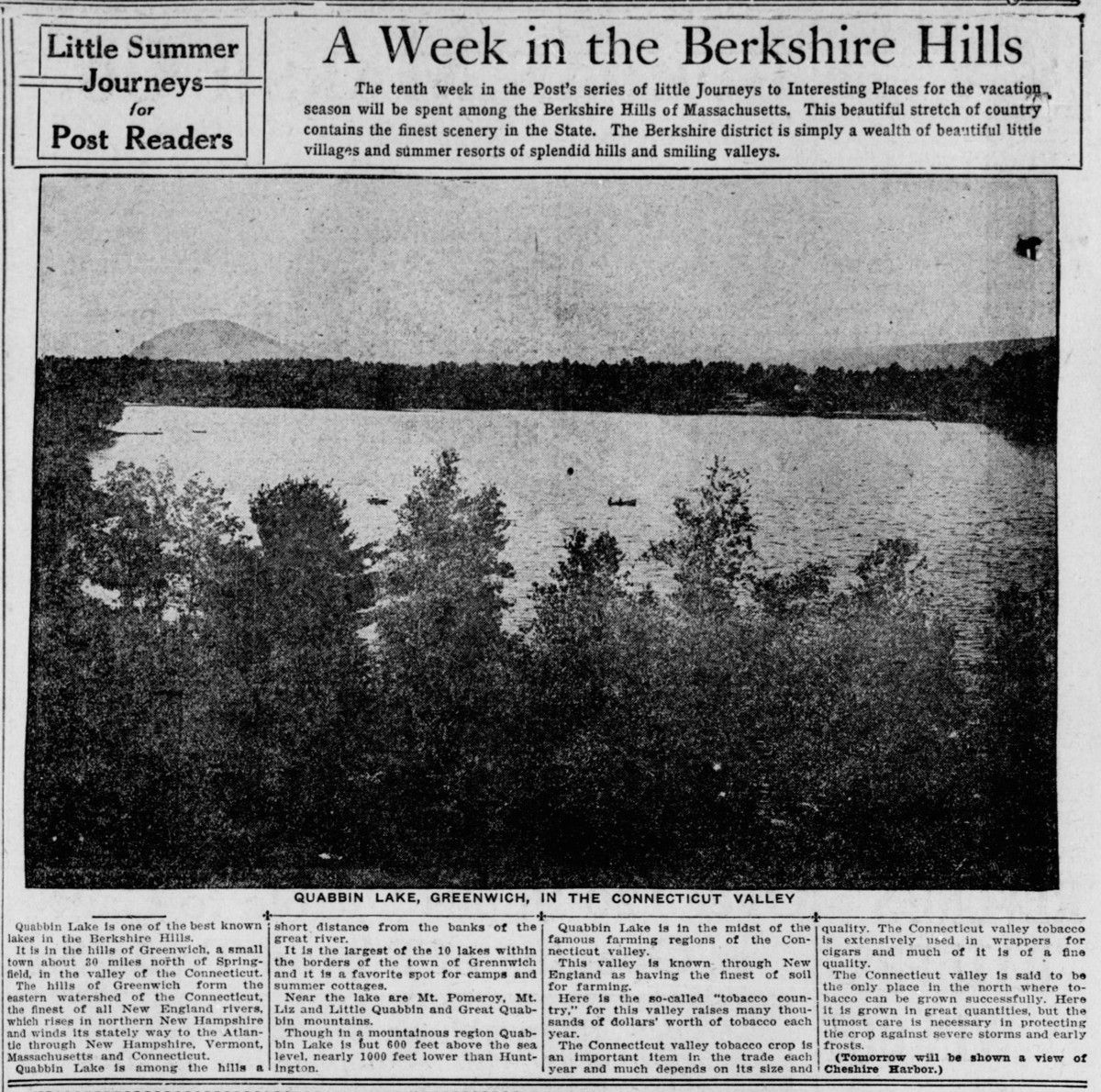
On August 14, 1939, the Quabbin Reservoir began to fill. Since the town was at a lower elevation than the surrounding towns, it is largely submerged except for the hilltops of Curtis Hill, Mount Lizzie, and Mount Pomeroy, which are now islands within the reservoir.
Governor Michael Dukakis declared 1988 as the official Year of Remembrance for the 50th anniversary of the disincorporation of Greenwich and the other Swift River Valley towns, and a celebration was held at the University of Massachusetts in Amherst.
Sources:
Howe, Donald W. Quabbin: The Lost Valley. The Davis Press, Inc., 1951.
Quabbin Facts and Figures. Friends of Quabbin, Inc., 1991.
“Greenwich.” Friends of Quabbin, friendsofquabbin.org/the-valley/greenwich/
“Greenwich (Mass.) Collection.” University of Massachusetts Amherst, scua.library.umass.edu/greenwich-mass-3/
“Old Feuds Buried.” The Boston Globe, 17 Nov. 1894, p. 4.
“Engineer Finds Relics of Indians.” The Boston Globe, 27 Dec. 1936, p. 9.
“Must Vacate by April 1.” Clinton Daily Item, 14 Jan. 1938, p. 2.
Carberg, Warren. “Farewell Party in Old Town Hall.” The Boston Post, 26 Mar. 1938, p. 1.
“New Salem Given Greenwich Library.” The Boston Globe, 24 Aug. 1938, p. 14.